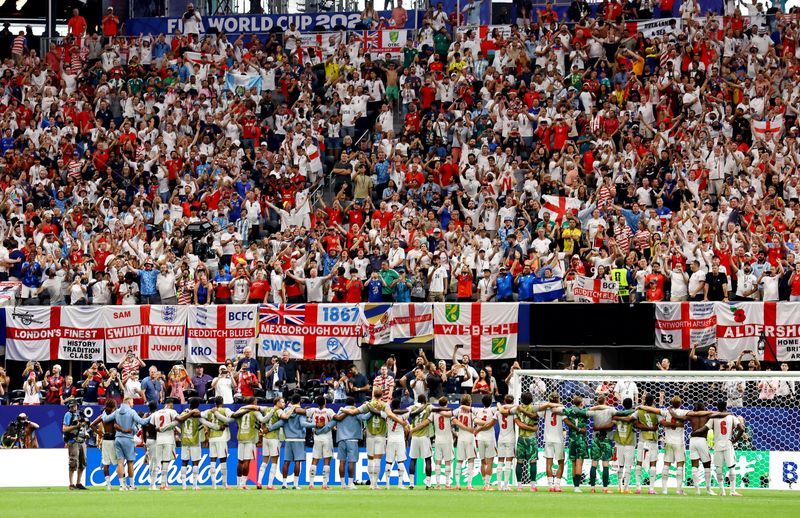
England's World Cup campaign has been a study in inconsistency, and their knockout-stage encounter with DR Congo on Wednesday in Atlanta only reinforced that narrative. After opening their tournament with an impressive 4-2 victory over Croatia, Thomas Tuchel's side had stuttered through the group phase, managing only a goalless draw with Ghana and a laboured 2-0 triumph against Panama. Questions about defensive solidity had been quietly building, but nothing prepared observers for the ordeal that awaited against the African underdogs.
The script took a shocking turn when Brian Cipenga's early strike, arriving just ten minutes into proceedings, handed DR Congo the lead. For the first time in the tournament, England found themselves chasing a deficit, a position they had never recovered from in a World Cup match. The psychological impact reverberated through the stadium—not just among the players, but visibly among the travelling English support. One television shot captured a supporter's face painted in red and white, his expression hardening as he gripped his drink with the kind of tension that comes from watching a World Cup dream unravel in real time.
DR Congo's gameplan was admirably straightforward: they would compress space, defend with intensity, and look to exploit England's known weaknesses at the back. Goalkeeper Lionel Mpasi became the orchestrator of resistance, making a succession of crucial interventions that kept his side's improbable dream alive. When Yoane Wissa struck the post in the latter stages of the first half, it seemed the script might truly flip entirely. England's Harry Kane's desperate penalty appeal, waved away by the referee moments later, underscored the mounting frustration. As the teams departed for halftime, the atmosphere inside Atlanta's stadium crackled with genuine uncertainty—a stark contrast to England's confident opening.
Tuchel visibly wrestled with his tactical approach during the interval, his frustration evident in his body language and occasionally sharp words to his players. The adjustments came incrementally: Declan Rice shifted to right back, fresh midfielder Eberechi Eze introduced to inject urgency into England's play. The second period gradually tilted England's way, though breakthrough opportunities continued to be squandered. Jude Bellingham drew heroic saves from Mpasi, while Marcus Rashford was denied by desperate last-ditch defending. The pattern suggested England would eventually prevail, yet the breakthrough remained maddeningly elusive.
When Kane's glancing header finally found the net in the 75th minute, brushing Mpasi's fingertips as it crossed the line, the release of tension was almost palpable. That goal represented Kane's 83rd international strike and, more significantly, it restored a measure of control to England's performance. Kane struck again eleven minutes later to seal a 2-1 victory that proved far more laborious than anyone had anticipated. The comeback itself carried historical weight—England's first World Cup recovery since defeating Cameroon in the quarter-finals in 1990, exactly 36 years to the day prior.
In the post-match analysis, Tuchel reflected on the character his side had demonstrated. "We kept believing," he stated, emphasising the importance of maintaining composure when circumstances grew difficult. The manager highlighted the team spirit and commitment as defining factors, while acknowledging that the victory, though deserved, had required far greater exertion than the scoreline suggested. His comments underscored a reality that would concern tactical observers: England's ability to manufacture victories without playing their best football would be tested more severely in the rounds ahead.
The next obstacle presents an entirely different challenge. Mexico arrives as opponents with a fundamentally different approach to DR Congo. Where the Africans sought to suffocate and contain, Mexico will test whether England can withstand sustained attacking pressure. Kane acknowledged this distinction, noting that knockout football operates under heightened stress and risk. "This and the next one are two difficult games for different reasons," he reflected, capturing the notion that progression through a World Cup tournament demands adaptability across multiple scenarios.
The venue compounds the difficulty significantly. Mexico City's Azteca Stadium, one of world football's most iconic arenas, sits at approximately 2,200 metres elevation. The atmospheric conditions—thinner air, reduced oxygen availability, and a ball that behaves unpredictably at altitude—present physiological challenges distinct from the Atlanta encounter. England's players, already drained from the emotional and physical intensity of the DR Congo match, must now prepare for an environment that will test not merely their tactical acumen but their basic physical conditioning.
For Malaysian and Southeast Asian observers, the England-Mexico contest represents more than a straightforward knockout match. The tournament's progression reflects broader patterns in contemporary international football: the unpredictability of knockout competition, the importance of squad depth and resilience, and the reality that even accomplished sides can struggle against determined opposition. England's near-exit against DR Congo serves as a reminder that World Cup advancement often depends less on aesthetic football than on mental fortitude and the capacity to recover from adversity. As England prepares for Mexico, the tests awaiting extend beyond the opposition's quality to encompass altitude, intensity, and the psychological toll of barely escaping elimination.

