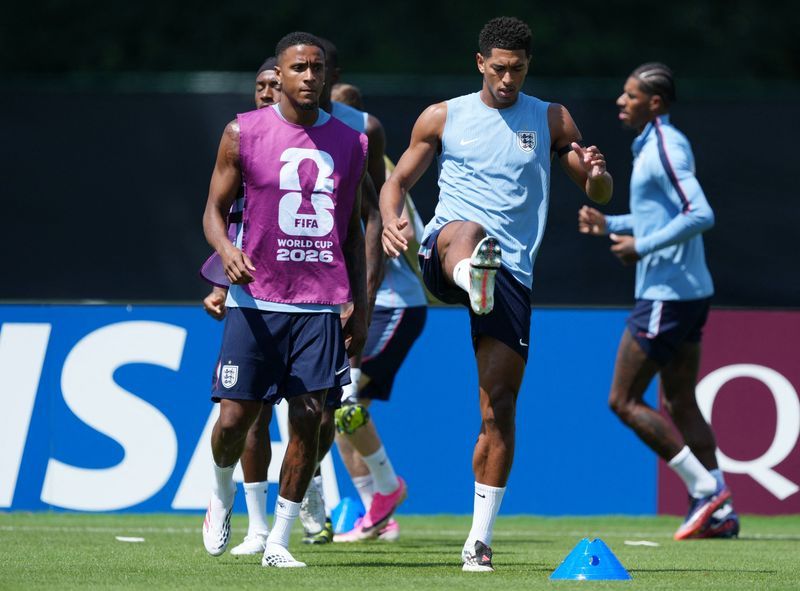
England's World Cup campaign enters a critical phase on Wednesday when the team faces Argentina in the semi-finals, with players and coaching staff alike projecting a message of cohesion and unwavering focus. The squad has deliberately insulated itself from external commentary and media narratives that have swirled around the team in recent days, choosing instead to concentrate on the task ahead in Atlanta. This deliberate filtering of outside distractions represents a conscious team strategy as the tournament reaches its climax, where psychological resilience becomes as important as tactical execution.
Defender Ezri Konsa acknowledged during Tuesday's press conference that scrutiny and speculation form an inherent part of playing for England at the highest level, yet he emphasised the squad's collective capacity to tune out such noise. The depth of England's experience within the playing group means that handling media pressure has become second nature, a skill honed through numerous major tournaments and competitive campaigns. Konsa's remarks reflected a maturity within the setup, suggesting that rather than being destabilised by external voices, the team views such attention as something to be managed professionally.
The narrative around England's quarter-final victory over Norway illustrates precisely the kind of chatter the squad seeks to minimise. Thomas Tuchel, the German manager, had expressed dissatisfaction with his team's overall performance despite the 2-1 extra-time triumph, while midfielder Jude Bellingham, who scored both England goals, offered a contrasting perspective by questioning whether Tuchel fully appreciated the physical and mental demands of playing in such conditions against elite opposition. Such divergent viewpoints, when filtered through media analysis, can easily become inflated into stories of discord and dressing-room tension. The players' collective response has been to reframe this moment not as division but as evidence of healthy debate within a functioning unit.
Marc Guehi, another defensive stalwart in the England setup, offered extensive praise for Tuchel's contribution to establishing team unity. The centre-back highlighted how the manager has cultivated an environment characterised by collective belief and shared purpose, qualities that transcend individual performances or tactical adjustments. Guehi's assessment suggests that Tuchel has successfully implemented systems and established relationships that enable players from diverse club backgrounds and competitive experiences to subsume individual perspectives into a unified team objective. This represents a significant achievement given the complexities of bringing together elite athletes from different European leagues and club cultures.
The strength of feeling about squad cohesion became particularly evident when players described the psychological effect of the Norway match. Rather than fracturing the group, the intensity of that encounter and the surrounding discourse appeared to deepen connections within the squad. Guehi characterised the post-match period as a bonding moment that reinforced rather than undermined collective commitment. This interpretation suggests that the team has genuinely processed the quarter-final experience as a unifying force rather than allowing speculation to create fault lines.
When Tuchel himself addressed these themes at his own press conference, his comments extended beyond the immediate squad to encompass broader observations about modern professional football. He reiterated his fundamental belief that football, despite the astronomical salaries and individual celebrity attached to elite players, ultimately remains a team endeavour requiring complete coordination and mutual sacrifice. Tuchel's perspective carries particular weight given his extensive experience across multiple top European clubs and his track record of building competitive squads. His assertion that the entire World Cup tournament has demonstrated this principle—with superstar players subordinating personal ambitions to national team objectives—reflects the elevated stakes and intensity of the competition.
The manager's pride in the team's mental fortitude and refusal to surrender, qualities he identified as defining characteristics of this England squad, points toward a group that has developed genuine psychological resilience. This dimension becomes especially important in knockout football, where matches frequently hinge on which team maintains greater composure and determination in critical moments. Tuchel appears confident that his squad possesses this attribute in abundance, built through both preparation and the crucible of competitive matches within the tournament itself.
Argentina represents a formidable opponent for England, bringing not only exceptional individual talent but also tournament experience and recent success in major competitions. The South American side will present tactical and physical challenges distinct from those posed by Norway, necessitating adjustment and refinement rather than wholesale strategic overhaul. Yet based on the messaging emanating from the England camp, the squad approaches this encounter with conviction that their collective identity and unified purpose constitute a competitive advantage that transcends specific matchups.
Looking beyond the Argentina fixture adds another layer to understanding England's psychological preparation. Should the team progress, they would face Spain in a repeat of the Euro 2024 final, a match the Spanish won decisively. Spain's 2-0 victory over France in their semi-final on Tuesday reinforces the calibre of opposition England may need to overcome. Interestingly, Guehi revealed he had not watched Spain's semi-final display, having slept during the flight from Kansas to Atlanta, a detail that underscores the squad's determined focus on their own preparations rather than extended analysis of potential future opponents.
For Southeast Asian and Malaysian readers following this World Cup, England's emphasis on squad unity offers instructive lessons about managing high-pressure team environments. The ability to maintain internal cohesion while filtering external noise applies across competitive contexts, from national team football to corporate leadership and political governance. England's approach demonstrates how deliberate communication, transparent leadership from management, and player maturity can transform potential crises into opportunities for strengthening team bonds.
The Argentina match will ultimately be decided by footballing performance on the pitch, yet the psychological preparation and team dynamics that Tuchel and his squad have cultivated in recent days may prove decisive in crucial moments. England's insistence on unified purpose and collective resolve, articulated consistently across media appearances, suggests a team that has moved beyond the immediate aftermath of quarter-final intensity toward focused preparation for the semi-final challenge. Whether this psychological positioning translates into sporting success remains to be determined, but the squad appears united in their determination to advance.

