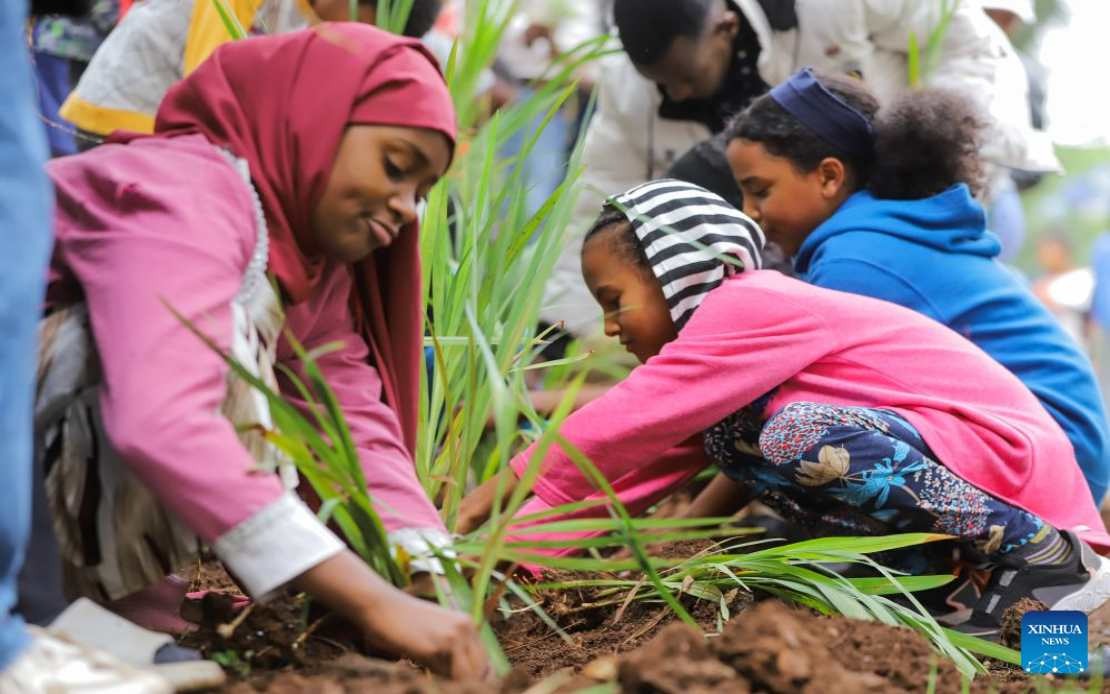
Ethiopia executed a remarkable feat of environmental mobilisation on Monday when millions of residents and foreign nationals converged across the country to plant approximately 800 million tree seedlings in just 24 hours. The coordinated nationwide campaign represents a significant milestone in the country's efforts to address deforestation and climate vulnerability, demonstrating the scale of commitment required to reverse environmental degradation on the African continent.
The initiative, formally known as the Green Legacy Initiative, was established by Prime Minister Abiy Ahmed in 2019 and has since evolved into Ethiopia's flagship environmental program. This year's campaign targets the planting of more than 8 billion seedlings during the rainy season, building towards the overarching goal of 50 billion trees since the program's inception. The sheer scale of these numbers underscores both the severity of Ethiopia's historical deforestation crisis and the ambition underpinning current recovery efforts.
The tree-planting drive extends beyond mere environmental restoration to encompass a broader vision for national development. Ethiopian policymakers have positioned the initiative as a crucial component of the country's economic transformation strategy, underpinning efforts to transition towards a green, lower-middle-income economy. Rather than viewing environmental rehabilitation and economic development as competing priorities, Ethiopia's approach seeks to integrate ecosystem restoration with sustainable prosperity, a framework increasingly relevant across Southeast Asia and the developing world.
Participation patterns reveal the campaign's deep penetration into Ethiopian society. Among the millions engaged were schoolchildren, healthcare workers, government employees, and community volunteers spanning urban and rural areas. Edilawit Legesse, a thirteen-year-old participant planting seedlings in the Alembank neighbourhood of Addis Ababa, exemplified the generational commitment to the initiative. Legesse noted this represented her third consecutive year of participation, suggesting the campaign has successfully embedded itself within annual cultural and civic rhythms.
Healthcare professionals also featured prominently in the planting efforts. Hewan Legesse, a nurse from a local hospital, mobilised a team of 35 colleagues to plant trees near Entoto Mountain. Individual participants set personal targets, with some committing to plant ten or more seedlings during the day. These stories illustrate how the initiative transforms environmental stewardship from an abstract policy goal into a tangible, participatory experience for ordinary citizens.
Prime Minister Abiy Ahmed characterised the annual one-day planting effort as a moment of national unity transcending social divides. In a statement shared through social media, he described the initiative as creating "a lasting legacy for generations to come", emphasising continuity and intergenerational responsibility. Abiy highlighted eight consecutive years of sustained action, positioning the Green Legacy Initiative not as a one-off campaign but as a cornerstone of long-term national policy.
The environmental objectives underlying the initiative address several interconnected challenges facing Ethiopia. Decades of deforestation have severely degraded the country's landscape, reducing forest cover and diminishing ecosystem services that rural populations depend upon for agriculture, water security, and livelihood stability. By systematically restoring tree cover, Ethiopia aims to rebuild landscape resilience, enhance carbon sequestration capacity, strengthen water retention, and create habitat for biodiversity conservation.
The climate adaptation dimension proves particularly significant for regional policymakers observing similar environmental pressures across East and Southern Africa. Ethiopia's experience with extreme droughts, erratic rainfall patterns, and environmental degradation has made climate resilience a central development concern. Mass afforestation functions as both a mitigation strategy, reducing atmospheric carbon, and an adaptation measure, stabilising hydrological cycles and reducing vulnerability to climate variability.
For Southeast Asian nations grappling with their own deforestation crises, Ethiopia's model offers instructive lessons regarding large-scale environmental mobilisation. The initiative demonstrates how governments can leverage civic participation to achieve environmental outcomes that would exceed state capacity alone. The integration of school children, healthcare workers, and community volunteers creates buy-in across demographic groups and embeds environmental consciousness within national culture.
The scalability challenge remains significant. Moving from planting 800 million trees in a single day to sustaining 8 billion annual plantings requires robust supply chains, quality control mechanisms, and long-term management of newly planted forests. Seedling survival rates, species selection, ecosystem appropriateness, and community stewardship all determine whether ambitious planting targets translate into genuine forest restoration.
Ethiopia's trajectory under the Green Legacy Initiative reflects a fundamental reorientation of national environmental policy. Rather than treating environmental restoration as peripheral to economic development, the framework positions ecological recovery as integral to poverty reduction, climate adaptation, and prosperity. This conceptual shift holds implications extending beyond Ethiopia's borders, as developing economies across Africa and Asia confront accelerating environmental pressures that threaten food security, water availability, and economic stability.
The campaign's success ultimately depends upon persistence beyond the symbolic one-day planting event. Sustaining momentum requires continued political commitment, adequate funding for seedling production and distribution, community engagement mechanisms, and adaptive management responding to local ecological conditions. Ethiopia's eight-year track record suggests institutional capacity exists to maintain this ambitious agenda, though the coming years will test whether enthusiasm can be converted into measurable forest regeneration and lasting environmental benefits.

