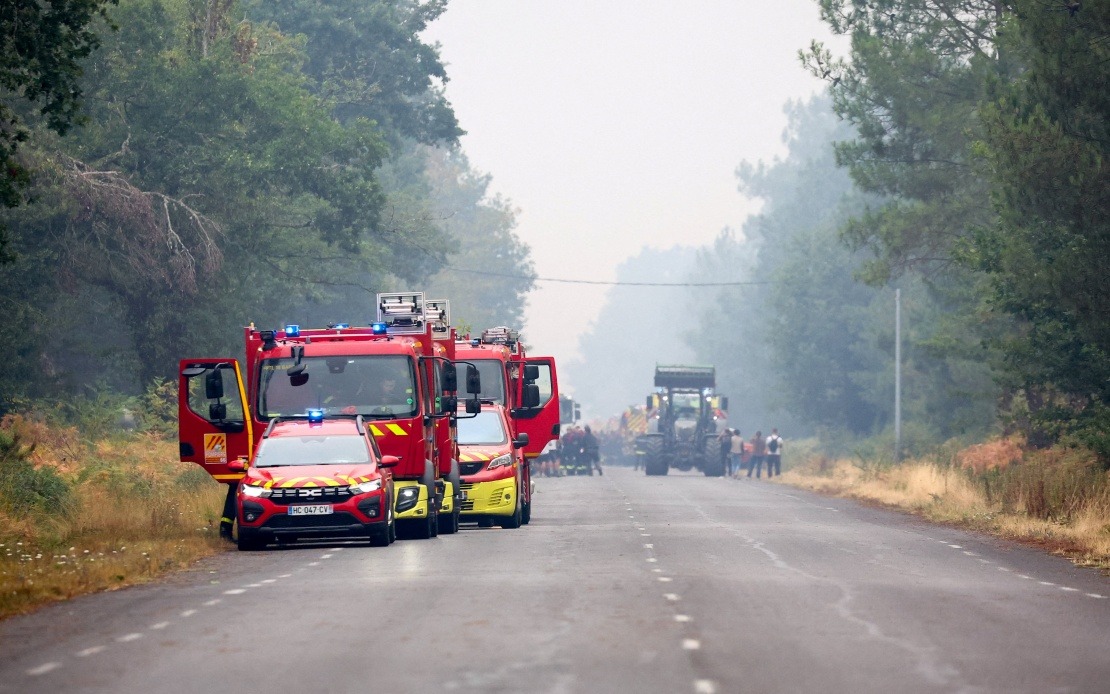
The ferocious wildfires that have consumed vast tracts of southwestern Europe over the past week are finally showing signs of retreat, offering temporary relief to exhausted fire services and anxious residents across France and Spain. Yet this reprieve comes with a troubling caveat: meteorologists are tracking another dangerous heat wave set to descend on the region, raising the spectre of renewed fire activity just as containment efforts appear to be gaining ground.
In the Gironde department of southwestern France, situation reports from Wednesday indicated that the primary wildfire had stabilised through the morning hours, though isolated flare-ups continued to erupt during the night shift. Emergency managers emphasised that while conditions had calmed considerably, the job of suppressing the blaze remained far from finished. Over 2,000 firefighters remained stationed across the fire perimeter, working methodically through the landscape to identify and extinguish remaining pockets of active combustion that could reignite if left unattended.
The human toll of the Gironde conflagration has been substantial. Since the initial outbreak, 126 firefighters have sustained injuries while battling the flames, illustrating the extreme physical demands and hazards inherent in large-scale wildfire suppression. The persistence of these injuries underscores the gruelling nature of extended firefighting operations, where exhaustion, heat exposure, and sudden fire behaviour changes create constant danger for personnel on the ground.
Elsewhere in France, the southeastern Var department achieved a significant milestone on Tuesday when authorities declared a major fire contained after it had ravaged nearly 4,800 hectares of forest and scrubland. Similarly, in the Landes department further west, crews managed to contain a separate blaze on Monday that had scorched approximately 3,600 hectares, though up to 350 firefighters remained deployed to maintain vigilance over the cooled terrain and suppress any residual hotspots. Despite these containment successes, the national risk assessment remains elevated: 65 departments across France have been placed under orange alert status due to the persistently high danger of fresh fire ignitions.
The meteorological outlook compounds this precarious situation. France's national weather service, Meteo-France, has issued orange heat alerts across 16 departments as forecasters predict the arrival of another intense heat wave. The combination of elevated ambient temperatures, low humidity levels, and parched vegetation creates conditions remarkably conducive to rapid fire spread—essentially resetting the clock on the containment efforts achieved over recent days.
Across the border in Spain, parallel struggles against advancing flames have similarly begun to stabilise. The Sierra Oeste wildfire affecting the Madrid region remained stable overnight without significant new flare-ups, according to Spanish media reports. However, active fire suppression continues across multiple fronts throughout the Spanish landscape, with ongoing operations in the Madrid region, Avila, Toledo, Castellon, and Almeria provinces. Spain, too, is bracing for another heat wave that could dramatically alter the current trajectory of containment efforts.
Evacuations across Spain have gradually reversed as conditions permit. Late on Tuesday, residents from 15 municipalities in the Madrid and Avila provinces received clearance to return to their homes. Larger population centres also began to repopulate: 9,000 residents in Castellon and 6,000 residents spread across 11 municipalities in Toledo were authorised to leave shelters and evacuation centres, representing a meaningful restoration of normalcy for affected communities. Yet significant displacement continues: the Vall d'Uixo wildfire in Castellon, which ignited on Saturday, remains beyond suppression capacity, having already consumed 10,000 hectares and forced the evacuation of 10,000 people who remain unable to return home.
The infrastructure damage across Spain remains extensive. Although some roads have been reopened as fire perimeters have been pushed back, a total of 30 transportation corridors remain closed across Avila, Castellon, Madrid, Toledo, and Leon provinces. These closures continue to disrupt commerce, restrict emergency access, and isolate communities, underscoring the broader societal impact of these catastrophic fires that extends well beyond the immediate threat to human life and property.
For Malaysian and Southeast Asian readers, these European wildfires carry instructive lessons about climate vulnerability and disaster preparedness. The convergence of multiple extreme weather events—sequential heat waves combined with prolonged drought—demonstrates how climate change can create cascading crises that overwhelm even well-resourced nations. The ability of France and Spain to mobilise thousands of firefighters, coordinate across national boundaries, and maintain supply chains for equipment reflects institutional capacities that many developing nations lack. Furthermore, the looming heat wave illustrates how short-term weather patterns can completely undermine containment efforts, a dynamic particularly relevant to Southeast Asia's monsoon-influenced climate where seasonal transitions can create dangerous fire windows. The economic and social disruption caused by mass evacuations and infrastructure closures resonates especially for densely populated countries like Malaysia and Indonesia, where similar scenarios could create far more severe consequences given higher population densities and potentially more limited emergency response resources.

