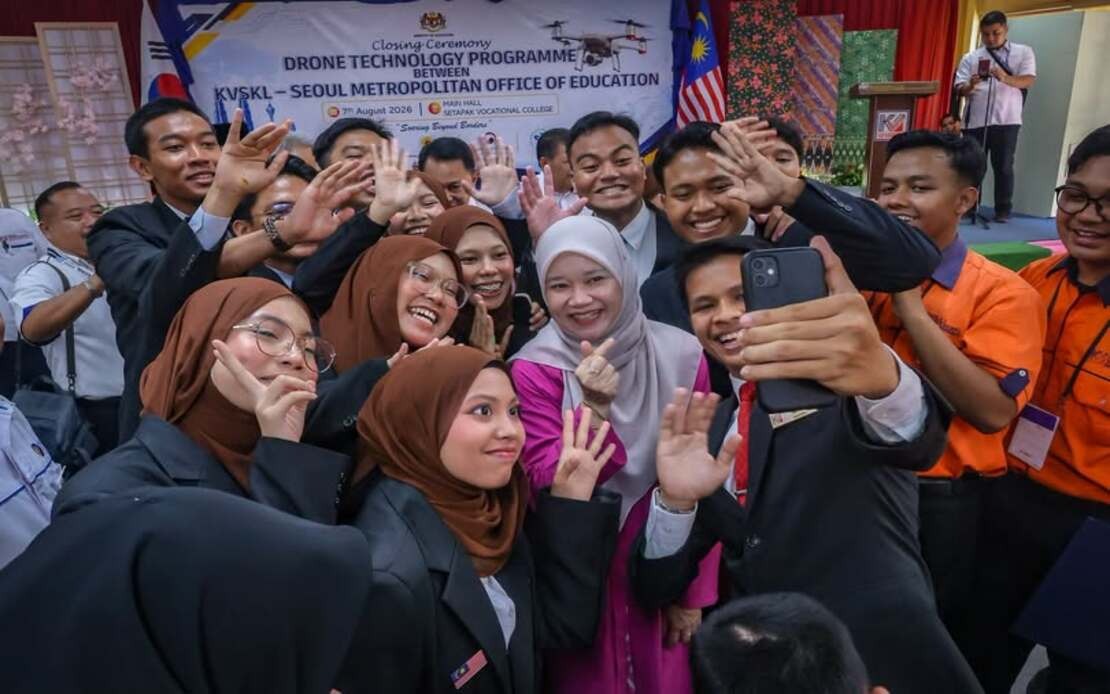
Education Minister Fadhlina Sidek has set Setapak Vocational College students a practical challenge: devise ways to harness drone technology for improved campus security within the next month. The initiative, announced during a bilateral education collaboration with South Korea, represents a deliberate shift toward embedding real-world problem-solving into Malaysia's vocational training curriculum, moving beyond theoretical instruction into applied technological innovation.
The one-month deadline reflects Fadhlina's broader vision of transforming how young Malaysians engage with emerging technologies. Rather than treating robotics, drones, and artificial intelligence as abstract concepts relegated to future workplaces, the minister is pushing vocational institutions to position these tools as immediate solutions to tangible challenges. Students will be expected to present detailed proposals demonstrating how drone systems could meaningfully enhance security operations at their institution, forcing them to think critically about practical implementation rather than merely acquiring operational skills.
The challenge emerged during a collaborative programme between the Seoul Metropolitan Office of Education and Setapak Vocational College, highlighting Malaysia's engagement with South Korean expertise in technology education. South Korean Ambassador to Malaysia Yeo Seung-bae attended the event, underscoring the diplomatic dimension of educational partnerships in Southeast Asia. Such bilateral collaborations reflect how nations are increasingly using education exchange to build soft power and strengthen regional ties through knowledge transfer.
Fadhlina witnessed student demonstrations of drone operations and robotic systems firsthand, and her remarks emphasised the pedagogical value of experimentation over perfection. She observed that some students succeeded immediately whilst others encountered difficulties, yet all persisted in their attempts. This framing of failure as integral to genuine learning departs from traditional Malaysian educational narratives that often penalise mistakes, potentially signalling a cultural shift within the ministry toward embracing iterative problem-solving methodologies more common in technology sectors.
The minister's intervention addresses a critical gap in Malaysia's skills pipeline. As robotics, drone technology, and artificial intelligence transition from emerging fields into established workplace requirements, vocational colleges must evolve curricula accordingly. Many Malaysian firms face shortages of technicians and engineers capable of deploying these systems effectively, yet educational institutions often lag in updating programmes to match industry demand. By framing technological literacy as essential rather than supplementary, Fadhlina is positioning vocational education as a pathway to high-value employment rather than a fallback option.
The security application focus carries particular relevance for Malaysian institutions. Campus safety remains a significant concern for school administrators, parents, and students alike, making it a compelling use case for emerging technologies. Drone-based surveillance, perimeter monitoring, and rapid emergency response systems represent genuine operational possibilities that students can meaningfully explore. This grounds their learning in authentic institutional needs rather than abstract scenarios, potentially increasing both engagement and the likelihood of practical implementation if proposals prove viable.
The challenge also illustrates how vocational education can foster entrepreneurial thinking among students. Successfully developing and pitching security solutions exposes participants to processes familiar in technology startups and innovation labs: identifying problems, researching solutions, prototyping approaches, and presenting findings to decision-makers. These competencies extend far beyond technical proficiency, encompassing communication, project management, and strategic thinking—attributes that employers consistently identify as critical yet often lacking in fresh graduates.
Fadhlina's emphasis on keeping pace with technological advancement reflects systemic pressures facing Malaysia's education sector. Regional competitors including Vietnam, Thailand, and Indonesia are similarly investing in STEM education and technology integration, creating competitive pressure to avoid falling behind. Malaysia's continued prosperity depends partly on its ability to develop workforces capable of operating at the frontier of technological capability rather than perpetually adopting and maintaining technologies developed elsewhere.
The Setapak Vocational College initiative also signals renewed attention to vocational pathways within Malaysia's education hierarchy. Historically, vocational training has occupied a subordinate position relative to academic secondary and tertiary education, with societal prestige often attached to university degrees over technical qualifications. By having the Education Minister personally engage with vocational students on innovation challenges, the ministry implicitly elevates the status and relevance of vocational education, potentially influencing parental and student perceptions of technical career pathways.
Implementation challenges remain significant. Students will require sustained access to drone technology, mentoring from experienced operators, and possibly technical support beyond their institution's current capacity. The one-month timeline, whilst creating productive urgency, may prove compressed for thorough research and proposal development. Success will depend partly on how effectively Setapak Vocational College can mobilise institutional and potentially external resources to support student teams, and whether faculty possess sufficient technological expertise to guide meaningful innovation rather than superficial demonstrations.
The security focus also raises questions about student engagement with responsible technology use. Drone surveillance, whilst offering institutional benefits, intersects with privacy considerations. Whether the challenge prompts students to grapple with ethical dimensions of surveillance technology—balancing security needs against individual privacy rights—could determine whether this initiative cultivates technologically literate citizens or merely trained technicians. Educational institutions have particular responsibility to embed ethical reasoning alongside technical capability.
Looking forward, Fadhlina's challenge establishes a template potentially applicable across Malaysia's vocational college system. If Setapak students produce viable security solutions, replicating this approach elsewhere could systematically strengthen the alignment between vocational education and institutional needs, create demonstration projects showcasing emerging technologies, and build student portfolios that impress prospective employers. The model also demonstrates how government leadership can meaningfully reshape educational practice through targeted, results-oriented challenges rather than purely regulatory mandates.
Ultimately, the initiative reflects a maturing understanding that vocational education's value lies not merely in reproducing existing technical competencies but in cultivating innovators capable of adapting technologies to solve contextual problems. By tasking students with designing security solutions rather than simply learning drone operation, Fadhlina positions vocational colleges as incubators for practical innovation—a role that could significantly enhance their relevance and appeal within Malaysia's education landscape.

