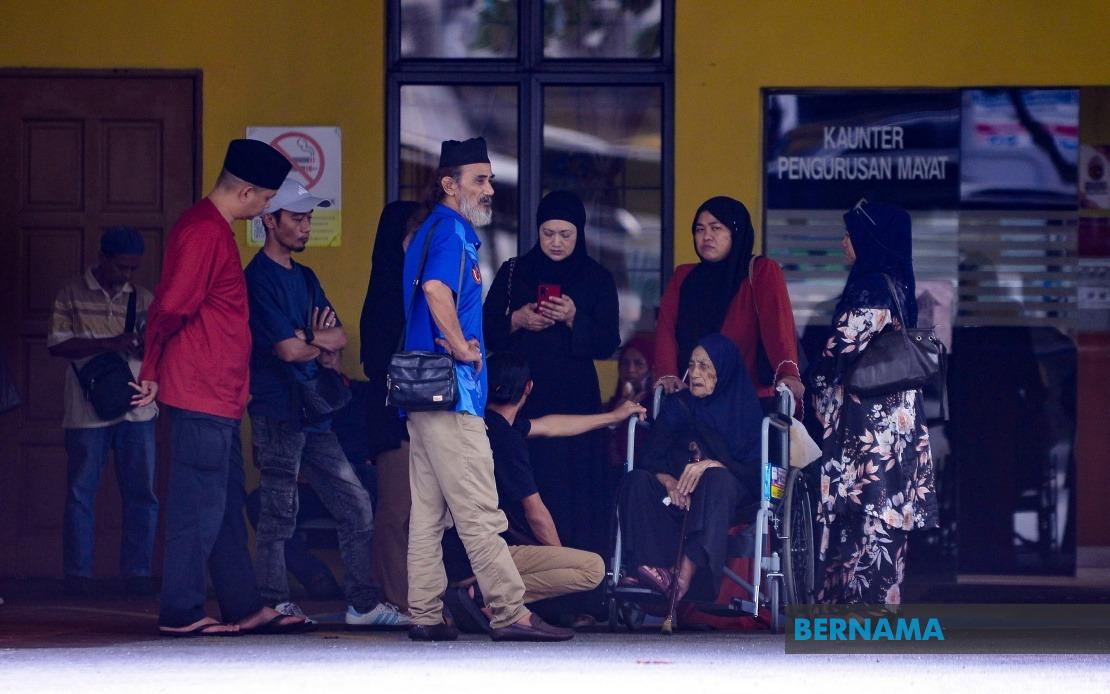
The family of three people killed in a collision at Maju Junction in Kuala Lumpur early last week is pressing authorities for a thorough and impartial investigation into the tragedy. Mohd Nadzri Razali, 69, whose brother-in-law Shaik Mohd Firdaus Shaikh Yahya was among those who perished in the incident, spoke publicly about his grief and frustration from his home in Taman Aman Fasa 2, Mambang Di Awam, saying that accountability must be established given what witnesses have reported about the circumstances surrounding the collision.
According to accounts of the accident, an empty Isuzu Black Maria operated by the Malaysian Immigration Department was en route from the Kuala Lumpur Immigration Office to Chow Kit to conduct enforcement operations targeting undocumented migrants when it entered the Maju Junction intersection. The critical question now dominating discussion among family members and observers concerns whether the lorry proceeded through a red traffic signal. Mohd Nadzri indicated he had received information suggesting exactly that scenario occurred, stating he was relying on what others had told him about the moment of impact. He has appealed for investigators to establish precisely what the traffic signals indicated at the moment the vehicles met.
The collision unfolded around 1 am when a Proton Saga that was travelling through the junction on a green light proved unable to stop or manoeuvre away from the Immigration lorry. The force of impact sent the heavier vehicle skidding out of control across the intersection. In its path were four pedestrians from the same household—Shaik Mohd Firdaus, his two daughters Siti Nor Sazlin, 25, and Siti Darwisyah Auni, 12, and his wife Norhayati Razali, 55. An Inokom Matrix multi-purpose vehicle was also struck during the chaos. The three pedestrians who died were pronounced dead at the scene, while Norhayati remained in critical condition at Kuala Lumpur Hospital's Intensive Care Unit as of the time Mohd Nadzri spoke to media.
Mohd Nadzri provided an update on his younger sister's medical status, noting that she had regained consciousness, though her condition remained serious enough that discharge remained uncertain. He expressed a preference to have her transferred to either Hospital Ipoh or Teluk Intan for ongoing care if her health allowed, citing proximity to family in the Perak region. The family has made arrangements to lay all three deceased members to rest together in a single grave at the Muslim Cemetery in Kampung Air Hitam Labu, Campar, in a final act of unity.
The personal impact on the broader family unit extends beyond those directly involved in the accident. Mohd Nadzri emphasised that the sudden loss of three relatives simultaneously has devastated those close to them, particularly given that the extended family had endured another bereavement mere months earlier on May 30. The emotional weight of consecutive tragedies has compounded the shock of these deaths. He recalled that the last occasion he had spent time with his sister's family was approximately two weeks before the accident, when they had travelled together to Teluk Bakong in Ayer Tawar to maintain the graves of earlier deceased family members—a traditional practice that now carries added poignancy.
The investigation into the incident is proceeding under Section 41(1) of the Road Transport Act 1987, the statutory provision governing serious motor vehicle collisions. This framework allows authorities to examine whether violations of traffic regulations or breaches of duty contributed to the catastrophe. The question of whether the Immigration Department lorry, despite operating its beacon lights and siren, should have exercised greater caution when approaching an intersection controlled by traffic signals remains central to understanding what occurred. Emergency lighting and auditory warnings do not automatically grant vehicles unconditional right of way; operators retain a duty to ensure that proceeding through an intersection will not endanger other road users.
The incident raises broader questions about the operation of government vehicles engaged in law enforcement activities and the protocols governing their transit through urban intersections. Immigration enforcement operations, while legitimate, must be balanced against public safety considerations. The timing of the collision—during the early morning hours when traffic volumes are typically lower but visibility may be reduced—and the deployment of an empty detention vehicle returning from an operation all form part of the operational context that investigators will examine. Whether standard procedures were followed and whether any training or procedural gaps contributed to the incident are matters that a comprehensive inquiry should address.
For Malaysian road safety advocates, the accident exemplifies the recurring vulnerability of pedestrians at busy intersections, particularly when large vehicles are involved. The Maju Junction area is a major traffic nexus in central Kuala Lumpur, and pedestrian safety in such locations depends on strict adherence to traffic control systems by all parties. The family's insistence on transparency reflects a broader public expectation that official investigations into accidents involving government vehicles should be conducted with the same rigour and impartiality as those involving private citizens, without any institutional bias that might compromise findings. Mohd Nadzri's public statement serves as a reminder that behind traffic statistics and accident reports are grieving families seeking not merely answers but assurance that such losses will prompt genuine improvements in road safety practices.

