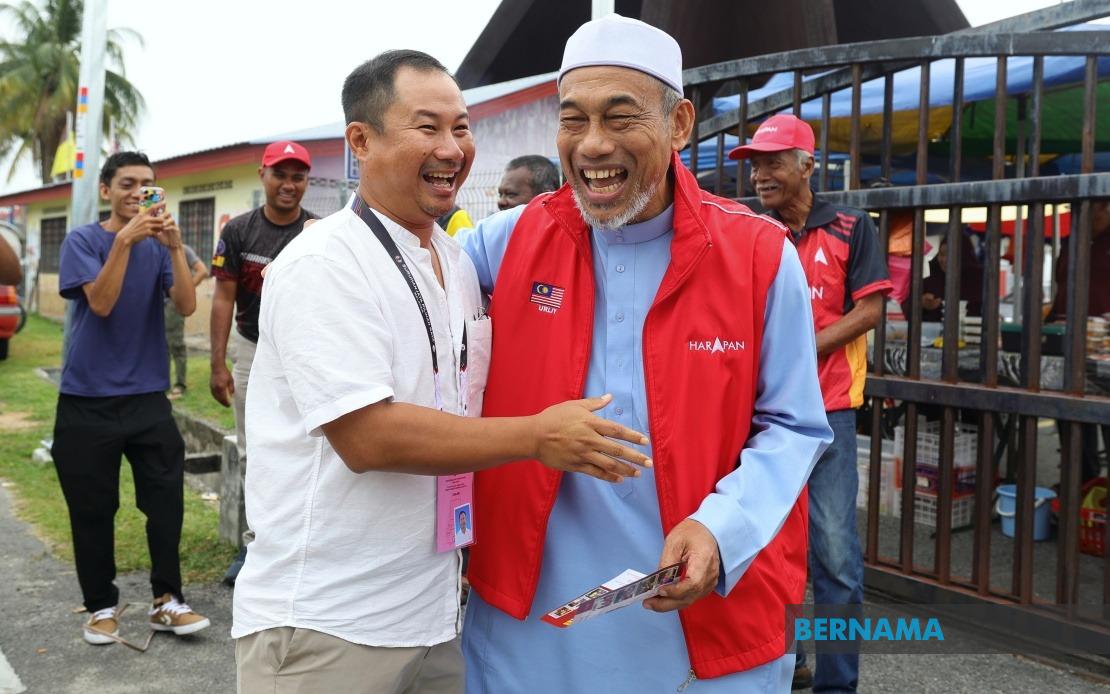
Personal relations have not fractured despite fierce political competition in the Negeri Sembilan State Election, where incumbent Datuk Bakri Sawir of Pakatan Harapan and his cousin Danni Rais of Perikatan Nasional encountered each other at Kuala Klawang weekend market during the second day of campaigning. The unexpected meeting between the two rivals at the bustling marketplace drew considerable attention from voters, traders and onlookers, many of whom seized the moment to photograph the rare political tableau or exchange words with both candidates as they worked through the crowd.
The simultaneous presence of the two candidates at the market presented an unusual scenario for local voters accustomed to more conventional campaign dynamics. Rather than escalating tensions or creating friction, the encounter unfolded in a notably civil manner, with both Bakri and Rais maintaining their separate campaign schedules without confrontation. Observers noted that the cousins even engaged in lighthearted banter, underscoring a pragmatic separation between family bonds and political ambitions that has become increasingly rare in Malaysian electoral contests.
Bakri, speaking to journalists after his market visit, reframed the contest with his relative as a straightforward contest of ideas and service rather than a personal vendetta. He articulated a philosophy that emphasises the primacy of civic duty over partisan rivalry, suggesting that the electoral process itself serves as the legitimate mechanism through which candidates present their platforms to constituents. His comments reflected a measured approach to campaigning that prioritises institutional respect over personal animosity.
The incumbent highlighted his commitment to procedural compliance when discussing recent interactions with local authorities. The Jelebu District Council had earlier issued guidance regarding campaign materials, specifically concerning the installation of flags on stadium fencing. Bakri indicated that once notified of the regulations, his team promptly removed the materials rather than contest the directive. This willingness to defer to administrative authority projected an image of a campaign that respected governmental structures and legal frameworks.
Bakri emphasised that adherence to established rules provides the foundation for demanding public compliance with law and governance. His reasoning articulated a straightforward principle: candidates and political operatives cannot credibly advocate for lawful conduct amongst the electorate whilst simultaneously flouting electoral regulations or administrative directives. This emphasis on procedural integrity appears designed to distinguish his campaign approach from competitors and establish a template for orderly political engagement.
Further reinforcing this stance, Bakri issued a broader appeal to all contending parties and their respective organisational structures. He specifically called upon campaign machinery—the volunteer networks, party functionaries, and grassroots activists who drive electoral mobilisation—to conduct themselves in ways that preserve social harmony throughout the election period. His framing positioned respectful campaigning not merely as a tactical choice but as a civic responsibility necessary for maintaining communal cohesion during inherently competitive political moments.
The Klawang state seat encompasses 13,355 registered voters across its constituency, making it a moderately sized electorate within the broader state assembly landscape. The contest itself involves three principal candidates: Bakri representing the governmental coalition, Rais fielding the opposition Perikatan Nasional ticket, and Muhammad Adib Musa competing as the Bersatu candidate. This three-way configuration adds complexity to voter calculations, as no single candidate enters the race with overwhelming presumptions of victory.
The Election Commission has structured the voting process across two distinct phases. Early voting has been scheduled for July 28, providing opportunities for eligible voters unable to participate on polling day to cast ballots in advance. The main polling date is set for August 1, concluding what will have been a concentrated campaign period. This compressed timeline places considerable pressure on candidates to maximise voter engagement through focused ground operations and public appearances.
The Klawang constituency holds particular significance within Negeri Sembilan's political ecosystem. As a state seat election rather than a federal parliamentary contest, the outcome will directly influence the composition of the state assembly and potentially the balance of power within the state government. Victories in multiple seats like Klawang collectively determine whether the incumbent coalition retains its legislative majority or whether opposition groupings can successfully challenge governmental control.
The harmonious interaction between Bakri and Rais stands in marked contrast to several recent Malaysian electoral campaigns characterised by personalised attacks, inflammatory rhetoric, and polarised political messaging. Their conduct suggests that intense political competition need not necessitate the abandonment of basic civility or family relationships. Whether this approach influences voter perceptions, and whether it becomes replicated by other candidates contesting in the same election cycle, remains uncertain but warrants close observation by political analysts.
For Malaysian voters and regional observers, the Klawang campaign presents a case study in how electoral contests can be prosecuted vigorously whilst maintaining institutional respect and communal harmony. The cousins' contrasting political affiliations and simultaneous pursuit of the same office demonstrate that democratic competition, at its best, remains compatible with mutual respect and procedural propriety. As polling day approaches, their respective campaign messages and voter mobilisation efforts will ultimately determine Klawang's electoral outcome.

