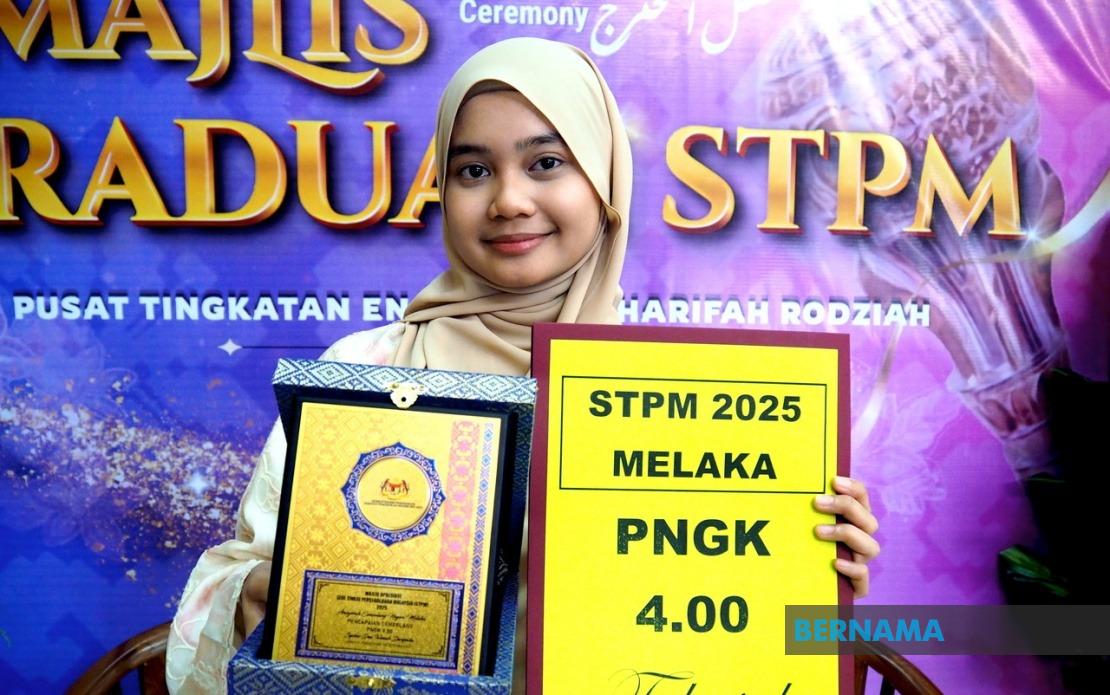
Nurfariesya Nasywa Hamedee, a 21-year-old from Sekolah Menengah Kebangsaan Agama Sharifah Rodziah in Melaka, has emerged as one of the state's exceptional STPM performers, securing a flawless 4.00 Cumulative Grade Point Average in the 2025 examination results announced this week. The standout achievement, however, carries deeper meaning for the young scholar—it represents a personal triumph over adversity and a fulfilment of her late father's final wishes.
Hamedee Asri, Nurfariesya's father, passed away unexpectedly from a heart attack just one week before she was scheduled to sit for her SPM trial examination several years ago. The timing of his death coincided with a critical juncture in her academic journey, leaving the teenager devastated and struggling to maintain focus on her studies. The loss prompted her to contemplate abandoning her education altogether, as financial pressures mounted on her family and the weight of grief became nearly unbearable. At that vulnerable moment, when her future seemed uncertain, her late father's parting counsel—delivered through her mother, Yusnita Ruslan—became her psychological anchor.
That final piece of advice, urging her not to squander her abilities and to pursue her studies with determination, transformed from mere words into a powerful motivational force that would carry her through subsequent years of secondary and pre-university education. Speaking to reporters after collecting her STPM results at Telok Mas, Nurfariesya reflected on how this paternal guidance sustained her resolve during periods of doubt and fatigue. The decision to channel her grief into academic achievement rather than allowing despair to derail her educational aspirations demonstrates remarkable emotional resilience for a teenager already navigating the typical pressures of examination life.
The actual achievement itself proved even more impressive than Nurfariesya's own projections. Based on her STPM trial examination results and preliminary calculations, she had cautiously anticipated a CGPA of approximately 3.92. The jump to a perfect 4.00 surprised her, suggesting that her thorough preparation and sustained effort during the formal examination period surpassed even her own optimistic estimates. This gap between expectation and outcome underscores the value of consistent, focused study habits and the capacity to perform under pressure—qualities that extend far beyond the examination hall.
Her subject selection at pre-university level reflected a deliberate career trajectory. By choosing to study General Studies, Arabic, Usuluddin (Islamic Theology), History, and Shariah, Nurfariesya had already mapped a clear pathway toward her aspiration of becoming a Shariah lawyer. This vocational clarity from adolescence is relatively uncommon, and it has evidently provided additional motivation beyond the abstract pursuit of grades. Her passion for Islamic jurisprudence and religious studies has been consistent since her secondary school years, providing intrinsic motivation that complements the extrinsic drive of achieving high marks.
Prior to her STPM success, Nurfariesya had demonstrated strong academic foundations by obtaining seven distinctions in her SPM examination, indicating that her recent breakthrough did not emerge from nowhere but rather represented the culmination of years of disciplined study. Her decision to pursue the STPM pathway rather than other pre-university routes such as A-Levels or diploma programs reflected a strategic consideration about efficiency and opportunity. She valued STPM's reputation as providing a more direct route into degree-level studies while simultaneously offering broader recognition among Malaysian universities.
When asked about the formula for academic success, Nurfariesya eschewed any suggestion of hidden techniques or extraordinary study methods. Instead, she articulated a philosophy grounded in persistent effort, resilience in the face of setbacks, and spiritual faith. She attributed much of her achievement to maintaining consistent daily revision schedules, refusing to succumb to discouragement when study became difficult, and anchoring her motivation in her Islamic beliefs. This no-nonsense approach to academic success—combining practical discipline with spiritual grounding—offers a refreshing counterpoint to narratives that sometimes sensationalise achievement through supposedly exotic study techniques.
Further testament to Melaka's strong STPM cohort came through the recognition of Ng Zhen Hong, a 20-year-old student from Kolej Tingkatan Enam Tun Fatimah, who was named the national-level best student for the Science Stream in the 2025 STPM examination. Ng's achievement reflects the calibre of pre-university education available in the state and demonstrates that Melaka is producing multiple candidates of genuinely elite academic standing. His path to this national recognition involved similar elements of family support, personal dedication, and a distinctive passion for his chosen field.
Ng credited his parents and teachers with providing continuous encouragement throughout his secondary and pre-university studies. His passion for science subjects, particularly those requiring calculation and problem-solving, drove him to invest substantial daily effort—typically between one to two hours per day—in revising his lessons. Rather than viewing scientific challenges as frustrating obstacles, he consciously reframed them as opportunities to develop greater mastery and deeper understanding. He had previously distinguished himself by obtaining ten distinctions in his SPM examinations, establishing himself as a consistently high-performing student across multiple levels of assessment.
Despite his track record of academic excellence, Ng expressed surprise at being named the national-level best student for the science stream, suggesting that identifying the very top performers across an entire nation's cohort of STPM candidates involves considerable competitive intensity. His plans to pursue either Chemical Engineering or Electrical Engineering at Universiti Malaya represent a natural continuation of his demonstrated aptitude and interest in quantitative, technically demanding disciplines. For Malaysian parents and students, Ng's trajectory—combining consistent performance across multiple examination stages with purposeful subject selection aligned to degree-level aspirations—provides a broadly replicable model.
The announcement of the 2025 Melaka State STPM results, officiated by Datuk Rosli Abdullah, the State Deputy Exco for Education, Higher Education, and Religious Affairs, highlighted the state's continued production of high-performing students. Both Nurfariesya and Ng exemplify different but complementary pathways to pre-university excellence. While one pursued humanities and religious studies and the other focused on science, both demonstrated that sustained effort, parental support, clear career ambitions, and personal resilience form the essential ingredients for achieving top-tier results.
For Malaysian readers and families approaching pre-university examination stages, these two cases offer several relevant insights. First, the choice between different pre-university pathways—STPM, A-Levels, or others—matters less than the quality of one's engagement with whichever system one selects. Second, combining academic ambition with identified career direction provides stronger motivation than grade-chasing alone. Third, family support and personal spiritual or philosophical grounding can serve as stabilising forces during demanding study periods. Finally, perfect or near-perfect scores remain achievable within Malaysia's education system for students willing to combine consistent effort with genuine passion for their chosen subjects.
%22%2F%3E%3C%2Fpattern%3E%3C%2Fdefs%3E%3Crect%20width%3D%22100%25%22%20height%3D%22100%25%22%20fill%3D%22url(%23ph4n81lg)%22%2F%3E%3Crect%20width%3D%22100%25%22%20height%3D%22100%25%22%20fill%3D%22url(%23ph4n81lp)%22%2F%3E%3Ctext%20x%3D%2250%25%22%20y%3D%2250%25%22%20text-anchor%3D%22middle%22%20dominant-baseline%3D%22central%22%20fill%3D%22rgba(255%2C255%2C255%2C0.95)%22%20font-family%3D%22Georgia%2C%20'Times%20New%20Roman'%2C%20serif%22%20font-weight%3D%22700%22%20font-size%3D%22272%22%20letter-spacing%3D%22-0.02em%22%3EAnwar%3C%2Ftext%3E%3C%2Fsvg%3E)