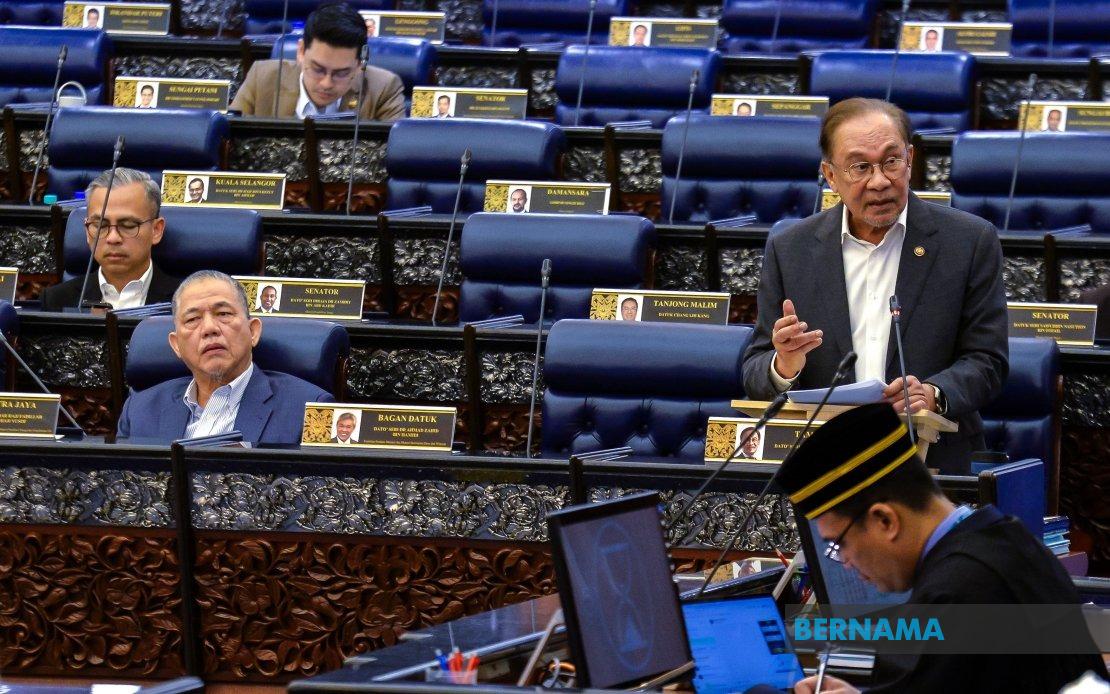
Prime Minister Datuk Seri Anwar Ibrahim has moved to rebut criticism of the federal government's allocation methodology, asserting that the majority of states benefit from receiving more federal funds than their tax contributions warrant. Speaking during parliamentary proceedings in Kuala Lumpur on June 30, he clarified that only Selangor and Penang generate tax revenues exceeding their federal allocations, a distinction reflecting their more developed economic bases. The clarification addresses recurring concerns about equity in the nation's intergovernmental fiscal system, a perennially sensitive issue in Malaysian federalism where disparities between contributing and receiving states frequently generate political tension.
The Prime Minister's emphasis on needs-based distribution rather than revenue-based formulae signals a deliberate policy pivot toward equity considerations. According to Anwar, the government calculates state allocations by examining the specific developmental challenges each region faces, ensuring that funds flow to areas requiring the most urgent infrastructure and social investments. This approach fundamentally rejects a purely transactional model where states would receive allocations proportional to their tax contributions, which would predictably advantage already-developed regions while constraining resources available to less-developed areas. The methodology reflects broader development theory recognising that uneven growth requires corrective redistribution to prevent widening regional disparities.
Anwar catalogued the types of projects guiding allocation decisions, providing concrete examples of how needs assessment translates into fiscal policy. Flood mitigation initiatives rank prominently given Malaysia's recurring inundation challenges, particularly in East Coast states vulnerable to monsoon rains. The Pan-Borneo highway upgrade represents significant infrastructure investment in Sarawak and Sabah, addressing long-standing connectivity deficits that constrain development in Malaysian Borneo. New road networks, water drainage systems, poverty eradication programmes, and educational facility development collectively comprise the allocation framework, demonstrating that the government evaluates multidimensional development indicators rather than applying simplistic fiscal formulas.
The government's positioning invites scrutiny of whether stated allocation principles actually translate into budgetary reality. International experience suggests that needs-based systems often produce outcomes that appear arbitrary without transparent methodology. In federal systems from India to Canada, transparent allocation frameworks typically employ explicit formulae combining variables such as population, poverty rates, and infrastructure deficits, allowing stakeholders to understand how decisions emerge. Malaysia's apparent reliance on need assessment without publicly disclosed formulae leaves room for legitimate questions about consistency and fairness, even if intentions are equitable. This opacity potentially fuels precisely the allegations Anwar sought to address.
The defence of contemporary allocations implicitly compares them favourably against the preceding administration's approach. Anwar specifically highlighted that states including Kedah, Terengganu, and Kelantan have received higher allocations under the MADANI Government than previously, a strategic rhetorical move positioning his administration as correcting alleged prior imbalances. This comparison carries political weight in Malaysian federalism, where state governments controlled by different coalitions frequently contest resource distribution fairness. The government's framing suggests that earlier administrations systematically disadvantaged certain states, though detailed comparative data remains unpublished. For Malaysian observers, such claims warrant examination against substantiated budget figures to assess whether rhetoric aligns with fiscal reality.
The timing of this parliamentary intervention reflects broader constitutional questions about federalism's operation in Malaysia. Article 109 of the Federal Constitution establishes the statutory revenue allocation framework, yet political discretion shapes actual distributions. The tension between constitutional prescriptions and administrative flexibility creates persistent uncertainty around allocation methodology. State governments, particularly those controlling revenue-rich territories like Selangor and Penang, naturally question transfers to less-developed regions when their own development needs remain substantial. Anwar's defence implicitly acknowledges this fundamental tension, attempting to reframe allocation discussions around shared national development rather than zero-sum interstate competition.
For Southeast Asian observers, Malaysia's allocation debates offer instructive lessons in federal governance. The region contains multiple federal and quasi-federal systems managing comparable tensions between wealthy and developing regions. Indonesia faces analogous challenges allocating resources across its vast archipelago, while India's federal finance commission grapples with similar equity-efficiency tradeoffs. Malaysia's approach, emphasising needs-based distribution while maintaining significant federal discretion, differs from more formulaic systems but shares the fundamental objective of preventing centrifugal pressures from widening regional disparities. How successfully the MADANI Government implements its stated principles will influence regional discussions about optimal allocation mechanisms.
The parliamentary question from Datuk Seri Doris Sophia Brodi, representing GPS-controlled Sri Aman in Sarawak, carries particular significance. Sarawak's historical experience includes longstanding resource disputes with the federal centre, making state representatives acutely sensitive to allocation fairness. GPS's position within the federal coalition creates incentive structures for scrutinising federal generosity toward Sarawak specifically. That Anwar addressed the question substantively rather than dismissively suggests the government recognises allocation disputes as requiring genuine engagement rather than rhetorical deflection. The interaction illustrates how even coalition partners maintain divergent interests requiring careful federal management.
Moving forward, the government faces pressure to substantiate allocation claims through transparent methodology disclosure. Malaysian civil society increasingly demands evidence-based policymaking, and budget transparency has become a democracy agenda item. Publishing explicit allocation formulae, weighting different need variables, and demonstrating how specific states' allocations emerged from this framework would substantially strengthen Anwar's defence. Such transparency would also facilitate parliamentary oversight and public accountability, strengthening the federal system's legitimacy. Without disclosures, even well-intentioned allocations risk appearing discretionary or politically motivated, perpetuating the suspicions the Prime Minister sought to address.

