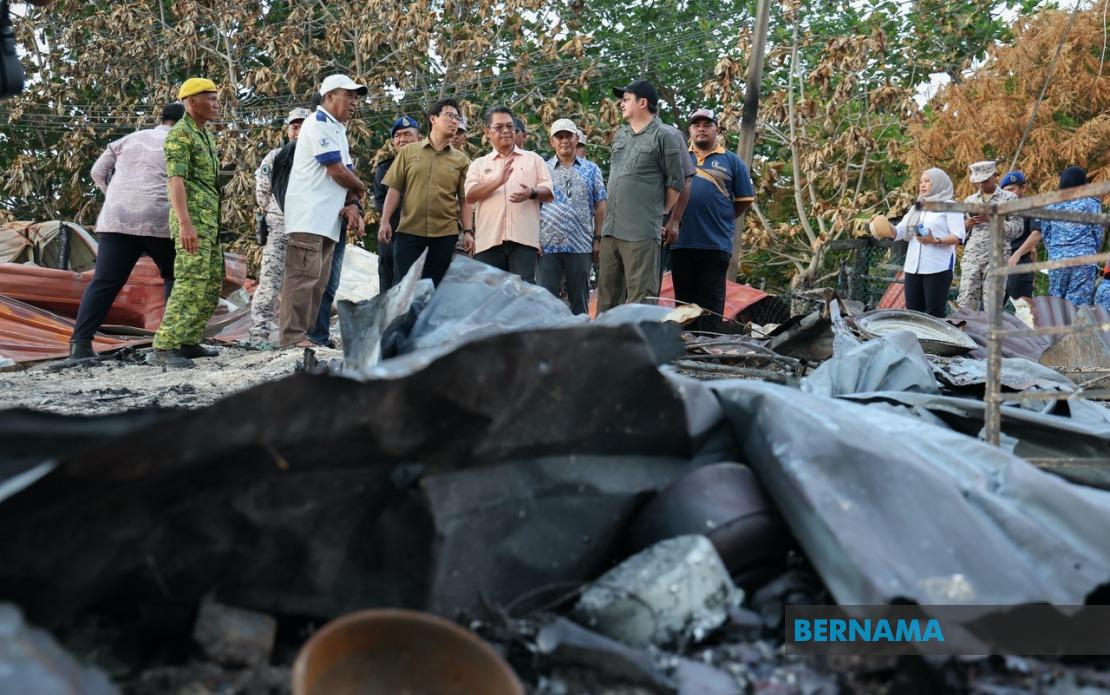
The Federal Government has swiftly deployed emergency relief to residents affected by a devastating fire that ravaged Kampung Nunuyan Laut in Sandakan yesterday morning, with the Prime Minister's Department coordinating an immediate support package for the displaced families. The blaze, which erupted around 3 am, consumed 28 residences in the waterfront settlement and rendered more than 100 people homeless, marking a significant disaster for the close-knit island community. Datuk Mustapha Sakmud, the Minister in the Prime Minister's Department overseeing Sabah and Sarawak affairs, announced that initial assistance has reached 29 household heads, while the department's Implementation Coordination Unit has begun mobilising broader recovery efforts across multiple government agencies.
The immediate intervention reflects the complexity of the humanitarian situation on Pulau Nunuyan Laut, where residents face both short-term displacement challenges and longer-term structural concerns. Beyond conventional relief provisions, the Federal Government has prioritised vulnerability-specific support, including wheelchairs distributed to elderly residents who require mobility assistance during this crisis period. This targeted approach demonstrates recognition that disaster relief must account for the particular needs of marginalised groups within affected communities, ensuring that elderly and infirm residents are not further disadvantaged by the loss of their homes and established support networks. The delivery of such specialised aid in the immediate aftermath reflects coordination between federal authorities and on-ground agencies capable of identifying and meeting these nuanced requirements.
The damage to critical infrastructure has prompted immediate government attention, particularly concerning the jetty that serves as the primary transport link for schoolchildren commuting to educational facilities. Mustapha specifically directed the Sandakan Municipal Council and relevant departments to prioritise repairs to this facility, emphasising the federal commitment to preventing the fire from disrupting children's access to education. This decision carries broader implications for the island community, as the jetty represents more than mere transportation infrastructure—it symbolises the connectivity lifeline that binds island residents to mainland economic and social opportunities. Disruption to school transport would compound the trauma already experienced by young residents and potentially accelerate permanent migration from the settlement as families lose confidence in the community's viability.
The long-term resettlement strategy presents complex challenges rooted in Pulau Nunuyan Laut's land tenure arrangements. Unlike many fire-affected communities, the disaster site involves two distinct private landowners whose property hosts the displaced residents, fundamentally complicating relocation and reconstruction planning. Datuk Walter Kenson, president of the Sandakan Municipal Council, acknowledged this awkward reality, noting that determination of relocation sites will require negotiation between government agencies, private landowners, and community representatives. The Rural Development Department has been tasked with evaluating suitable relocation options, including potential use of village reserve land administered by local authorities, representing an attempt to establish permanent housing solutions outside the complicated private land arrangement.
The proposed relocation framework encompasses comprehensive infrastructure development that would enable sustainable living standards at any new settlement location. Plans include provision of electricity, water supply systems, and new jetty construction, reflecting understanding that simply transferring residents to alternative land without essential services would perpetuate their precarious situation. These infrastructure commitments address fundamental gaps that likely characterised Pulau Nunuyan Laut even before the fire, suggesting that disaster recovery may catalyse broader development improvements for this marginalised coastal population. However, the success of such infrastructure provision ultimately depends on sustained government commitment and adequate budget allocation beyond initial crisis response phases.
The involvement of multiple government bodies—from the Prime Minister's Department to the Municipal Council and Rural Development Department—reflects the multi-layered governance structures required for effective disaster management in Malaysia's federal system. Coordination between these entities determines whether initial relief translates into coherent, comprehensive recovery. The establishment of clear lines of responsibility, with the Implementation Coordination Unit serving as the central body managing agency collaboration, provides a structural framework for maintaining momentum beyond the immediate crisis period. Such coordination mechanisms prove essential in island communities where geographic isolation and limited local resources create particular vulnerability to governance fragmentation.
The fire's impact extends beyond individual household losses to encompass broader community cohesion and settlement viability. With over 100 people rendered homeless and 28 structures destroyed, Pulau Nunuyan Laut faces existential questions about its future as a viable residential community. The fire may accelerate pre-existing migration pressures, as residents without secure land tenure or infrastructure investment consider relocation to urban centres offering greater economic opportunity and established support systems. Government efforts to facilitate relocation within the region rather than enabling complete dispersal reflect acknowledgment that community preservation represents a legitimate policy objective alongside individual family welfare.
The experience of Pulau Nunuyan Laut residents illuminates broader vulnerabilities within Malaysia's informal waterfront settlements, where inadequate building standards, limited fire-fighting access, and precarious land tenure converge to create catastrophic risk environments. Fire incidents in similar settlements across Southeast Asia demonstrate consistent patterns of rapid spread due to densely packed wooden structures, limited escape routes, and delayed emergency response times inherent to island locations. The Sandakan incident provides opportunity for nationwide review of fire safety standards applicable to informal settlements, potentially catalysing regulatory improvements that would protect similar vulnerable communities throughout Malaysian coastal regions.
The private landowner dimension introduces additional complexity increasingly relevant across Malaysian informal housing contexts, where substantial populations occupy land without formal lease arrangements or ownership documentation. These residents occupy an ambiguous legal position that complicates government assistance provision and long-term planning. Negotiations between government, private landowners, and residents must balance property rights with humanitarian imperatives, requiring careful legal and diplomatic management to prevent scenarios where private land claims obstruct public disaster response. The Sandakan Municipal Council's acknowledgment of this challenge suggests growing awareness that informal settlement governance demands policy frameworks specifically designed for tenure-insecure populations.
Relief provision to fire victims represents immediate government responsibility, but sustainable recovery requires addressing the structural vulnerabilities that enabled the disaster. Pulau Nunuyan Laut's relocation and reconstruction must incorporate resilience-building elements including improved building codes, enhanced fire-fighting capacity, and secure land tenure arrangements that incentivise residents' long-term investment in their community. The Integration Coordination Unit's involvement suggests federal-level commitment to comprehensive rather than purely symptomatic responses, though implementation quality will ultimately determine whether this fire catalyses meaningful improvement to residents' living conditions or represents merely a temporary intervention before underlying problems reassert themselves.
For Malaysian policymakers, the Sandakan incident underscores the necessity of proactive planning regarding informal settlement vulnerability reduction before disasters occur rather than reactive crisis management afterwards. Pulau Nunuyan Laut residents' experience—losing homes, facing relocation uncertainty, and depending on government goodwill for assistance—might have been substantially mitigated through earlier investment in fire safety infrastructure, building standards improvement, and secure land tenure. While immediate relief provision demonstrates government responsiveness, prevention-oriented policy approaches would prove more cost-effective and less traumatic for vulnerable communities across the nation's numerous informal waterfront settlements that mirror Pulau Nunuyan Laut's precarious characteristics.

