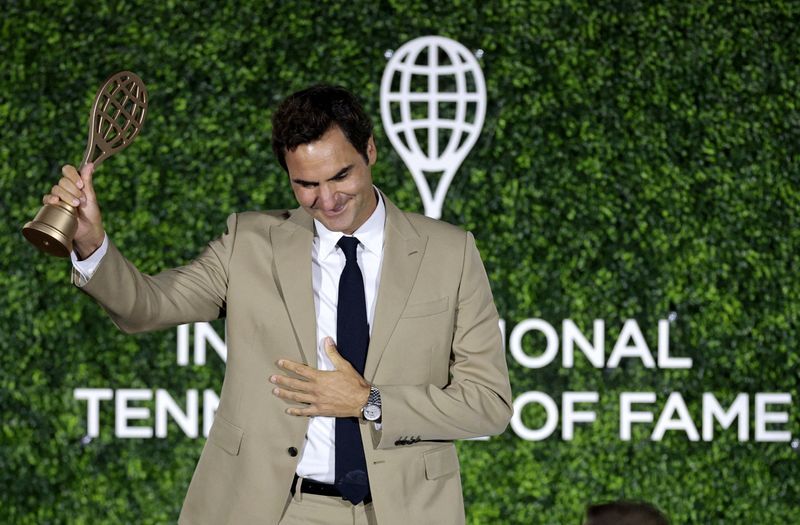
Roger Federer's induction into the International Tennis Hall of Fame marked a poignant milestone for the 45-year-old Swiss legend, who delivered a heartfelt address that underscored how deeply the sport has defined his entire existence. Inducted alongside broadcaster and journalist Mary Carillo at the ceremony in Newport, Rhode Island, Federer spoke with evident emotion about his relationship with tennis—not merely as a competitor seeking accolades, but as a life pursuit that shaped everything he holds dear. His remarks revealed a man still grappling with what his retirement means, insisting he was "still writing his love letter" to the game even as he stepped away from professional competition three years ago.
The induction itself represents the culmination of one of sport's most illustrious careers. Federer's 20 Grand Slam titles place him among tennis's greatest champions, yet his statistical achievements—eight Wimbledon crowns, six Australian Open victories, five U.S. Open titles, and a single French Open triumph—only partially capture his influence on the sport. His 310 weeks at world number one fundamentally altered expectations about what consistency and longevity could mean in professional tennis, while his 103 ATP Tour titles demonstrated sustained excellence across multiple decades and surfaces. For Malaysian and Southeast Asian tennis enthusiasts, Federer's career represented an aspirational standard, proof that meticulous technique and intelligent play could triumph even as the sport evolved toward greater athleticism and power.
What distinguished Federer's Hall of Fame address from typical retirement speeches was his explicit rejection of fame as a motivating force. He articulated instead a philosophy centred on artistic expression within sport's framework, describing tennis as a canvas for innovation rather than merely a competitive arena. His commitment to expanding what was possible on court—evolving from serve-and-volley through transition games to unconventional tactics like the SABR (Sneak Attack by Roger)—reflected a creative impulse that transcended winning individual matches. This philosophy carries particular relevance for Asian players and coaches, many of whom have traditionally approached professional tennis through a lens of rigid technical precision rather than adaptive creativity.
Federer's emotional tributes to family, coaching staff, and medical personnel who enabled his career underscored a theme often obscured by media coverage focused on rankings and tournament victories. He specifically thanked his wife Mirka, emphasizing that his character as husband and father mattered equally to his accomplishments on court. This perspective challenges the zero-sum narrative sometimes prevalent in Asian sports culture, where professional success is positioned as requiring sacrifice of personal relationships. Federer's integrated approach—building a lasting marriage, raising children, and sustaining a 25-year professional career at the highest level—offers an alternative model that resonates increasingly with younger generations seeking sustainable achievement rather than burnout-inducing pursuit of individual greatness.
The Swiss star's reflection on his journey from ball boy in Basel, watching tennis at age 13, to becoming one of the sport's defining figures, demonstrates how formative early experiences shape lifelong commitment. He approached his Hall of Fame induction not as a farewell but as a transition point, deliberately connecting his playing career to the future contributions he intends to make. This stance differentiates him from athletes who treat retirement as complete disconnection from their sport. For Southeast Asian sporting figures, Federer's model suggests that post-retirement relevance and continued influence depend on maintaining intellectual engagement with one's field rather than seeking to escape it entirely.
Federer's comments about playing alongside multiple generations—from Andre Agassi and Lleyton Hewitt through Andy Roddick, Rafael Nadal, and Novak Djokovic—highlighted how his career spanned transformative shifts in professional tennis. He witnessed the transition from a more serve-and-volley-dominant style toward baseline-oriented play, the globalization of the sport beyond traditional European and North American strongholds, and the emergence of technological innovations affecting everything from racquet design to match analysis. This historical perspective positions Federer as not merely a record-holder but as a living archive of tennis's recent evolution, someone equipped to comment meaningfully on the sport's trajectory.
Crucially, Federer used his induction platform to advocate for the preservation of amateurism's spirit within professional tennis. His concern that the sport's accelerating pace and globalizing structure might erode the camaraderie among players addresses real tensions visible in contemporary professional athletics across multiple sports. He urged future generations to maintain authenticity, ask critical questions, and take calculated risks rather than conforming to established templates for success. This message resonates particularly strongly in Asian contexts, where coaching often emphasizes pattern replication and risk minimization rather than experimentation and individual expression.
Federer's insistence that "the sport keeps evolving" while imploring players to infuse innovation into their games presents a paradox worth examining. He essentially advocated for a balance between respecting tennis's traditions and conventions while simultaneously pushing boundaries through novel approaches. This balanced perspective—neither conservative preservation nor reckless experimentation—offers wisdom applicable far beyond professional tennis, suggesting how institutions and individuals might navigate tradition and innovation simultaneously.
The ceremony itself represented a moment when professional sport acknowledged not just quantitative records but qualitative contributions to athletic culture. Federer's eight Wimbledon titles and 310 weeks at number one are measurable achievements, but his influence on how tennis is played, how athletes can conduct themselves with grace under pressure, and how competition might serve purposes beyond trophy accumulation constitute less tangible yet arguably more profound legacies. His elevation to the Hall of Fame thus sanctifies not only what Federer accomplished but how he accomplished it—with elegance, creativity, and commitment to bringing out the best in both himself and the sport itself.

