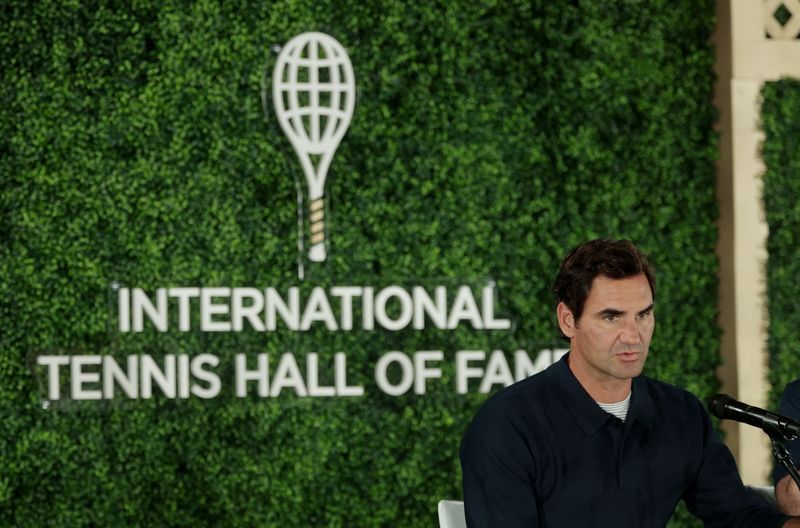
Roger Federer's induction into the International Tennis Hall of Fame represents a landmark moment that extends far beyond the recognition of his unparalleled on-court achievements. At 45, the legendary Swiss player used the occasion to articulate a vision of legacy that transcends the trophy cabinets and record books that traditionally define greatness in professional sport. Speaking at a news conference in Newport ahead of Saturday's ceremony, where he joins broadcaster Mary Carillo as this year's inductees, Federer presented a thoughtful examination of what it means to leave an indelible mark on a sport beyond winning.
Federer's competitive career reads like a masterclass in dominance. His eight Wimbledon titles stand as a men's record, complemented by six Australian Open victories, five U.S. Open crowns, and the 2009 French Open that completed his career Grand Slam. Beyond singles, he captured Olympic doubles gold alongside Stan Wawrinka in 2008 and played a pivotal role in Switzerland's 2014 Davis Cup triumph. The numbers underscore an extraordinary tenure: 103 ATP Tour titles accumulated across two decades, 310 weeks spent atop the world rankings, and a retirement in 2022 that followed a glittering career spanning nearly a quarter-century.
Yet Federer made clear that he views his contribution through a broader lens than these individual accomplishments. During his reflections, he articulated a conviction that his influence should be evaluated through the prism of systemic improvements he helped facilitate within professional tennis. Specifically, he pointed to tangible enhancements in prize distribution mechanisms that have benefited not merely Grand Slam champions but players competing in early-round matches, fundamentally altering the economic viability of a professional career in tennis.
The financial transformation of professional tennis carries particular significance for emerging markets and developing nations seeking to cultivate world-class talent. Malaysia and Southeast Asia have periodically produced promising tennis prospects, and the improved earning potential at lower rungs of professional competition creates genuine pathways for regional players to sustain careers without dependence on sponsorships or family wealth alone. When Federer noted that "way more players can make a living," he was acknowledging a structural shift that democratises opportunity within the sport, potentially enabling more diverse geographic participation at elite levels.
Beyond prize money, Federer highlighted his involvement in conversations with ATP leadership, Grand Slam administrators, and player councils regarding comprehensive improvements to tournament infrastructure and player welfare. These discussions touched on evolving medical facilities, enhanced media accommodations, stadium modernisation, and working conditions for support staff. Such interventions represent the unglamorous institutional work that shapes professional sport's evolution, often invisible to casual observers fixated on tournament outcomes.
Federer's willingness to engage in these governance conversations reflects a philosophical stance toward celebrity athletes' responsibilities that remains relatively uncommon at the highest echelons of sport. Rather than retreating into retirement and enjoying accumulated wealth, he positioned his influence as a resource to be deployed for the sport's collective benefit. This approach offers a template for how retired athletes with substantial credibility might contribute meaningfully to their sports' development.
The psychological dimension of navigating superstardom also emerged in Federer's reflections. He acknowledged that elite athletic careers generate intense external scrutiny and perpetual judgment based narrowly on competitive outcomes. He described this accumulated commentary as "one big storm sometimes in your brain," a vivid characterisation of how relentless evaluation and expectation can erode the intrinsic enjoyment that drew individuals to sport initially. His assertion that he maintained happiness "for the most part" throughout his career suggests a conscious mental discipline required to sustain perspective amid the pressures accompanying sustained excellence.
Federer's observations about channelling early success rather than resisting external expectations offer psychological insights relevant to aspiring athletes across the region. His embrace of pressure as a motivating force rather than an obstacle—his assertion that he "liked being on Centre Court" and deliberately positioned himself as someone who thrived in high-stakes environments—represents a particular psychological orientation toward competition that cannot necessarily be taught but can be recognised and nurtured in developing players.
Looking forward, Federer indicated openness to various post-retirement engagements with tennis, including potential roles as a Laver Cup captain, mentor to emerging players, or commentator. His commitment to attending several events annually ensures his continued connection to the professional circuit's evolution. This deliberate maintenance of involvement reflects his acknowledgment that retirement need not mean disconnection from one's life's passion.
For Malaysian and Southeast Asian tennis stakeholders, Federer's emphasis on systematic improvement and infrastructure development rather than individual heroics carries practical implications. Regional tennis federations and tournament organisers might examine how they can replicate the institutional advancements Federer championed—improved medical support, better facilities, more equitable prize distribution—as means of attracting and retaining talent at developmental stages.
Federer's Hall of Fame moment ultimately illuminates a particular understanding of sporting legacy. While his Grand Slam tally and ranking records remain objectively extraordinary, his willingness to measure his career through contributions to institutional progress and systemic improvement suggests that greatness encompasses dimensions beyond statistical dominance. For a region building its sporting infrastructure and talent development systems, such a holistic conception of athletic contribution offers a valuable philosophical framework alongside the inspiration derived from individual excellence.

