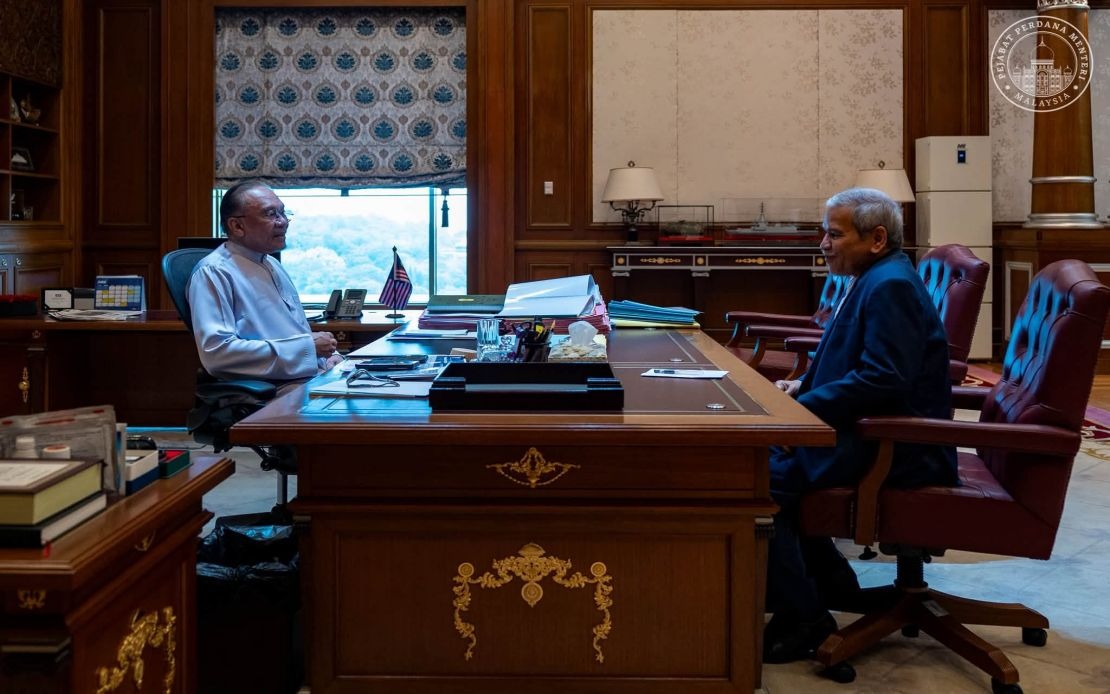
Prime Minister Datuk Seri Anwar Ibrahim has stressed the critical need for sustained institutional development at the Federal Land Development Authority (FELDA), positioning the organization as essential to raising living standards among settler communities and their dependents across Malaysia. During a recent courtesy meeting with incoming FELDA chairman Tan Sri Ahmad Badri Mohd Zahir at Putrajaya, Anwar articulated a comprehensive vision that encompasses both immediate welfare priorities and longer-term organizational resilience.
The timing of this emphasis carries particular significance given broader economic uncertainties affecting rural constituencies. Anwar, who concurrently holds the Finance Ministry portfolio, framed FELDA's mission within a dual mandate: protecting current settler livelihoods while simultaneously enhancing the authority's capacity to generate sustainable income streams that benefit future generations. This balancing act reflects the government's recognition that legacy institutions like FELDA face mounting pressures to modernize operations without abandoning their foundational social purpose.
A central concern highlighted in Anwar's remarks involves addressing the distinctive challenges confronting younger-generation settlers who have inherited land parcels or recently entered the FELDA scheme. These cohorts often possess different educational backgrounds and entrepreneurial aspirations compared to the original settler population, creating tension between traditional agricultural models and contemporary market demands. The Prime Minister's explicit reference to "younger generation" issues signals awareness that FELDA must adapt its support mechanisms—from extension services to financing options—to remain relevant to this demographic shift.
Economic competitiveness emerged as an equally weighted priority in Anwar's message. Rather than viewing FELDA purely as a social welfare conduit, the government appears committed to transforming it into an economically viable entity capable of competing within modernized agricultural markets. This approach acknowledges that indefinite subsidization proves unsustainable, necessitating structural improvements in productivity, value-chain integration, and market access. For settlers, this translates into tangible investments in technology adoption, skills training, and direct buyer linkages that can substantially improve returns per hectare.
Tan Sri Ahmad Badri's appointment, effective July 15, represents a leadership transition aimed at executing this revitalization agenda. His predecessor, Datuk Seri Ahmad Shabery Cheek, completed a tenure concluding June 30, marking an opportune moment for strategic recalibration. The new chairman inherits an organization grappling with complex issues: aging settler populations, environmental sustainability concerns, land fragmentation, and competition from larger-scale commercial agricultural operations. Successfully navigating these challenges will require both political backing and innovative operational approaches.
Anwar's invocation of the MADANI Government's commitment to "full support" for FELDA carries budgetary implications that remain to be detailed. Rural constituencies, which comprise FELDA's core constituency, represent significant voting blocs across multiple states including Pahang, Johor, and Perak. The political economy of FELDA thus intersects with broader electoral considerations, making government backing as much a matter of political sustainability as institutional necessity. However, genuine strengthening requires more than rhetorical endorsements; it demands targeted resource allocation and policy reforms that address structural bottlenecks.
For Malaysian settlers and their families, Anwar's emphasis on institutional strengthening potentially signifies several practical developments. Enhanced extension services could facilitate crop diversification and climate adaptation strategies increasingly crucial amid weather volatility. Improved financing mechanisms might enable settlers to invest in mechanization or value-added processing facilities. Strengthened supply-chain coordination could reduce transaction costs and enhance profit margins. Yet translating governmental commitment into ground-level improvements depends substantially on administrative capacity and implementation fidelity within FELDA itself.
The Malaysian context positions FELDA within a broader framework of rural development and inclusive growth. As the nation pursues middle-income status and technological advancement, rural agricultural communities risk marginalization unless proactive measures ensure they benefit from economic transformation. FELDA's approximately 112,000 settler families represent a significant portion of Malaysia's rural population, making the organization's trajectory consequential for national inequality metrics and social cohesion. Strategic investment in FELDA strengthening thus carries implications extending beyond the settler community to encompass broader development equity considerations.
Regional comparisons offer instructive perspective. Other Southeast Asian nations have experimented with various models for supporting smallholder farmers and land-reform beneficiaries, with mixed results. FELDA's institutional longevity and established infrastructure provide advantages that emerging programs elsewhere may lack, yet also create institutional inertia that resists necessary modernization. Successfully balancing preservation of FELDA's social mission with introduction of contemporary management practices represents the core challenge confronting Ahmad Badri's leadership.
The government's framing of FELDA as an institution serving "the people" reflects recognition that settler families constitute stakeholder communities deserving sustained policy attention. Moving forward, implementation mechanisms—whether through revised credit facilities, technology transfer initiatives, or market-access programs—will ultimately determine whether Anwar's emphasis on strengthening translates into measurable improvements in settler incomes and quality of life. The coming months will reveal whether Ahmad Badri's appointment inaugurates substantive reform or constitutes primarily rhetorical repositioning.

