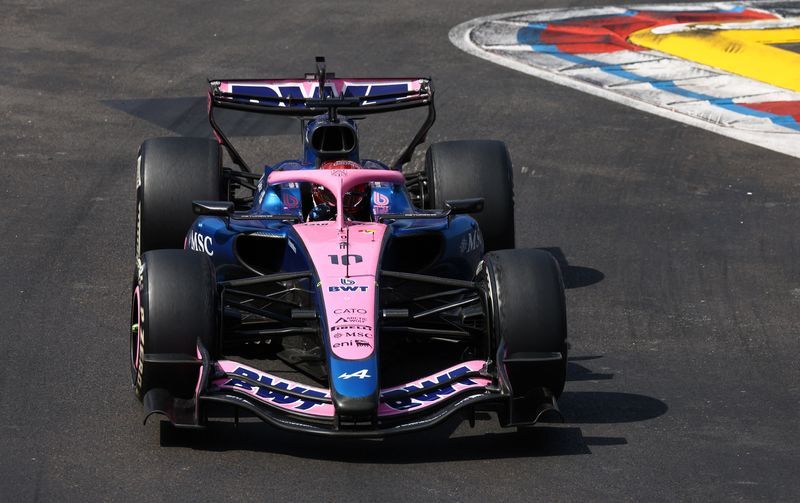
The International Court of Appeal for Formula One convenes in Paris this week to render a final verdict on one of motorsport's most contentious recent rulings: whether Alpine driver Pierre Gasly legitimately finished third at the Monaco Grand Prix on June 7 or whether the podium should belong to Red Bull's Isack Hadjar. The decision, coming more than two months after the Mediterranean classic, will settle a dispute that has exposed vulnerabilities in Formula One's penalty administration and raised uncomfortable questions about competitive fairness across the grid.
Gasly's podium position became contested when race stewards applied two five-second penalties for pit-lane speeding violations after the chequered flag, dropping the French driver to seventh and elevating Hadjar to the podium. The immediate sanction appeared definitive, with Hadjar celebrating on the top step with traditional champagne spraying. However, Alpine quickly moved to challenge the ruling, presenting evidence that stewards had made a timekeeping error in measuring Gasly's pit-lane speed. The team's technical documentation proved persuasive enough that just five days later, on June 12, the penalties were rescinded and the trophy returned to Gasly in an unusual reversal that left Hadjar empty-handed.
This reversal, however, triggered deeper concerns within the paddock that extend well beyond Gasly's individual result. McLaren and Red Bull both filed appeals to the international court on June 16, introducing a second layer of complexity to the matter. Their challenge was not merely about restoring Hadjar's podium but rather addressing a broader systemic issue revealed by the sequence of events. The appeal highlights how penalty administration and post-race decision-making procedures can disadvantage drivers unequally depending on the circumstances and timing of sanctions.
McLaren's grievance centres on Oscar Piastri, who finished fourth on the day but dropped to fifth when Gasly's reinstatement pushed him down the order. Unlike Gasly, Piastri had incurred the identical pit-lane speeding penalty during the race itself, receiving a five-second time penalty that he served immediately by losing track position in the pits. Piastri proceeded through the remainder of the race under the assumption that his penalty was unavoidable and non-negotiable, even though he maintained he had not actually been speeding. The critical distinction between his situation and Gasly's lay in opportunity: Gasly's penalties, applied after the race concluded, could theoretically be removed without affecting his race strategy, whereas Piastri's in-race penalty forced tactical compromises that permanently altered his competitive position and championship points.
The implications for Piastri extended beyond mere finishing positions. Once he dropped in the field following his penalty, his race unfolded differently than it might otherwise have. The ripple effects of serving a penalty during competition—losing DRS activation opportunities, falling into different traffic patterns, adjusting fuel and tire strategies—created consequences that persisted throughout the remaining laps. When Gasly's penalty was later rescinded, Piastri had no mechanism to appeal or recover from a sanction that, under hindsight, may have been incorrectly applied in the first instance. This asymmetry formed the crux of McLaren's appeal, with the Woking-based team arguing that the process itself compromised sporting integrity.
Andrea Stella, McLaren's team principal, articulated the team's position with particular emphasis on both philosophical and material grounds during the Dutch Grand Prix weekend, which McLaren won through Lando Norris. Stella contended that the post-race reversal of Gasly's penalty established a problematic precedent that questioned whether penalties could be reliably challenged after the event, undermining confidence in the stewards' initial judgments. More pressingly, he highlighted that McLaren had suffered tangible championship damage from serving a non-appealable penalty that may have been erroneous, a consequence Gasly was spared through Alpine's successful appeal and the timing of his sanction.
Stella emphasised that McLaren's appeal operated on two distinct levels: a matter of principle regarding Formula One's broader competitive structure and integrity, and a matter of direct consequence affecting McLaren's championship standing. The team boss argued that if Piastri had not served that penalty or if it could have been rescinded as Gasly's was, the Australian driver's final position and championship points would differ materially. In a season where points accumulate over twenty-four races and championship margins often prove razor-thin, even a single lost position carries quantifiable impact on the year-long competition.
Red Bull's involvement in the appeal, though less vocally detailed in public statements, reflects similar concerns about procedural consistency and the implications for teams competing in tight championship battles. Both McLaren and Red Bull recognised that the Monaco saga had exposed a gap in the regulatory framework: penalties applied during the race are effectively final and cannot be appealed once race control certifies the results, whereas post-race penalties can be challenged through established appeals procedures. This creates an inequitable situation where the timing of a steward's decision determines whether teams possess recourse.
The FIA has scheduled the hearing at its Paris headquarters without public or media attendance, citing confidentiality protocols. This closed-door approach is standard for international court proceedings in Formula One, reflecting the governance model established for technical and sporting disputes. The tribunal will weigh not merely the technical evidence regarding Gasly's pit-lane speed but also the procedural questions raised by McLaren and Red Bull about consistency, fairness, and the competitive implications of post-race penalty reversals.
For Malaysian and Southeast Asian motorsport enthusiasts following Formula One, this appeal illuminates how contemporary racing operates under complex regulatory structures that can yield counterintuitive outcomes. The saga demonstrates that winning or podium positions are not always final, that technical appeal procedures exist for legitimate reasons, yet that these very procedures can create new complications. The court's decision will likely establish guidance for how future penalty disputes are handled, potentially influencing how stewards apply sanctions knowing that post-race reversals remain possible if new evidence emerges or procedural errors are identified.
The resolution will be published as soon as the court concludes its deliberations, finally providing certainty to a matter that has lingered through multiple Formula One weekends. Whether Gasly retains his podium position or whether it reverts to Hadjar, the case will have already reshaped how stakeholders view penalty administration and appeals processes. For competitors, team principals, and the governing FIA, the court's reasoning and findings will establish parameters for interpreting sporting regulations in ways that extend well beyond this single race.

