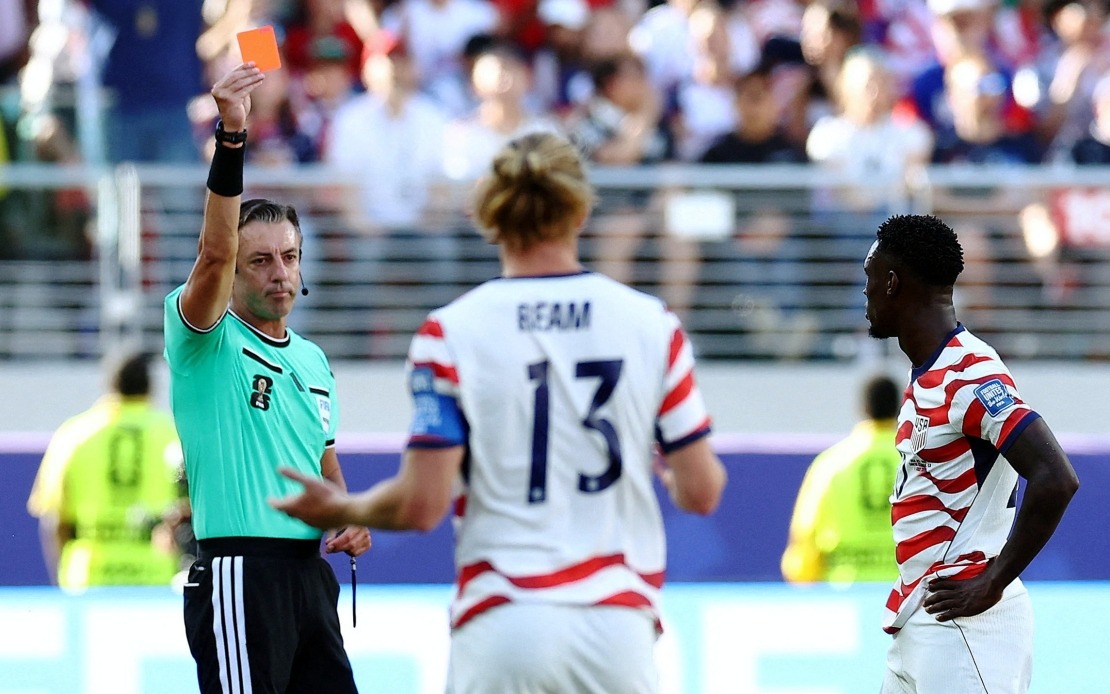
FIFA's decision to suspend enforcement of a suspension handed to American striker Folarin Balogun has thrust the sport's disciplinary framework into the spotlight just hours before a high-stakes World Cup clash between the United States and Belgium. The world football governing body announced on Sunday that Balogun would be eligible to participate in Monday's round-of-16 encounter in Seattle, despite receiving a red card in his nation's earlier group-stage victory. The ruling immediately provoked Belgium's football association to declare its formal displeasure and signal its intention to explore legal avenues to challenge the determination.
Balogun's dismissal stemmed from an incident during the United States' 2-0 triumph over Bosnia and Herzegovina on July 1, when the striker stamped on opponent Tarik Muharemovic. FIFA's Disciplinary Committee initially found him culpable under Articles 14 and 66 of its code and issued a standard one-match sanction. However, invoking Article 27 of the same regulatory instrument, the committee chose to suspend the implementation of that ban for a probationary period lasting twelve months. This technical manoeuvre effectively permits the player to take the field against Belgium while maintaining the underlying suspension as a dormant penalty that could be activated should he commit another similar transgression during the probationary window.
For the United States, the reprieve carries substantial significance. Balogun has emerged as the team's leading goal contributor at the tournament with three strikes, making his continued availability a tactical asset as the Americans pursue their first quarterfinal appearance since 2002. The match against Belgium represents a genuine pathway toward advancing further in the competition, and Balogun's presence materially enhances the team's attacking capacity against a traditionally formidable opponent.
Belgium's Royal Football Association responded swiftly with an official statement expressing "astonishment" at FIFA's determination. The federation's objection centres on what it characterises as a departure from established and repeatedly affirmed protocols governing red-card suspensions at World Cup tournaments. According to Belgian officials, Article 66.4 of FIFA's Disciplinary Code unambiguously stipulates that any player dismissed by direct red card must be automatically suspended for their team's subsequent match. The federation contends that this automatic suspension provision has been consistently applied throughout the current World Cup competition, making Balogun's exemption an anomalous exception without precedent in this tournament.
The Belgian challenge gains further weight from its citation of Article 10.5 of the FIFA World Cup 2026 Competition Regulations, which mandates automatic suspension for players receiving either a direct red or second yellow card, with additional punishments remaining permissible. Belgium's federation notes that this automatic suspension requirement was specifically reaffirmed in FIFA World Cup 2026 Circular No. 16, distributed to all participating member associations in May. Throughout the tournament, official FIFA match coordination meetings and sanctioned workshops have repeatedly emphasised and reiterated this rule to team delegations.
The invocation of Article 27 by FIFA's Disciplinary Committee appears to have caught Belgium off-guard, suggesting that the committee interpreted its discretionary power to suspend enforcement of sanctions as superseding the automatic suspension mechanism enshrined in Article 66.4. This interpretative approach potentially opens a significant gap in the disciplinary framework, as the probationary suspension mechanism could theoretically be applied to other cases, undermining the consistency that Belgium identifies as fundamental to maintaining competitive integrity across different matches and tournaments.
Belgium's formal response indicates the federation is examining all feasible remedies available to it. Such avenues might include formal appeals to FIFA's appeals body or requests for emergency intervention by relevant World Cup governing committees. The federation has framed its concern not merely as a matter of self-interest but as a broader issue of fair play principles and the need to maintain uniform application of disciplinary rules across all participating nations. This framing resonates with broader concerns about consistency and transparency in international sporting competition.
For football governance in Southeast Asia and globally, the episode underscores persistent tensions between codified rules and the discretionary authority granted to disciplinary bodies. The Malaysian football community and other regional leagues observe how international football's governing bodies reconcile competing provisions within their regulatory frameworks and apply those standards when high-stakes matches are involved. The precedent established here may influence how future disciplinary decisions are crafted, particularly regarding the interplay between automatic suspension clauses and discretionary suspension mechanisms.
FIFA's statement makes clear that should Balogun commit a further infraction of similar character and severity during his twelve-month probationary period, the original suspension will take automatic effect alongside any additional sanctions imposed for the new offence. This conditional framework essentially transforms the punishment into a suspended sentence, restoring the ban only upon proof of recidivism. However, the logic underlying this approach—that an automatic rule governing red cards might be suspended through reference to a different article addressing probationary measures—remains contentious and inadequately explained by FIFA in its public communications.
The timing of the decision inevitably raises questions about whether the competitive significance of the match and the presence of a host nation influenced FIFA's interpretative approach. The United States, as co-host nation facing potential elimination, carries both organisational prestige and commercial implications for the tournament. Belgium, meanwhile, arrives as a traditional powerhouse without the organisational advantages of hosting, but with substantial expectations rooted in its strong recent tournament pedigree. Whether FIFA consciously or unconsciously weighted these factors in selecting which regulatory provisions to emphasise remains speculative but forms an inevitable component of how such decisions are perceived.
As the Monday encounter approaches, all attention will focus on Balogun's participation and performance. A strong showing could vindicate FIFA's decision in the court of immediate opinion, while any involvement in controversial play might validate Belgium's concerns about consistency and precedent. Regardless of the match outcome, the episode demonstrates that major international football competitions remain susceptible to interpretative disputes that pit one regulatory provision against another, with real consequences for national teams and their aspirations.

