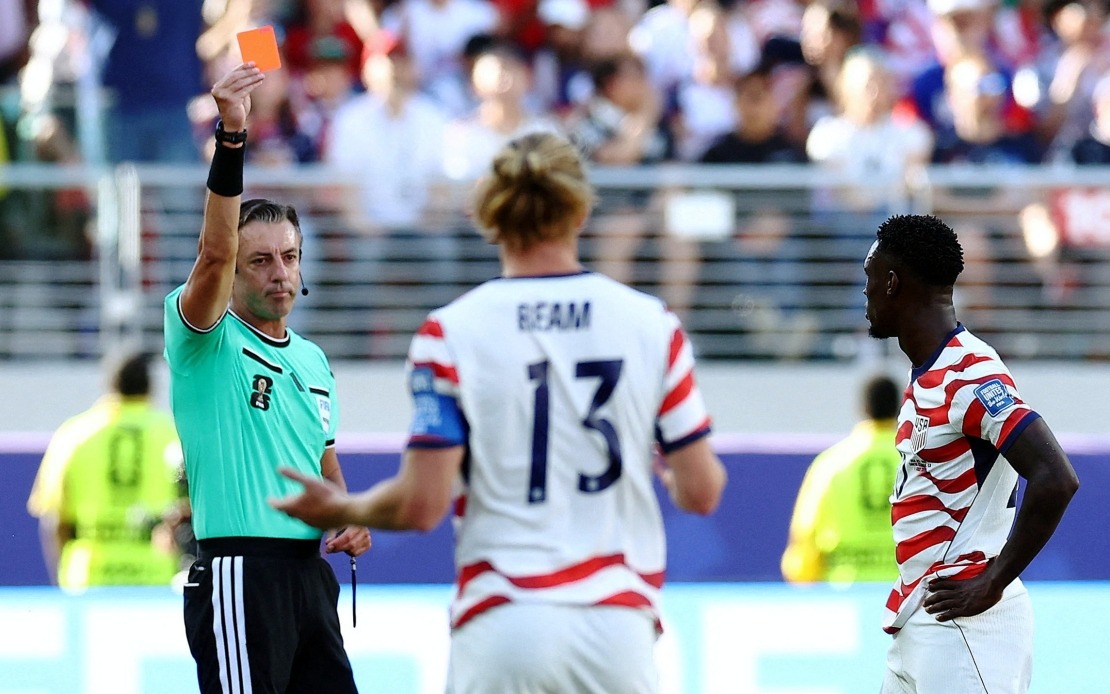
FIFA has rallied behind Brazilian referee Raphael Claus following public censure from United States President Donald Trump over a controversial dismissal during the World Cup. The dispute centres on a red card that Claus issued to American striker Folarin Balogun during a last-32 encounter against Bosnia and Herzegovina, a decision that ignited significant political commentary from the White House.
Trump's criticism emerged after the initial red card was mysteriously overturned on Sunday, enabling Balogun to participate in the subsequent round-of-16 fixture against Belgium, which the US subsequently lost 4-1 in Seattle on Monday. The reversal of the sending-off raised eyebrows across the football world and prompted direct intervention from the highest levels of American political leadership. The sequence of events—the card's issuance, its contestation, and ultimately its suspension—created an unusual intersection between international football governance and executive political pressure.
In a formal statement issued through official channels, FIFA described Claus as "one of the world's leading professional referees and a valued member of Team One," referring to the designated group of match officials assigned to the tournament. The organisation emphasised that throughout his career, Claus has "consistently demonstrated the highest standards of professionalism and integrity," language designed to reinforce institutional confidence in the official's decision-making abilities and character. This public backing represents more than routine support; it signals FIFA's determination to insulate its referees from external political interference.
Pierluigi Collina, who holds the position of FIFA's chief referee and oversees all match officials at major tournaments, provided additional reassurance about Claus's standing within the organisation. Collina noted that Claus had previously refereed at the 2022 World Cup in Qatar, establishing him as an experienced figure in FIFA's referee hierarchy rather than an untested newcomer. "He is an experienced and highly respected referee and we maintain full confidence in him as a trusted match official," Collina stated, underscoring the stability of FIFA's position on the matter. This continuity across tournaments reinforces the notion that Claus has weathered the scrutiny and retained his credibility among football's governing authorities.
Interestingly, speculation has emerged that Claus could potentially be selected to officiate the final match of the tournament, a recognition typically reserved for referees of exceptional standing. Since Brazil exited the competition at the last-16 stage, there is no perceived conflict of interest that would ordinarily prevent a Brazilian referee from securing such a high-profile assignment. The possibility of Claus reaching football's grandest stage would effectively serve as a definitive statement from FIFA regarding its confidence in his abilities and the legitimacy of his controversial decision.
FIFA President Gianni Infantino took a more measured approach when addressing the controversy. Rather than explicitly defending Claus by name, Infantino offered a broader defence of the officiating standard across the tournament, published on Instagram to reach a wider audience. The Swiss executive noted that the World Cup 2026 had achieved substantial success, attributing this partly to the calibre of match officials selected through FIFA's rigorous vetting process. His comments emphasised that referees are chosen based on demonstrated skills, consistency, and sustained performance over extended periods, suggesting that selections are merit-based rather than arbitrary or politically influenced.
The broader context here involves Infantino's prior personal communication with Trump regarding the Balogun red card decision. This direct engagement at the presidential level marked an unprecedented moment of political pressure on FIFA's administrative machinery. While Infantino did not confirm that his conversation with Trump influenced any decision to overturn the card, the timing and the public nature of subsequent reversals have fuelled speculation about the interplay between political pressure and institutional action. Infantino's subsequent Instagram posts appear designed to restore institutional confidence in the neutrality and integrity of FIFA's refereeing processes.
Infantino's message also struck a philosophical note about the essential role referees play in football governance. "Once more, I reiterate that we must respect the referees and respect the rules that govern our game," he wrote, framing referee respect as fundamental to the sport's functioning. This rhetorical pivot transforms the discussion from a specific controversial decision into a broader principle about maintaining the integrity of competitive sport. By elevating the discourse beyond the Balogun incident, FIFA attempts to position Trump's criticism as an attack on the principles underlying professional football rather than a reasonable questioning of a single decision.
For Malaysian and Southeast Asian observers, this episode illustrates how international sports governance intersects with geopolitical power dynamics. The willingness of a sitting US President to publicly question a referee's decision—and potentially influence its reversal—demonstrates how political influence can penetrate the supposedly neutral domain of sport. The response from FIFA, balancing public confidence in its officials with apparent deference to American political pressure, raises questions about whether international sports organisations can maintain genuine independence when dealing with powerful nations. This case study will likely inform how Asian football associations approach decision-making processes and their relationship with government entities, particularly as the region hosts increasingly significant football events.

