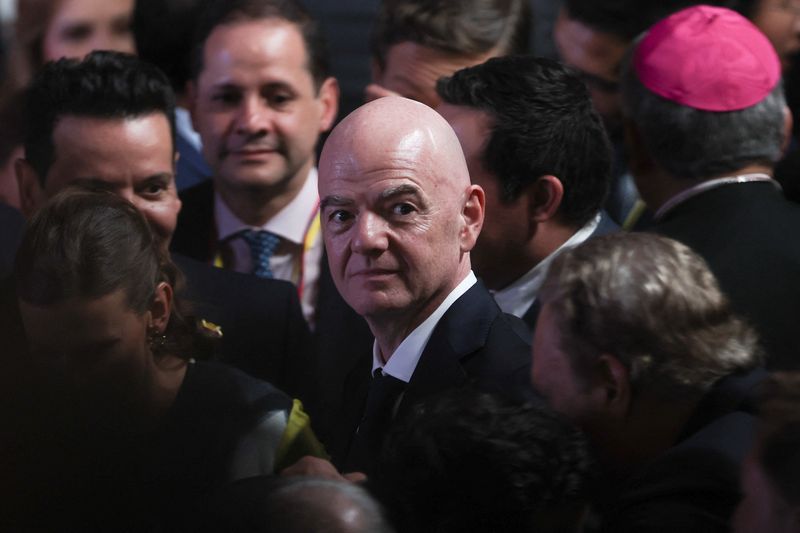
FIFA has issued a pointed warning against what the organisation describes as a "concerted and ongoing effort" to destabilise President Gianni Infantino's leadership, insisting that any legitimate challenges to his authority must proceed through the governing body's established democratic frameworks and constitutional procedures. The statement, released on Saturday, represents an escalation in FIFA's increasingly defensive posture as the international football body grapples with its deepest institutional crisis in recent years.
The crisis stems from the spectacular collapse of Infantino's ambitious proposal to generate approximately $4.2 billion in revenue by selling stakes in the commercial rights to the World Cup and other major tournaments under FIFA's control. The proposal, which would have significantly restructured how FIFA monetises its flagship competitions, encountered fierce resistance from multiple quarters within world football's power structure, triggering widespread demands for the president's resignation and prompting an emergency leadership meeting in Morocco this week.
The controversy has exposed deep fractures within global football's governance structures. UEFA, which represents Europe's football confederations, has publicly declared it no longer holds confidence in Infantino's leadership. This position carries particular weight given UEFA's status as one of FIFA's most influential regional confederations and its substantial contributions to FIFA's revenue streams. Norwegian Football Federation President Lise Klaveness joined the chorus of critics on Friday, explicitly calling for Infantino's resignation and arguing that he no longer possesses the institutional credibility necessary to effectively govern a global organisation.
Yet despite the vocal opposition from Europe's football establishment, Infantino has retained substantial backing among FIFA's broader membership base. The Confederation of African Football unanimously reaffirmed support for the president on Thursday, demonstrating the considerable support Infantino maintains across Africa's substantial voting bloc within FIFA. South America's CONMEBOL confederation similarly rejected any attempts to remove Infantino through mechanisms other than a formal vote involving all FIFA member associations, effectively resisting efforts to engineer his removal through procedural means rather than democratic election.
Mexico's football federation adds another layer of complexity to the political dynamics, having declared its backing for Infantino despite its regional confederation CONCACAF having called for comprehensive accountability regarding the president's stewardship. The Mexican federation's statement emphasised that any institutional processes concerning FIFA's leadership must operate strictly within FIFA's constitutional framework, rejecting extra-institutional challenges to established procedures.
FIFA's Saturday statement conspicuously refrained from identifying precisely which parties or organisations the governing body believes are orchestrating efforts to undermine Infantino, nor did it specify which particular allegations or media reports it considered misleading or unfounded. However, the timing of the statement suggests a direct response to recent reporting by The Daily Telegraph concerning payments UEFA made to a former employee during Infantino's tenure as the European confederation's general secretary—allegations which Infantino has categorically denied and which FIFA has dismissed as baseless.
The FIFA statement employed notably forceful language in rejecting what it characterised as "unsubstantiated assertions and demonstrably false claims" circulating about the organisation and its president. The governing body committed to challenging inaccurate or misleading reporting "directly and vigorously," signalling an aggressive posture toward media scrutiny and institutional criticism. This defensive stance reflects FIFA's broader strategy of framing opposition to Infantino as procedurally illegitimate or factually unfounded rather than substantively addressing underlying concerns about his governance or the merits of his policy proposals.
Following the emergency Morocco meeting on Wednesday, FIFA issued a formal apology to its 211 member associations for mishandling the commercial rights proposal, while simultaneously reaffirming that its leadership structures maintain full confidence in Infantino. This simultaneous acknowledgment of institutional failure and reassertion of presidential support creates a peculiar tension—admitting significant error in execution while insisting the architect of that error retains the organisation's complete backing.
The immediate political question concerns Infantino's bid for a fourth consecutive term as FIFA president at the organisation's Congress scheduled for March in Morocco. Currently, no clear alternative candidate has emerged to challenge Infantino's re-election, despite mounting institutional criticism. This absence of a viable challenger substantially strengthens Infantino's political position, as dissenting voices lack a focal point around which to coalesce their opposition, effectively rendering rhetorical criticism structurally ineffective absent a concrete alternative.
For Malaysian and Southeast Asian observers, this crisis carries broader implications regarding institutional governance within global sports bodies and the extent to which regional confederations can exercise meaningful influence over FIFA's direction. The demonstrated unity among African and South American confederations in supporting Infantino, contrasted with European skepticism, suggests that FIFA's centre of political gravity has fundamentally shifted away from Europe toward the Global South—a development with consequences for how FIFA's revenue is distributed and how tournament hosting decisions are made.
The coming months will prove critical in determining whether Infantino consolidates control or whether opposition coalesces into a meaningful challenge. The failure of the commercial rights proposal reveals vulnerability in his policy agenda, yet his retained backing among the majority of FIFA's membership suggests his political foundation remains substantially intact. The tension between procedural legitimacy and substantive criticism of his leadership will likely define FIFA's institutional politics through the March Congress and beyond.

