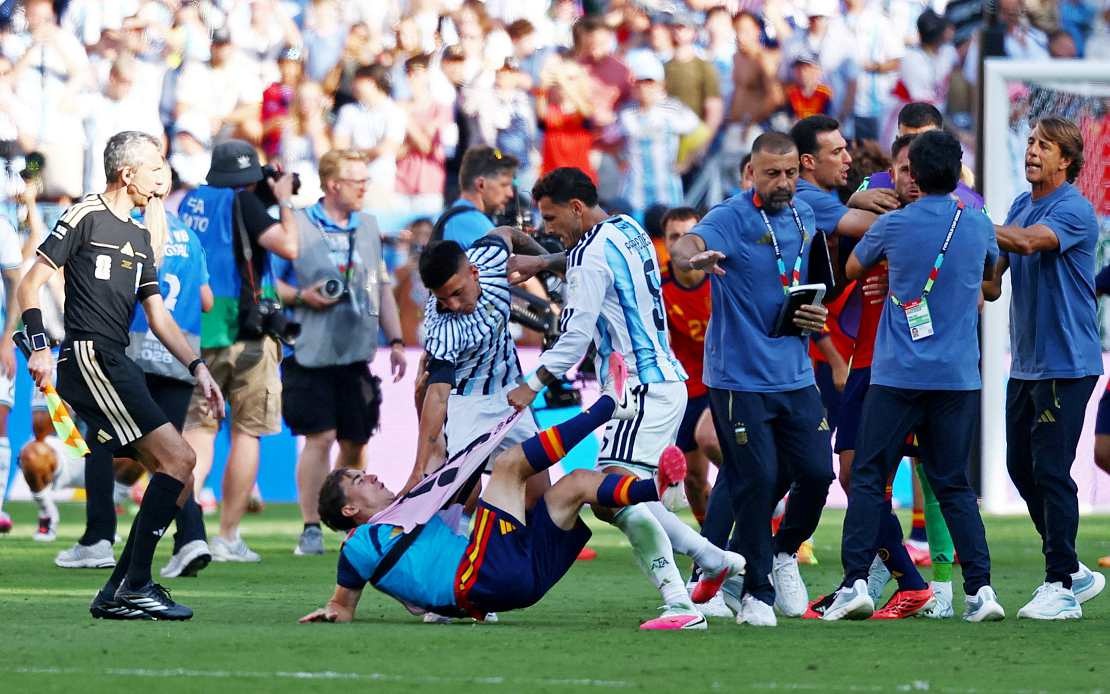
FIFA has initiated a formal investigation into potential disciplinary breaches committed by Argentina during and after the World Cup final against Spain, marking another chapter in a tournament that has seen intense scrutiny of player conduct and compliance with international football regulations. The decision to appoint a Disciplinary and Ethics Prosecutor follows a comprehensive review of match reports submitted by tournament officials, signalling the world football body's commitment to maintaining standards of on-field behaviour across its flagship competition.
The flashpoint incident occurred immediately after the final whistle in New Jersey, when Argentina midfielder Leandro Paredes allegedly threw punches at members of the Spain team who were celebrating their victory on the pitch. This confrontation, captured by multiple cameras and witnessed by thousands of spectators, became the focal point of FIFA's formal review process and represents a significant moment of player discipline at the highest level of international football. The incident has prompted questions about whether FIFA will apply consistent enforcement of its regulations across different nations and playing styles.
Argentina's physical approach throughout the tournament had already drawn considerable attention from match officials and football observers. During their semi-final victory over England, the South American side faced repeated criticism for their robust tackling and aggressive play, culminating in midfielder Enzo Fernandez's dismissal for accumulating two separate yellow cards. This pattern of behaviour raised broader questions about whether Argentina's tactics reflected disciplinary lapses or simply a different interpretation of how the game should be contested at international level.
FIFA's formal statement outlining the investigation referenced Article 36 of the FIFA Disciplinary Code, which governs the appointment of prosecutors to examine potential rule violations. The statement indicated that additional information would be released only after the prosecutor completes their detailed examination and submits findings for committee review. This measured approach contrasts with some observers' expectations of more immediate or transparent communication regarding the nature and scope of potential violations being investigated.
Beyond the physical altercations on the pitch, unresolved questions surround whether FIFA is also investigating Argentina's use of political messaging during their England match victory. Following that semi-final triumph, Argentine players displayed a banner asserting their nation's claim to sovereignty over the Falkland Islands, an action that appeared to breach Article 34.3 of the tournament regulations governing political expression during competition. The fact that FIFA has not publicly confirmed whether this banner incident falls within the scope of the current investigation creates ambiguity about the organisation's enforcement priorities.
Historical precedent provides mixed signals about how FIFA typically handles such violations. When Argentina engaged in an identical banner demonstration during a 2014 friendly match against Slovenia, the Argentine Football Association faced a financial penalty without more severe consequences. However, UEFA has demonstrated a notably stricter approach to comparable offences, recently imposing one-match bans on Spain players Rodri and Alvaro Morata after they engaged in chanting regarding Spain's territorial claims to Gibraltar following their Euro 2024 victory. This disparity between FIFA and UEFA enforcement suggests inconsistent application of discipline across different continental bodies.
The investigation also reflects FIFA's broader historical intolerance toward political gestures and expressions of sovereignty claims within competitive fixtures. The organisation previously took a firm stance against the English Football Association regarding captain Harry Kane's intention to wear a 'OneLove' rainbow-coloured armband during the 2022 World Cup in Qatar, explicitly warning that he would face sporting sanctions beginning with a yellow card. That incident illustrated FIFA's willingness to enforce strict compliance with regulations governing player expression, even when such expression addressed human rights concerns.
For Malaysian and Southeast Asian observers, this investigation underscores the complexity of maintaining unified global standards in international sport. The region has witnessed similar tensions between national sovereignty claims and international sporting regulations, making the FIFA process a relevant case study in how global sporting bodies navigate competing national interests. The investigation also highlights the challenges of applying consistent disciplinary standards across diverse playing styles and cultural approaches to competitive football.
The lack of public timeline for the prosecutor's investigation creates uncertainty about when conclusions might be announced. This opacity contrasts with modern expectations for transparent governance and raises questions about whether delays in disciplinary processes might influence the perceived fairness of outcomes. For Argentina, the uncertainty extends to potential consequences, which could range from individual player suspensions to team fines or broader sanctions affecting future competition eligibility.
The broader context of this investigation reflects evolving expectations around player conduct in modern professional football. As the sport becomes increasingly global and media scrutiny intensifies, governing bodies face mounting pressure to maintain disciplinary consistency while respecting legitimate sporting competition. The Argentina case will likely influence how FIFA approaches similar situations in future tournaments, establishing precedent for what constitutes acceptable physical contact and post-match behaviour at the highest international level.

