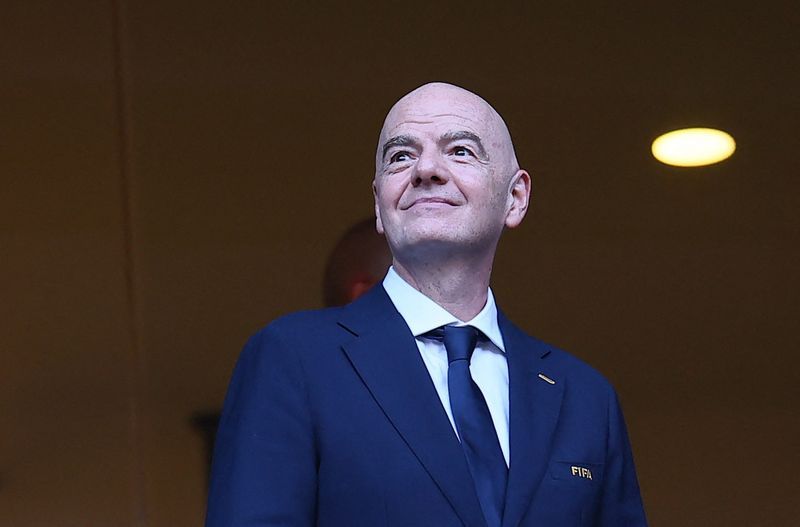
FIFA President Gianni Infantino's grip on power has been severely weakened following the collapse of his audacious plan to monetise the World Cup through private investment, according to reports emerging from the football world's highest offices. The Swiss-Italian administrator, who has led world soccer's governing body since 2016, withdrew his proposal to establish a new commercial entity that would have raised $4.2 billion just days after introducing it, but the damage to his political position appears irreversible. The reverberations from this failed gambit continue to destabilise FIFA's leadership structure, with evidence mounting that regional confederations are actively coordinating efforts to unseat him before the organisation's Congress convenes in Morocco in March 2025.
The shock announcement of Infantino's plan had triggered an extraordinary period of internal conflict within FIFA, catching most stakeholders entirely off guard. The proposal would have marked the first time private investors gained direct ownership stakes in the World Cup commercial rights—a fundamental shift in how the tournament is managed. After three days of what observers describe as unprecedented turmoil in soccer administration, Infantino retreated from the scheme on Friday evening, issuing an apology that acknowledged the divisive nature of his initiative. Yet this tactical withdrawal, rather than stabilising his position, appears to have accelerated the political forces arrayed against him.
The immediate casualties of Infantino's misstep are evident in the formal withdrawal of support from five major European football associations. England's Football Association, along with four other European federations, has publicly announced it will not back Infantino's bid for reelection, effectively removing crucial votes from his coalition. Denmark has gone further, signalling it never intended to support him regardless of circumstances. These defections represent a significant blow to a leader who previously enjoyed broad consensus among Europe's powerful football establishment, traditionally a cornerstone of FIFA leadership legitimacy.
Infantino has managed to retain explicit public backing from a handful of national federations, including those from Morocco, Qatar, Kuwait, Lebanon, and Sri Lanka. However, the numerical reality underscores his predicament: with 211 national associations entitled to vote at Congress, the publicly declared positions on either side currently represent a small fraction of the total voting body. The true measure of his political strength will only become apparent as the March vote approaches, during a seven-month period when alliance-building, negotiation, and potential deal-making will intensify across the football world.
The defection of regional confederations represents perhaps the most ominous signal for Infantino's future. UEFA, which governs European football and represents wealthy, influential associations, issued a strongly worded statement expressing lost confidence in his leadership. CONCACAF, which oversees North and Central American and Caribbean football, delivered similarly harsh criticism. Most significantly, the AFC—Asia's football confederation, historically one of Infantino's more reliable pillars of support—stopped short of outright condemnation but declared the lack of consultation over his plan "totally unacceptable" and called for institutional reform at FIFA. This measured but pointed criticism from Asia suggests that even his traditional power base has eroded.
According to reporting from the Times of London, the three confederations have begun discussing more aggressive strategies to remove Infantino from office, including potentially paralyzing FIFA's decision-making processes and even establishing competing international football competitions if he refuses to step down voluntarily. While such claims remain unverified and the confederations have declined to comment publicly, the mere circulation of such scenarios demonstrates the depth of opposition forming against him. The threat of institutional paralysis carries particular weight given FIFA's dependence on smooth operations for tournament planning and revenue generation.
Infantino faces an immediate tactical threat in the form of an Extraordinary Congress, which could be called if 43 or more FIFA member associations submit a formal written request. Such a session, convened outside the normal schedule, could dramatically accelerate political movements against him and potentially trigger an emergency leadership election. His primary defensive strategy in the coming months will likely focus on preventing this threshold from being crossed, while simultaneously attempting to repair relationships with regional confederations and shore up support among national associations that depend on FIFA's financial distributions.
The underlying political economy of FIFA provides context for understanding both Infantino's initial strength and his current vulnerability. Like his predecessors Joao Havelange and Sepp Blatter, Infantino built his power base by cultivating relationships with less wealthy national associations outside Europe—federations that rely substantially on FIFA funding to maintain their operations. His controversial proposal directly targeted these associations, promising each national federation between $20 million and $40 million in dividends beginning in January 2025. By pitching the scheme to cash-starved football associations rather than consulting with the sport's more established power centres, Infantino employed a classic strategy of appealing to economic self-interest among marginal players.
However, this approach backfired catastrophically when Europe's confederations and established football powers felt blindsided and excluded from the decision-making process. The proposal exposed a fundamental tension in FIFA's political structure: Infantino's coalition of smaller associations depends on FIFA's financial health, yet the organisation's revenue streams and commercial viability depend on decisions made by Europe's wealthy federations and established broadcast partners. By attempting an end-run around traditional power structures, Infantino miscalculated the tolerance of Europe's football establishment for unilateral executive action.
The path to Infantino's potential removal hinges on whether opposition forces can identify a credible alternative candidate capable of simultaneously appealing to both the prosperous European associations and the economically dependent federations of Africa, Asia, and smaller continental confederations. Nominations for the FIFA presidency must be submitted by November 18, providing a window of roughly four months for opposition movements to coalesce around a candidate. Whoever emerges as a challenger will need to address the interests of multiple constituencies that have traditionally competed for influence within FIFA, a balancing act that requires political skill, international credibility, and demonstrated commitment to both development funding and institutional reform.
For Malaysia and the Southeast Asian football community, the unfolding crisis at FIFA carries implications for regional tournament governance, funding priorities, and the distribution of World Cup qualification pathways. The AFC's measured but critical stance suggests that Asian federations will demand greater consultation and transparency in future FIFA decision-making, potentially strengthening the negotiating position of regional confederations relative to the FIFA presidency. Should Infantino be forced from office, his successor's approach to development funding, tournament expansion, and regional representation could significantly affect Southeast Asian football's trajectory over the next decade.

