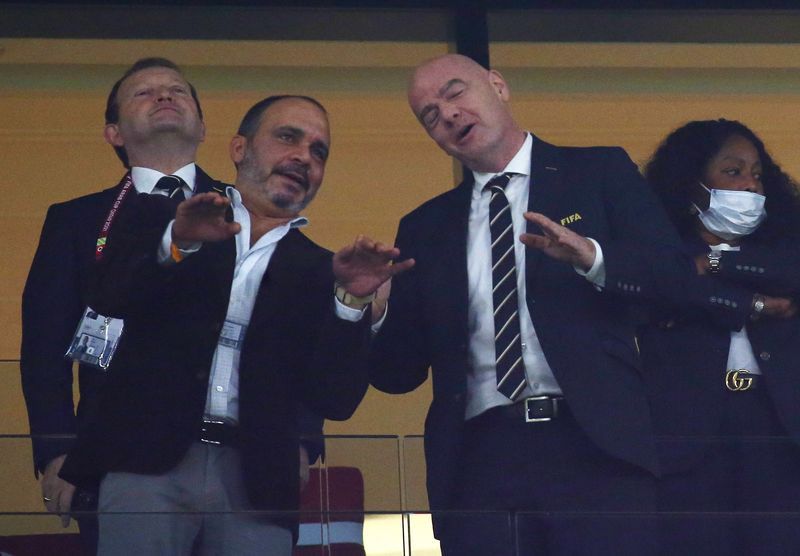
Jordan's national football team and its coaching staff have at last received outstanding prize payments for competing in the 2025 Arab Cup final, according to Prince Ali bin Hussein, the Jordan Football Association's president, who announced the resolution on Thursday. The timing of this development came just two days after Prince Ali made public allegations that FIFA had engaged in what he characterised as blackmail tactics, linking the withholding of funds to expectations of political support for FIFA President Gianni Infantino.
The dispute centres on payments that should have been transferred to Jordan immediately following the team's runner-up finish in the tournament held in Qatar last December. Instead, the Jordan Football Association found itself waiting eight months for compensation that was contractually owed, creating a financial strain on the organisation's operations and raising questions about FIFA's payment practices to participating confederations. Prince Ali's public criticism appears to have prompted swift action from FIFA's administration, which delivered the disputed funds on the morning of his announcement.
Prince Ali's allegations are particularly significant given the broader political context surrounding FIFA's leadership. He claims that during discussions at the World Cup, FIFA representatives verbally conveyed to him that supporting President Infantino "would go a long way to helping our FA out." This assertion suggests a pattern of conditional assistance, where FIFA might prioritise resolving member associations' financial grievances in exchange for endorsement during leadership elections. The accusation reflects growing tensions within world football governance as Infantino faces questions about his direction of the organisation.
The Jordan FA president has been notably critical of Infantino's recent initiatives, particularly the controversial proposal to sell commercial rights to the World Cup tournament. This plan faced considerable pushback from confederations and national associations across multiple continents, forcing the FIFA leadership to retreat from the proposal. Prince Ali was among the prominent voices opposing this initiative, and his emergence as a vocal critic may have contributed to FIFA's sudden decision to resolve the payment dispute.
For Malaysian and Southeast Asian football administrators, this episode illuminates important dynamics within international sports governance. Regional associations often depend on FIFA prize distributions and development funding, and delayed payments can significantly impact operational budgets and player welfare. The suggestion that such funds might be contingent on political alignment rather than purely contractual obligations raises concerns about institutional integrity and the treatment of smaller confederations.
While Prince Ali welcomed the financial resolution, he made clear that receiving the overdue money would not alter his fundamental position regarding FIFA's leadership or his voting intentions. He stated unequivocally that neither his federation nor he personally would endorse President Infantino or cast votes in his favour. This distinction is crucial: Prince Ali is signalling that the payment, however welcome, represents merely a correction of an injustice rather than a concession that changes his assessment of FIFA's leadership problems.
Prince Ali framed the delayed payment as symptomatic of deeper systemic issues within FIFA, which he connected to the organisation's electoral cycles. His observation suggests that financial irregularities and selective assistance are recurring features of FIFA's operations, particularly during periods when leadership decisions are contested. This pattern, he implies, reflects fundamental governance challenges that extend beyond any single dispute with any particular member association.
FIFA's official response has been notably restrained. The organisation acknowledged errors in its abandoned World Cup commercialisation proposal and issued an apology to member associations for the missteps. However, FIFA's leadership reaffirmed its support for President Infantino following a crisis meeting held in Morocco on Wednesday, suggesting internal confidence despite external criticism. The refusal to directly respond to Prince Ali's blackmail allegations leaves those serious charges unaddressed in any formal capacity.
The incident demonstrates the intersection of financial management and political pressure within global sports institutions. For developing football associations with limited financial reserves, FIFA payments represent critical funding streams for player development, coaching infrastructure, and administrative operations. When such payments are delayed without clear explanation, the impact reverberates through the entire ecosystem of national football programmes, potentially affecting competitive development and player welfare across the region.
Prince Ali's willingness to publicly articulate these concerns, despite receiving the delayed funds, suggests a shift toward greater transparency and accountability demands from senior figures within FIFA's membership. His refusal to allow the payment to mollify his criticism establishes a precedent that financial rectification does not substitute for institutional reform. This approach may encourage other federation leaders facing similar issues to speak out rather than remain silent in exchange for financial resolution.
The episode also highlights vulnerabilities in FIFA's institutional design. An organisation's credibility depends partly on the predictability and fairness of its financial dealings with member associations. When payments are delayed without explanation and then suddenly released following public criticism, confidence in the institution's impartiality necessarily erodes. For Southeast Asian confederations, this serves as a reminder to maintain clear documentation of all financial agreements and to pursue transparent communication channels when disbursements fall short of contractual timelines.

