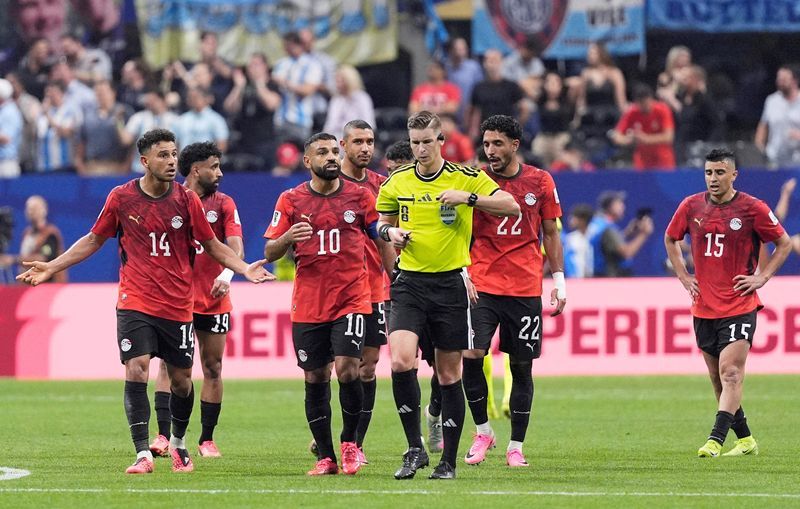
FIFA's head of refereeing, Pierluigi Collina, has moved to quash mounting criticism surrounding the controversial World Cup round-of-16 encounter between Argentina and Egypt, which saw the South American side overturn a two-goal deficit to secure a dramatic stoppage-time triumph through Enzo Fernandez's late strike. In comments released on FIFA's official website on Thursday, Collina rejected suggestions that referees showed favouritism toward either team, emphasising instead that officials discharged their duties with absolute impartiality and without external influence.
The match sparked considerable outcry from Egypt's camp following their elimination from the tournament. Coach Hossam Hassan publicly suggested that officials may have succumbed to pressure to keep Argentina—a tournament favourite—in contention, while the Egyptian Football Association lodged formal complaints highlighting what they characterised as multiple critical errors that fundamentally altered the match's trajectory. The defeat left Egyptian football officials convinced that subjective decision-making had tilted the contest unfairly against their side at crucial junctures.
The focal point of Egypt's grievance centred on the disallowance of Mostafa Zico's second-half goal, which officials determined should not stand following a foul assessment during the build-up play. Egypt contended the infringement was fabricated, claiming Marwan Attia committed no wrongdoing against Argentina defender Lisandro Martinez. Simultaneously, Egyptian officials voiced frustration that a physical challenge involving Mohamed Salah immediately before Argentina's winning goal went unpunished, compounding their sense of injustice.
Collina's response directly addressed these contentions, asserting that video assistant referee technology correctly identified an actual foul by Attia during the attacking sequence preceding Zico's attempt. He articulated FIFA's philosophical stance on the matter, noting that the presence or absence of obviousness does not determine whether a foul has occurred; rather, VAR functions to alert on-field referees to infractions they may have missed during live play. This interpretation underscores FIFA's commitment to technical consistency over subjective notions of visibility or severity.
Regarding the Salah incident, Collina maintained that both the referee and VAR determined the contact between the Egyptian winger and Julian Alvarez represented permissible engagement within normal competitive bounds. He elaborated that while deliberately stepping on an opponent's foot constitutes a foul, a defender who establishes initial contact with the ball before making subsequent normal physical contact does not thereby commit an infraction. This technical distinction, though subtle, proved decisive in determining whether Egypt should have received a penalty opportunity.
Beyond the specific match decisions, Collina issued a broader statement condemning unfounded allegations against referee integrity. He acknowledged that tactical debate surrounding officiating forms an inherent part of football discourse; however, he drew a firm line at accusations that officials acted with bias or that external forces could manipulate FIFA's refereeing standards. Such allegations, he argued, risk creating dangerous circumstances for match officials and their families, potentially exposing them to threats and harassment that extend beyond the sporting arena into personal safety concerns.
Collina invoked FIFA president Gianni Infantino's authority, stating explicitly that even the organisation's highest-ranking official cannot influence referee decision-making during matches. This pronouncement appears designed to reassure stakeholders across global football that institutional safeguards prevent any hierarchical interference in match outcomes, a concern that periodically surfaces when prestigious teams receive controversial advantages. The refereeing chief framed such independence as fundamental to football's legitimacy and the sport's credibility with fans and federations worldwide.
The Argentine Football Association largely accepted the officiating and has proceeded with preparations for subsequent tournament matches, whereas Egyptian football authorities appear unlikely to accept FIFA's explanation without further internal reflection. This divergence highlights how controversial moments in major competitions can either reinforce or erode confidence in the sport's governance structures depending on which nation benefits from contested decisions.
Collina's willingness to defend specific VAR applications and articulate the technical reasoning behind them demonstrates FIFA's strategy of transparently explaining officiating principles rather than dismissing criticism outright. However, his comments may not fully satisfy Egyptian stakeholders who harbour deeper concerns about consistency in how similar situations are adjudicated across different matches and competitions. The episode underscores the ongoing tension between human judgment, technological intervention, and the demand for absolute fairness that characterises modern football administration.
For Malaysian and Southeast Asian football communities observing this controversy, the matter carries relevance beyond sporting interest. It raises questions about how regional nations with less political or economic leverage might fare when their teams face established footballing powers in competitions where controversial decisions arise. The principle that referees maintain complete independence from external pressure, while theoretically sound, continues to generate scepticism among nations whose teams perceive systematic disadvantage in major tournaments.

