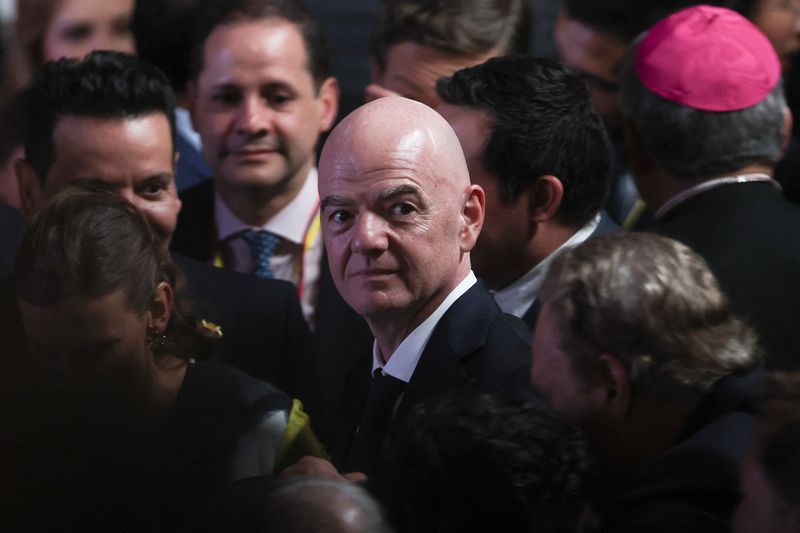
The leadership of world football faces an unprecedented constitutional crisis as three of FIFA's six continental confederations openly contemplate removing President Gianni Infantino through a formal vote of no confidence—a mechanism never deployed in the organisation's 122-year history. UEFA, the Asian Football Confederation (AFC), and CONCACAF, representing North and Central America and the Caribbean, are actively discussing the extraordinary measure after Infantino's now-defunct proposal to invite private investors into a new commercial entity controlling World Cup rights sparked fury among football's traditional power brokers.
The proposal, which would have granted FIFA associations access to one-time capital grants of up to $20 million for infrastructure and grassroots development, instead became a flashpoint over governance and transparency. Senior officials with knowledge of the confidential discussions revealed that frustration has crystallised into a fundamental question: whether Infantino should voluntarily withdraw from next year's scheduled presidential election in March 2027, or face removal through formal constitutional means. One source, speaking anonymously due to the sensitivity of internal confederation communications, articulated the binary choice bluntly: "Either he goes the peaceful way and decides not to stand in March or he goes the hard way."
Under FIFA's governing statutes, an Extraordinary Congress can be convened at any time by the FIFA Council, or alternatively must be called if at least one-fifth of FIFA's 211 member associations submit a formal written request outlining their agenda items. Once triggered, such a congress must assemble within three months, with each member association exercising one vote. Notably, FIFA's rulebook contains no explicit procedures governing a presidential no-confidence motion, meaning any such vote would operate in ambiguous legal territory and likely face fierce procedural challenges from Infantino's supporters.
The three confederations have presented a united front criticising what they characterise as a fundamental breach of trust, citing repeated failures of transparency, adequate consultation with member associations, and basic governance principles. UEFA was notably circumspect when contacted, declining to confirm or deny specific discussions but stating that any review of FIFA leadership "should be thorough and fundamental" and that "no option should be off the table." CONCACAF similarly deferred to its joint statement with UEFA and the AFC, while the AFC did not immediately respond to requests for clarification. This studied silence masks intense behind-the-scenes manoeuvring among confederations that collectively represent the world's most developed football markets and richest associations.
Infantino, however, retains formidable institutional advantages heading into any confrontation. He has publicly declared his intention to seek reelection in March 2027 and maintains substantial support among FIFA's member associations, particularly across Africa's confederation (CAF), whose President Patrice Motsepe publicly reaffirmed continental backing last week. Additionally, six Arab football associations, including Qatar and Morocco (co-host of the 2030 World Cup), publicly endorsed Infantino following FIFA's crisis meeting in Morocco, signalling that geopolitical and commercial alignments still favour the incumbent despite the governance debacle.
Yet Infantino's position has demonstrably weakened following successive institutional ruptures. Chief Operating Officer Kevin Lamour departed this week after openly criticising the investment proposal and claiming that FIFA staff had been deliberately "deceived" about what he characterised as a project driven by a single individual. The exodus shocked the organisation and prompted FIFA Vice President Sandor Csanyi to publicly withdraw his support, declaring Lamour's departure the "final straw" in a pattern of mismanagement. These departures signal cracks in the leadership coalition that sustained Infantino through previous controversies, suggesting that internal dissent has reached critical levels.
Paradoxically, the three confederations hesitate to proceed with a no-confidence motion, fearing that an unsuccessful challenge could backfire catastrophically. Insiders suggest that a failed removal attempt would paradoxically strengthen Infantino by demonstrating his continued electoral superiority, bolstering his credibility ahead of the March 2027 election, and potentially consolidating his support among fence-sitting associations. This strategic calculation paralysises action despite deep dissatisfaction, creating a situation where the threat of removal may prove more valuable than its actual execution.
The opposition movement also faces structural disadvantages. No credible alternative candidate has publicly declared intentions to contest the presidency before the November 18 nomination deadline, meaning Infantino faces no immediate electoral challenger. For smaller associations like Malawi's, the calculus remains uncertain; as Football Association of Malawi President Fleetwood Haiya articulated, prospective challengers must articulate concrete benefits for developing football nations to persuade them to abandon the incumbent. The bifurcation of interests between wealthy European and Asian federations and cash-strapped associations in Africa and smaller regions limits coalition-building capacity.
Pressure extends beyond the formal structures of FIFA governance. The European Football Clubs organisation, chaired by Paris Saint-Germain president Nasser Al-Khelaifi and representing over 800 professional clubs, has aligned itself with UEFA and other reform advocates, wielding significant sporting and commercial leverage despite lacking FIFA votes. The EFC has warned that member clubs could boycott future Club World Cup competitions unless FIFA addresses governance concerns and clarifies the relationship between continental leagues and the global body. This threat of sporting sanction represents a vulnerability that Infantino cannot dismiss, as the commercial viability of expanded World Cup formats depends entirely on club participation and player availability.
The broader reputational cost to FIFA remains substantial despite the absence of public sponsor criticism. Michael Payne, the former International Olympic Committee marketing chief, observed that even electoral victory would not necessarily heal the organisation's divisions. He highlighted the fundamental paradox: a president who governs with the majority support of FIFA's smallest and smallest-revenue associations but faces unified opposition from football's genuine superpowers occupies an untenable strategic position. How, Payne asked, can an international organisation function effectively when all major footballing powers actively oppose its leadership? This question encapsulates the governance crisis underlying the surface conflict.
FIFA projects revenues exceeding $15 billion for the 2023-2026 cycle, with the bulk arriving during this year's World Cup, yet this financial abundance has paradoxically created the conditions for institutional rupture rather than solidarity. The failed privatisation proposal represented an attempt to convert FIFA's extraordinary earning power into permanent assets that could fund continental confederations, but the governance chaos surrounding the initiative has undermined confidence in Infantino's stewardship. Whether he survives through electoral victory in March 2027, survives a no-confidence motion, or voluntarily steps aside, the episode has fundamentally damaged FIFA's image as a representative body genuinely committed to transparent, consultative decision-making—a vulnerability that will haunt the organisation's governance debates for years ahead.

