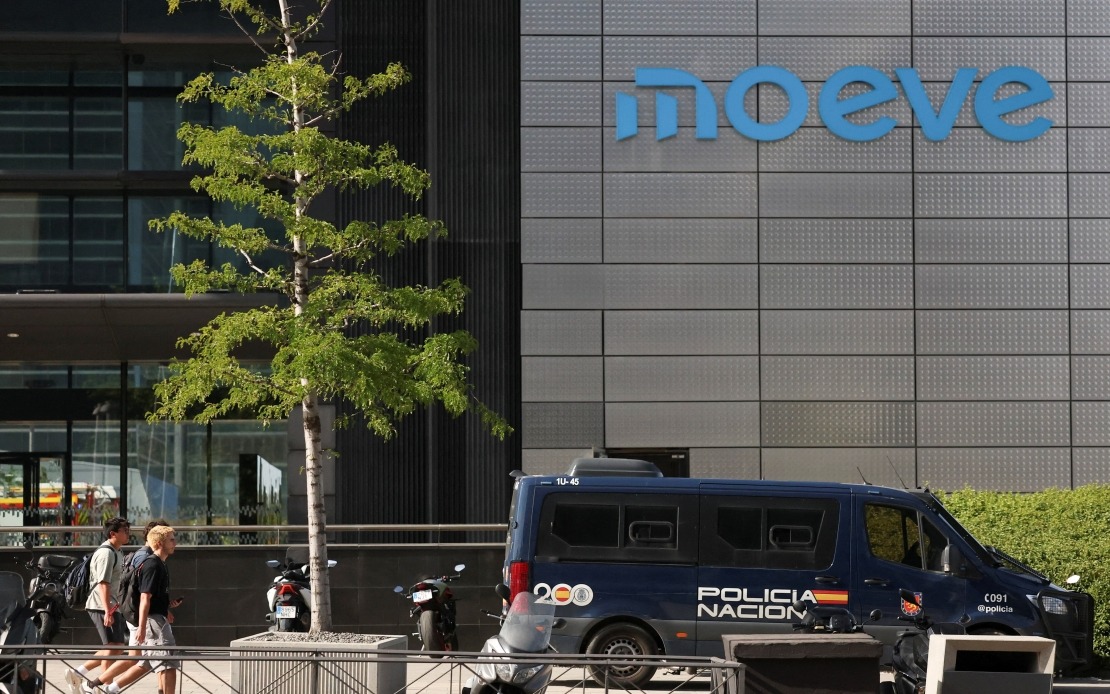
A major fire swept through Torre Moeve in central Madrid on Tuesday, sending thick columns of smoke visible across much of the Spanish capital. The incident occurred at Spain's second-tallest building, causing emergency responders to spring into action and authorities to implement swift evacuation procedures as a protective measure. The dramatic blaze, which could be seen from numerous vantage points throughout the city, prompted a significant emergency response that ultimately prevented any loss of life.
The fire ignited following an explosion inside the structure at approximately 5.00 pm local time, according to reports from Spain's national broadcaster RTVE, which cited statements from the National Police. The Spanish government delegation in Madrid subsequently confirmed that the blaze originated on the 25th floor, a level dedicated to housing the building's critical technical and mechanical infrastructure systems. This information proved crucial for firefighting efforts, as it helped responders understand the nature and potential spread of the incident.
Madrid's municipal firefighting teams responded swiftly to the emergency call and worked to contain and extinguish the flames. Within hours, officials declared the fire fully extinguished, and firefighters began the process of conducting thorough interior inspections to ensure complete safety and assess any structural or system damage that may have occurred. These post-fire assessments are standard protocol to identify potential hazards and prevent any rekindling of flames.
The evacuation of Torre Moeve proceeded smoothly as a precautionary measure, allowing occupants to reach safety while the emergency situation unfolded. Authorities credited their rapid response and well-coordinated evacuation procedures with preventing casualties despite the severity of the incident. The building's occupants and workers were efficiently guided away from the structure as emergency personnel arrived and took control of the scene.
Casualty figures remained remarkably low given the scale of the incident. According to reports from local media outlets, only three individuals required medical attention. Two workers sustained mild smoke inhalation injuries, while a passer-by experienced an acute anxiety attack triggered by witnessing the emergency. Notably, all three individuals received treatment at the scene and required no hospitalisation, indicating that injuries were confined to minor health impacts.
The incident at Torre Moeve underscores the critical importance of robust fire safety protocols in high-rise buildings across Europe. Modern skyscrapers incorporate multiple redundant safety systems, including advanced detection technology, automated suppression mechanisms, and carefully designed evacuation routes. The successful outcome at Torre Moeve demonstrates how these systems, combined with rapid emergency response, can minimise harm during building emergencies.
For Malaysian readers and the Southeast Asian region, the Torre Moeve incident offers important lessons for urban safety management. As cities across Malaysia and the broader region continue to develop increasingly sophisticated high-rise developments, studying international best practices in emergency response becomes essential. The rapid coordination between local authorities, firefighting services, and building management at Torre Moeve exemplifies the type of professional integration that Southeast Asian cities should emulate in their own safety protocols.
The technical nature of the incident, originating in mechanical systems on the 25th floor, highlights how even sophisticated modern buildings require constant vigilance regarding equipment maintenance and monitoring. Building managers and property owners throughout the region must prioritise regular inspection schedules and preventative maintenance to reduce risks associated with technical failures that could trigger fires. This applies particularly to older buildings or those where maintenance standards may have lapsed.
The absence of fatalities at Torre Moeve reflects successful execution of evacuation procedures and the effectiveness of modern building safety standards implemented across Europe. However, the incident reminds us that even well-designed systems depend on human factors including awareness, training, and quick decision-making. Malaysian building regulators and the property industry should view this incident as validation of the importance of investing in comprehensive safety infrastructure and staff training programs.