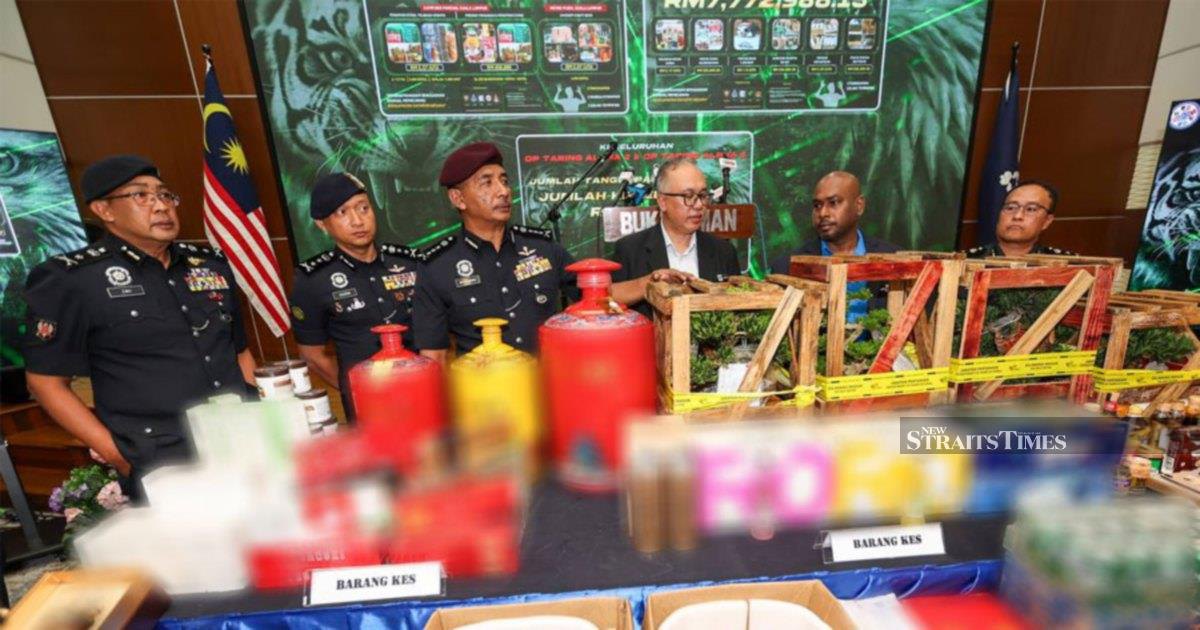
In a significant crackdown on organised smuggling activities, Malaysian police have arrested five suspects and recovered contraband and merchandise valued at RM12.8 million across two separate enforcement operations conducted in Kuala Lumpur and Klang. The coordinated actions underscore the Royal Malaysia Police's intensifying focus on disrupting illicit trade networks that threaten the nation's tax base and fuel underground criminal enterprises.
The two operations, executed in rapid succession, targeted separate smuggling networks suspected of operating across the Klang Valley industrial and port regions. By striking at multiple nodes within what authorities believe are interconnected supply chains, the enforcement action aims to disrupt logistics and distribution networks that have traditionally been difficult to penetrate. The scale of the seizure—approaching RM13 million—indicates these were not opportunistic cases of petty contraband but rather sophisticated operations with significant financial turnover and likely connections to larger criminal organisations.
Smuggling remains a persistent challenge for Malaysian law enforcement, particularly given the nation's role as a major transhipment hub in Southeast Asia. The Klang Valley's concentration of ports, logistics centres, and proximity to international shipping routes make it an attractive target for smuggling networks seeking to move goods into regional markets while evading customs duties and excise taxes. The efficiency of modern supply chain infrastructure, ironically, can be exploited by criminal syndicates to obscure the origins and destinations of contraband shipments. These operations demonstrate police recognition that dismantling such networks requires intelligence-led enforcement targeting not just the smuggled goods themselves but the operational infrastructure enabling their movement.
The timing of these arrests coincides with heightened scrutiny of organised crime activities throughout Malaysia. Law enforcement agencies have increasingly coordinated their efforts to target the financial and logistical dimensions of smuggling operations rather than focusing solely on individual trafficking incidents. By apprehending five individuals simultaneously across two locations, authorities have likely disrupted key personnel within the networks, from logistics coordinators to distribution handlers. The arrests create opportunities for further investigation into upstream suppliers and downstream buyers, potentially unravelling larger criminal structures.
The nature of the recovered goods provides insight into prevailing smuggling trends in Malaysia. Contraband seizures typically encompass duty-free liquor and tobacco, counterfeit luxury products, consumer electronics, pharmaceuticals, and automotive components. Each category represents distinct supply chains and consumer bases, suggesting these networks may have served multiple illegal markets simultaneously. The sophistication required to manage parallel smuggling operations across different product categories implies management structures and capital reserves comparable to legitimate trading enterprises.
From an economic perspective, smuggling operations directly undermine government revenue collection. Unpaid customs duties and excise taxes on RM12.8 million in contraband represent substantial losses to the federal treasury at a time when Malaysia faces fiscal pressures. Beyond immediate revenue impact, smuggling distorts legitimate markets by introducing unregulated competition that undercuts compliant businesses unable to match prices set without tax burdens. Small and medium enterprises operating legitimately face unfair competitive disadvantages against criminal networks exploiting regulatory gaps.
The role of the Klang Port and surrounding logistics infrastructure in these cases warrants attention. As one of Southeast Asia's busiest transshipment hubs, Klang processes hundreds of thousands of containers annually. Smuggling networks exploit this volume to conceal contraband within legitimate cargo flows, relying on the statistical improbability that every container will be thoroughly inspected. The manpower and technology required for comprehensive screening remains a constraint on enforcement effectiveness. However, intelligence-led targeting—using data analytics, risk assessment, and informant networks to identify high-probability smuggling shipments—enables police to maximise the impact of limited inspection resources.
The seizure's substantial value also reflects the profit margins embedded in smuggling operations. Contraband goods typically command prices 50 to 100 percent above their official market value once sold through underground distribution channels. A RM12.8 million seizure thus represents not only lost criminal profit but also prevented consumer harm, as counterfeit pharmaceuticals and unregulated products pose safety risks. The financial scale underscores why sophisticated criminal organisations maintain these operations despite enforcement risks; the profit-to-risk ratio remains attractive in jurisdictions where border security faces resource constraints.
Moving forward, the effectiveness of these arrests depends partly on prosecution outcomes and sentencing severity. Smuggling cases involving organised networks and substantial contraband quantities can attract charges under the Customs Act, with penalties including substantial fines and imprisonment. However, criminal networks have demonstrated adaptability, quickly reconstituting disrupted operations through redundant supply chains and replacement personnel. Sustainable impact requires sustained enforcement coupled with supply-side reduction strategies targeting source countries and demand-side prevention addressing consumer participation in illegal markets.
The coordination demonstrated in these operations reflects evolving police capability in targeting complex criminal enterprises. Inter-agency cooperation between customs, port authorities, and state police has improved significantly in recent years, leveraging shared intelligence and cross-border enforcement protocols. For Southeast Asian neighbours including Singapore, Thailand, and Indonesia facing similar smuggling pressures, Malaysia's operational approach offers a model for intelligence-led enforcement against organised trafficking networks.

