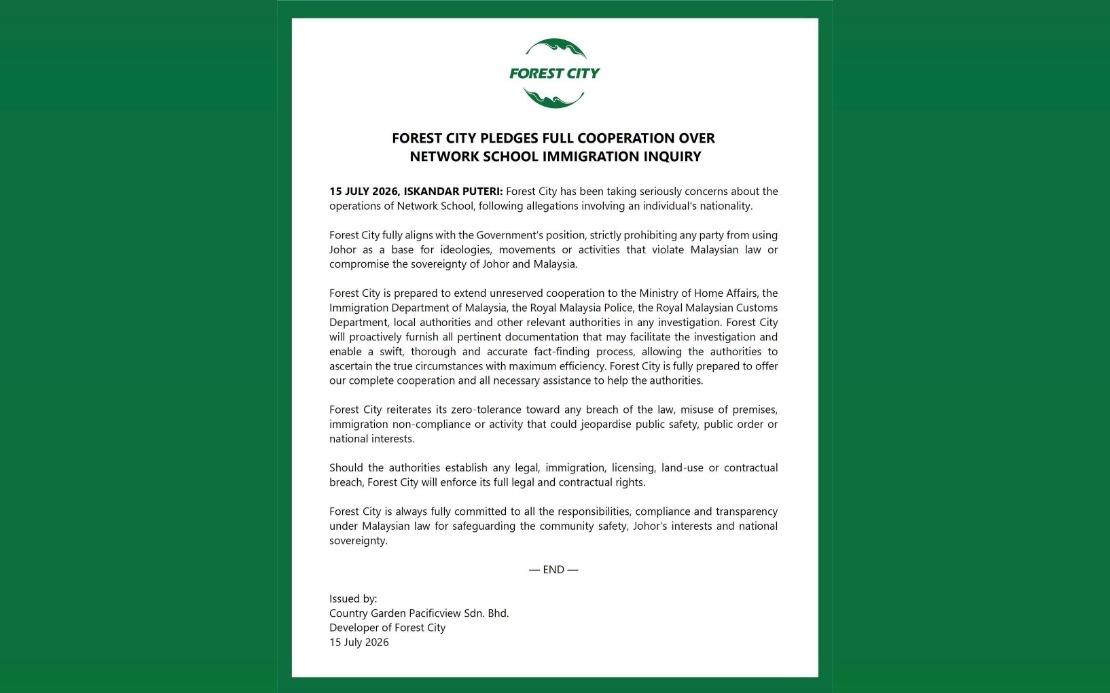
Country Garden Pacificview Sdn Bhd, the developer behind Forest City in Johor Bahru, has committed to providing full assistance to government authorities investigating the controversial Network School operation that has drawn scrutiny over the presence of alleged Israeli citizens at the facility. The developer's willingness to cooperate comes amid rising public concern about potential breaches of immigration protocols and activities that may contravene Malaysia's foreign policy stance.
In a formal statement released on July 15, the developer emphasised that it regards the matter with considerable seriousness and aligns itself with the federal government's position that Johor—or any part of Malaysia—should not serve as a venue for activities that violate domestic law or compromise national sovereignty. This stance reflects broader sensitivities in Malaysia regarding Israeli-related activities, which have consistently generated political and public attention across the nation. The developer's explicit support for the government's position suggests an effort to distance the commercial development from any potential liability or reputational damage arising from the investigation.
The developer has formally notified the Home Ministry (KDN), Immigration Department (JIM), Royal Malaysia Police, Royal Malaysian Customs Department, local authorities, and other relevant agencies of its readiness to participate in the inquiry. This multi-agency involvement underscores the seriousness with which Malaysian authorities are treating the matter, as the investigation spans immigration compliance, security, and local governance domains. The coordinated approach reflects standard practice when allegations potentially affect national security, immigration law, and public order simultaneously.
Country Garden Pacificview has pledged to furnish all necessary documentation to support the investigation and accelerate the fact-finding process, signalling a transparent approach that prioritises accuracy and thoroughness. By committing to submit records proactively, the developer may hope to demonstrate institutional cooperation and reduce suspicions about the development's operations or management practices. Such documentation could include visitor records, facility usage agreements, staff employment details, and communications related to the Network School operation.
The developer has adopted a zero-tolerance policy toward legal violations, premises misuse, immigration regulation breaches, and activities endangering public safety and security. This formal declaration appears designed to establish clear operational standards and signal that any future transgressions would not be tolerated under Forest City's management framework. The explicit commitment serves as a public reassurance to residents, investors, and regulators that the development maintains stringent compliance measures.
Johor Menteri Besar Datuk Onn Hafiz Ghazi initiated the investigation after concerns emerged about the Network School's operations within Forest City. Onn Hafiz indicated that participants allegedly used secondary passports from other nations to gain entry into Malaysia, circumventing standard immigration procedures and raising questions about how such documentation was processed and accepted. This allegation suggests potential systemic vulnerabilities in immigration screening or deliberate circumvention of standard protocols, matters that would naturally trigger official scrutiny.
The specific claim that individuals utilised alternative nationality credentials to enter Malaysia represents a significant breach of immigration integrity, particularly given Malaysia's careful approach to Israeli-linked activities. The use of dual or secondary passports to obscure true nationality or citizenship status constitutes document fraud and potentially violates the Immigration Act 1959/63. Such practices, if substantiated, would indicate either negligence in immigration processing or deliberate manipulation of entry procedures.
Immediate action by the Immigration Department resulted in an inspection of 266 foreign nationals representing 40 different countries present in Forest City. Preliminary verification confirmed that all individuals examined possessed properly authorised immigration documents at the time of inspection. However, the ongoing nature of the investigation indicates that authorities are examining not merely the current validity of documentation but also the circumstances under which entry was originally granted and whether the purposes stated at entry matched actual activities undertaken.
The investigation touches on broader governance questions affecting major mixed-use developments in Malaysia, particularly regarding oversight of residential and commercial facilities that attract diverse international populations. Forest City has established itself as a significant real estate project attracting investment and residents from across the Asia-Pacific region, making it subject to heightened scrutiny regarding security, immigration compliance, and adherence to government policy directives. The Network School controversy highlights how developments housing thousands of residents require robust management systems to monitor tenant activities and ensure compliance with national regulations.
For Malaysian investors and residents in Forest City, the investigation and developer's cooperative stance may provide reassurance regarding management competence and regulatory oversight. However, the incident underscores risks associated with large-scale international developments and the importance of rigorous vetting procedures for activities, especially educational or training operations, that operate within mixed-use communities. The outcome of this investigation will likely influence how similar facilities are regulated and monitored throughout Malaysia's major metropolitan developments.
The situation also reflects ongoing tensions between Malaysia's economic interests in attracting foreign investment and residents, and its foreign policy commitments regarding certain nations. Balancing these interests while maintaining security and regulatory compliance remains a persistent challenge for authorities managing major international developments. The transparent approach adopted by Country Garden Pacificview suggests developers recognise that cooperation with investigations ultimately protects their commercial interests and reputations more effectively than resistance or obfuscation.

