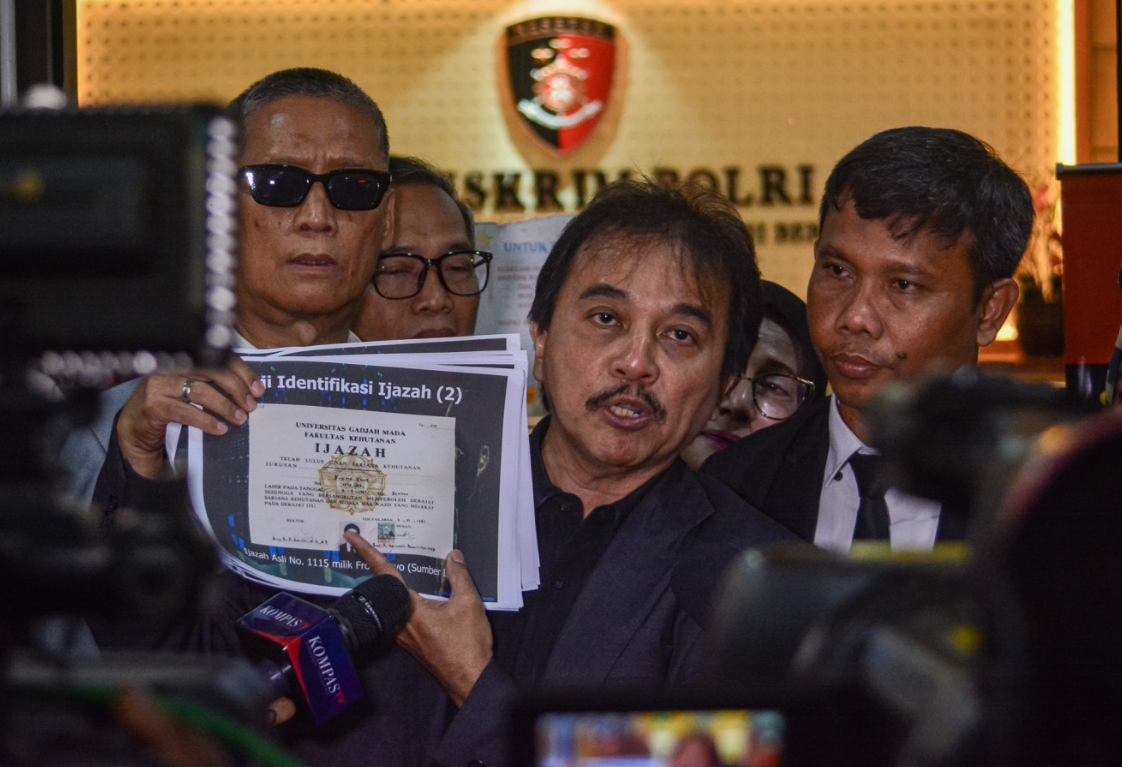
Jakarta Police have taken the long-simmering dispute over former president Joko Widodo's academic credentials to a critical juncture by detaining ex-youth and sports minister Roy Suryo and prominent health activist Tifauzia Tyassuma on defamation charges. The detention, which occurred on Friday morning at the suspects' residences, represents a sharp escalation in what has become one of Indonesia's most contentious political controversies since allegations first surfaced on social media platforms in 2019. The move signals authorities' determination to pursue legal action against those who have persistently questioned the authenticity of Widodo's university diploma, a matter that has divided Indonesian society and attracted international attention.
According to Roy's legal representative Ahmad Khozinudin, both individuals were apprehended as part of standard procedural measures preceding the transition of their case to the Jakarta Prosecutor's Office. The Jakarta Police's General Crimes Directorate characterized the detention as a necessary administrative step rather than extraordinary action, emphasizing that such measures are routine when cases advance from investigative to prosecutorial phases. Investigation director Sr Comr Iman Imanuddin explained at a press conference that the detention facilitates the handover of suspects and evidence to prosecutors once police documentation reaches completion, ensuring that essential procedural requirements such as medical examinations and evidence verification occur without unnecessary delays.
The accusations extend beyond simple defamation to include charges of electronic document manipulation. Authorities allege that Roy and Tifa fabricated or altered digital materials to substantiate their contentions that Widodo's diploma was fraudulent. These allegations invoke Indonesia's Electronic Information and Transactions Law, which prescribes maximum imprisonment of six years for violations. The breadth of charges demonstrates prosecutors' intention to pursue a comprehensive case that addresses both the substance of the diploma challenge and the methods allegedly employed to disseminate these claims.
Roy's background as a former minister in the administration of Susilo Bambang Yudhoyono, a political rival of Widodo's, has invited speculation about whether factional interests drive the dispute. However, the underlying question of academic credential authenticity has maintained sufficient traction among segments of Indonesian civil society that the controversy transcends simple partisan calculation. The persistence of skepticism regarding Widodo's educational background, despite official investigations and certifications, reflects deeper concerns about transparency and institutional credibility that resonate across Indonesia's political spectrum.
The diploma controversy itself stretches back to 2019, when initial questions regarding Widodo's academic record circulated online. Rather than fading, the dispute evolved through multiple iterations: a civil lawsuit filed in 2022, police investigations, and judicial reviews extending into 2025. This protracted timeline suggests that neither institutional pronouncements nor legal processes have effectively resolved public doubts. The National Police concluded in May 2025 that Widodo's diploma was authentic and closed their initial forgery investigation, yet skeptics including Roy continued presenting objections during a subsequent case review conducted in July 2025.
The detention decision has prompted vigorous criticism from the defendants' legal counsel. Refly Harun, representing both Roy and Tifa, challenged the necessity of the detention given that case transfer to prosecutors was scheduled for Monday, characterizing the measure as disproportionate and unnecessarily punitive. Harun emphasized that his clients had consistently complied with all police summonses and reporting obligations, thereby eliminating the flight risk that typically justifies pretrial detention. This legal pushback signals potential courtroom battles ahead regarding procedural fairness and the proportionality of government actions.
The case has ensnared multiple individuals throughout its evolution. Police initially designated six persons as suspects under the Electronic Information and Transactions Law, but subsequently withdrew charges against three individuals—Eggi Sudjana, Damai Hari Lubis, and Rismon Sianipar—following mediation agreements. This selective prosecution pattern raises questions about consistency in investigative approach and whether political considerations influence the decision to pursue certain defendants while releasing others. For observers monitoring Indonesian institutional development, such variations in enforcement create ambiguity regarding the rule of law's application.
The detention of Roy and Tifa occurs within a broader context of Indonesia's political transformation following Widodo's presidency. Although Widodo has departed the presidency, his legacy and decisions continue generating controversy, and his allies and detractors remain engaged in competing narratives about his tenure and character. The diploma dispute, viewed through this lens, represents more than an academic question; it encompasses competing interpretations of credibility, institutional integrity, and the legitimacy of authority itself.
For Malaysian and wider Southeast Asian observers, the Indonesian case illuminates recurring tensions within democratic systems regarding the balance between protecting institutional reputation and preserving space for legitimate scrutiny and dissent. The application of defamation law to suppress diploma challenge allegations raises fundamental questions about whether citizens possess adequate opportunity to question official narratives, particularly when those narratives concern public figures and matters of demonstrated public interest. As Indonesia's legal proceedings advance, the case will likely continue influencing regional discussions about press freedom, political expression, and institutional accountability.