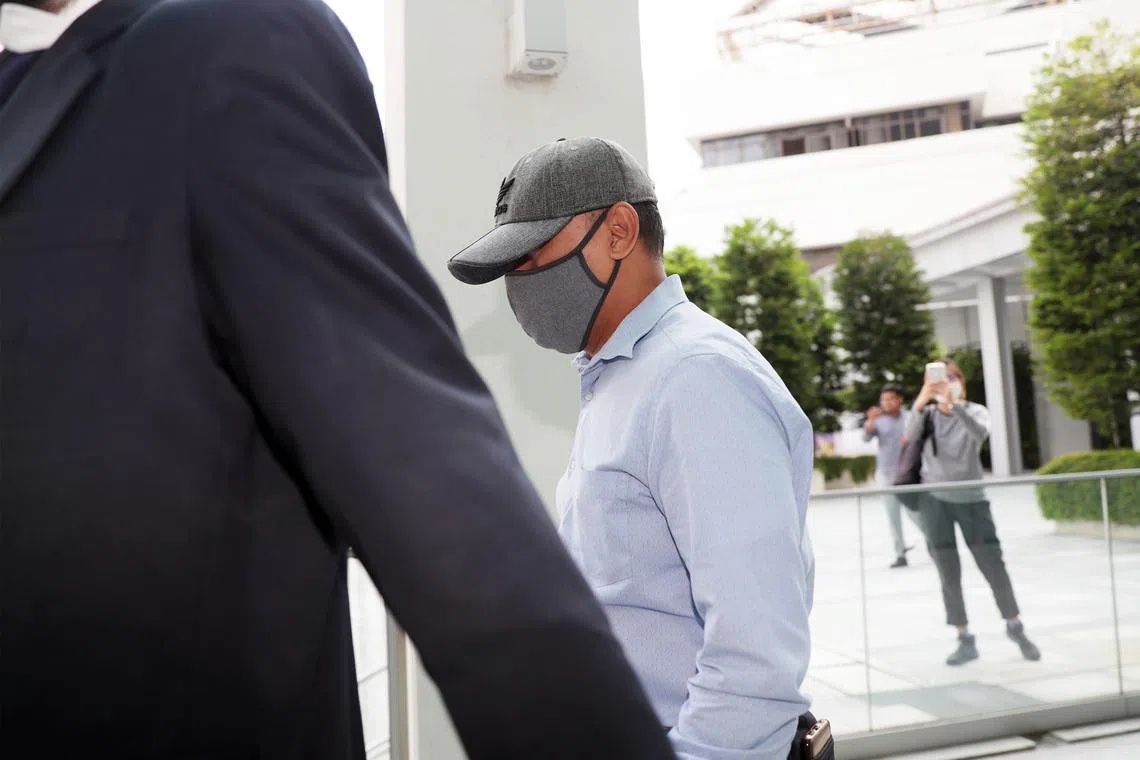
Abdul Rahim Mawasi, the 59-year-old former executive chairman of Darul Aman Mosque and Sallim Mattar Mosque in Singapore, received a 14-month custodial sentence on Friday after being convicted of graft linked to construction contracts worth S$223,000. His conviction marks a rare instance of senior mosque leadership being held accountable for corruption within Singapore's religious institutions, raising questions about governance and oversight mechanisms that Southeast Asian countries including Malaysia continue to grapple with in managing charitable and religious organisations.
At the time of his offences, Mawasi held a dual role as a senior officer with the Islamic Religious Council of Singapore (MUIS) while being seconded to both mosques, where he chaired their management boards. This positioning created inherent conflicts of interest that should have been managed through stricter institutional safeguards. The case emerged from an arrangement struck in July 2018 between Mawasi and his long-time acquaintance Mohd Mustaqim Kam, the 66-year-old director of construction firm Zeal-Con Engineering. The two men devised a scheme whereby Mawasi would facilitate construction work opportunities for Zeal-Con at both mosques, with Kam reciprocating by using profits from these contracts as capital contributions to a joint pilgrimage travel company in which Mawasi would hold an interest.
The corruption manifested through a sophisticated pattern of bid manipulation across two separate projects. When Darul Aman Mosque sought vendors for yard construction work in 2018, Zeal-Con initially submitted a quote of S$128,600 in August. Following extensive price discussions between Mawasi and Kam that remained undisclosed to the mosque's board, Zeal-Con revised its bid downward to S$118,000 in September—significantly undercutting the nearest competitor's submission of S$125,500. Mawasi's provision of crucial price guidance enabled Zeal-Con to calibrate its offer precisely, securing the contract for S$118,000 on September 26, 2018. The mosque's management board remained entirely unaware of these behind-the-scenes negotiations.
A parallel scheme unfolded at Sallim Mattar Mosque, where similar price manipulation tactics proved equally effective. Zeal-Con first quoted S$115,700 for renovation work encompassing the roof and reception areas in September 2018. By July 2019, after consultations with Mawasi, the company reduced its quotation to S$105,000 for identical work. The mosque subsequently awarded contracts linked to this lower figure the following month. Throughout both transactions, Mawasi concealed his advisory role and financial interest in the arrangements from institutional oversight bodies.
To obscure his involvement further, Mawasi orchestrated a deliberately opaque ownership structure. In November 2019, Kam converted an existing shell company into Amal Travel and Tour (ATT), capitalising it at S$100,000 across 100,000 shares. Rather than holding shares directly, Mawasi arranged for his own son to receive 25,000 ATT shares valued at S$1 each, effectively shielding his interest from institutional disclosure requirements and regulatory scrutiny. This stratagem failed during investigation and trial proceedings, which revealed the elaborate concealment effort designed to prevent MUIS from learning of his undisclosed business involvement.
Mawasi's defence strategy centred on denial and technical distance-setting. During trial, represented by lawyer Satwant Singh Sarban Singh, he denied any involvement with ATT and highlighted that he held no shares in the company—a technically accurate but fundamentally misleading position given his son's shareholding and the scheme's origins. The court found this explanation insufficient, viewing it as part of a broader pattern of concealment rather than genuine separation from the enterprise. Prosecutors successfully demonstrated that the entire structure existed solely to facilitate Mawasi's participation while evading detection by MUIS.
While the Deputy Public Prosecutor acknowledged that Darul Aman Mosque and Sallim Mattar Mosque did not sustain substantial financial losses—Zeal-Con's construction work was satisfactorily completed—the court treated this as largely irrelevant to sentencing. Prosecutors emphasised that Mawasi had perpetrated a deliberate, premeditated corruption offence targeting the public sector for personal financial gain. The methodical nature of the scheme, spanning months and involving multiple falsified quotations, indicated this was not an impulsive transgression but rather a calculated exploitation of his institutional position.
Mawasi's co-conspirator, Mohd Mustaqim Kam, received a comparatively lighter six-month jail sentence in February 2025, suggesting courts viewed him as less culpable despite his active participation. Kam was the operational entrepreneur who executed the corruption through his company, whereas Mawasi wielded the institutional authority that made the scheme possible. This sentencing differential reflects judicial recognition that officials occupying positions of trust bear heightened responsibility when they weaponise that trust against the organisations they serve.
The case carries significant implications for Southeast Asian governance frameworks. Malaysia, with its extensive mosque networks and religious administrative structures, operates similar institutional hierarchies where seconded officials oversee facilities and procurement. The Mawasi case exemplifies vulnerabilities in these systems: insufficient separation between procurement decision-making and advisory roles, inadequate disclosure requirements for official involvement in external commercial ventures, and limited institutional mechanisms for detecting conflict-of-interest schemes. Religious organisations across the region often rely on voluntary compliance with ethical standards rather than mandated governance protocols, creating openings for determined individuals to exploit loopholes.
Mawasi, who joined MUIS in 2005 and had maintained an unblemished record until conviction in April 2024, represented a trusted institutional figure whose position enabled rather than prevented wrongdoing. His defence counsel appealed for leniency on June 26, requesting no more than six months' imprisonment and highlighting the absence of prior convictions. The court rejected this characterisation, imposing 14 months instead—a sentence reflecting the aggravating factor of breach of public trust. He was released on S$30,000 bail pending commencement of his sentence on July 10, 2025.
The prosecution's case revealed a sophisticated understanding of how institutional hierarchies can be weaponised. Mawasi's technical knowledge of procurement processes, combined with his authority over bid evaluation, allowed him to function as an orchestrator rather than a passive participant. Had stronger institutional controls existed—mandatory recusal from procurement decisions involving personal associates, regular conflict-of-interest audits, or requirement for independent approval of contracts above certain thresholds—the scheme might have been detected far earlier. Religious institutions across Southeast Asia would be wise to examine whether their governance structures contain similar vulnerabilities.

