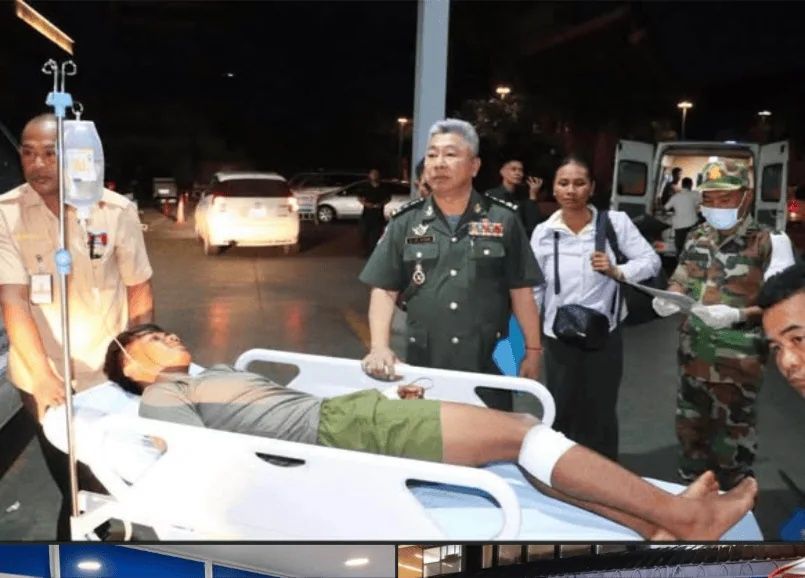
Cambodia's defence ministry confirmed Monday that an explosive device detonated during a military patrol operation along its shared frontier with Thailand, leaving four soldiers injured. The incident unfolded on Sunday afternoon in a cashew plantation region straddling Chouk Kruos and Thma Don villages within Oddar Meanchey province, one of several border areas where the two nations maintain an ongoing security presence.
Lieutenant General Maly Socheata, who serves as an undersecretary of state and spokesperson for Cambodia's Ministry of National Defence, provided official confirmation of the Sunday blast, which occurred at 12:35 p.m. local time. She emphasised that the wounded personnel were receiving immediate and comprehensive medical attention from medical specialists and associated staff, though the ministry did not disclose details regarding the soldiers' conditions or the severity of their injuries.
The Cambodia-Thailand frontier has long represented a complex security landscape, with both nations maintaining regular patrol operations across disputed or sensitive boundary zones. Cashew plantations in this region serve as economic resources for surrounding communities, yet their remote locations and challenging terrain make them periodic flashpoints for security incidents. Oddar Meanchey province, situated in northwestern Cambodia, shares an extended border with Thailand's Sisaket, Surin, and Ubon Ratchathani provinces, making it strategically significant for both governments' border management strategies.
Thai military authorities moved quickly to issue their own statement regarding the explosion, with Royal Thai Army spokesperson Winthai Suvaree clarifying the Bangkok perspective on Sunday itself. Thai forces conducting routine patrols on their side of the border reported hearing the detonation emanating from Cambodian territory at the time of the incident. This prompt Thai response suggested coordination between the two militaries' operational monitoring systems or at least awareness protocols designed to prevent misunderstandings in the sensitive border region.
Thailand's defence establishment took particular care to distance itself from any responsibility for the explosion. The Royal Thai Army explicitly stated that its personnel had not discharged any weapons or deployed grenades during the period in question. A subsequent investigation conducted by relevant Thai military units confirmed their assessment that the blast originated on Cambodian soil and bore no connection to Thai military actions. Such clarification attempts to forestall diplomatic friction and prevent escalation of tensions between the neighbouring countries.
The nature of the explosive device itself remained unspecified in the official announcements. Cambodian and Thai border regions have historically been affected by landmines and unexploded ordnance dating from various conflicts, including the Cambodian civil war and subsequent military operations. Remnants of older conflicts continue to pose dangers to civilian populations and military personnel conducting patrols in less accessible areas. The incident's location in a rural plantation zone heightens the possibility that the device was a legacy hazard rather than a freshly deployed military munition.
For Malaysia and other Southeast Asian nations, border incidents of this nature carry broader implications regarding regional stability and cross-boundary cooperation mechanisms. ASEAN member states share diverse bilateral boundaries, and establishing clear protocols for managing accidental incidents prevents misinterpretations that could cascade into larger conflicts. The Cambodia-Thailand episode demonstrates both the benefits of rapid official communication between defence establishments and the ongoing challenges of maintaining security along remote frontier zones where civilian economic activity intersects with military operations.
The timing of the announcement on Monday, a day after the Sunday incident, reflected standard defence ministry procedures for verifying facts before public disclosure. Both governments' careful coordination of their public statements suggested functional military-to-military communication channels, despite the diplomatic complexity occasionally characterising broader Cambodia-Thailand relations. Neither side accused the other of culpability, which itself represents significant restraint in a region where border incidents have periodically generated tensions.
Cambodian defence officials did not disclose whether investigation teams would attempt to recover or analyse the explosive device, though such procedures would typically fall within their purview as the incident occurred on Cambodian territory. Understanding the device's origin, construction, and deployment timeline would offer valuable intelligence for both nations' security establishments regarding potential threats within the border region. The incident underscores ongoing vulnerabilities affecting military personnel operating in remote areas where conflict legacies persist alongside modern security challenges.
This event also reflects the reality that despite occasional diplomatic strains, Cambodia and Thailand maintain operational military relationships that permit real-time incident communication and coordinated fact-finding. The ability to exchange information rapidly and establish shared understanding of events helps maintain the fundamental security equilibrium upon which regional stability depends. For analysts monitoring Southeast Asian security developments, such incidents and the responses they generate provide important indicators of bilateral relationships and the effectiveness of transnational military cooperation protocols that have developed over decades of close engagement between the two nations.

