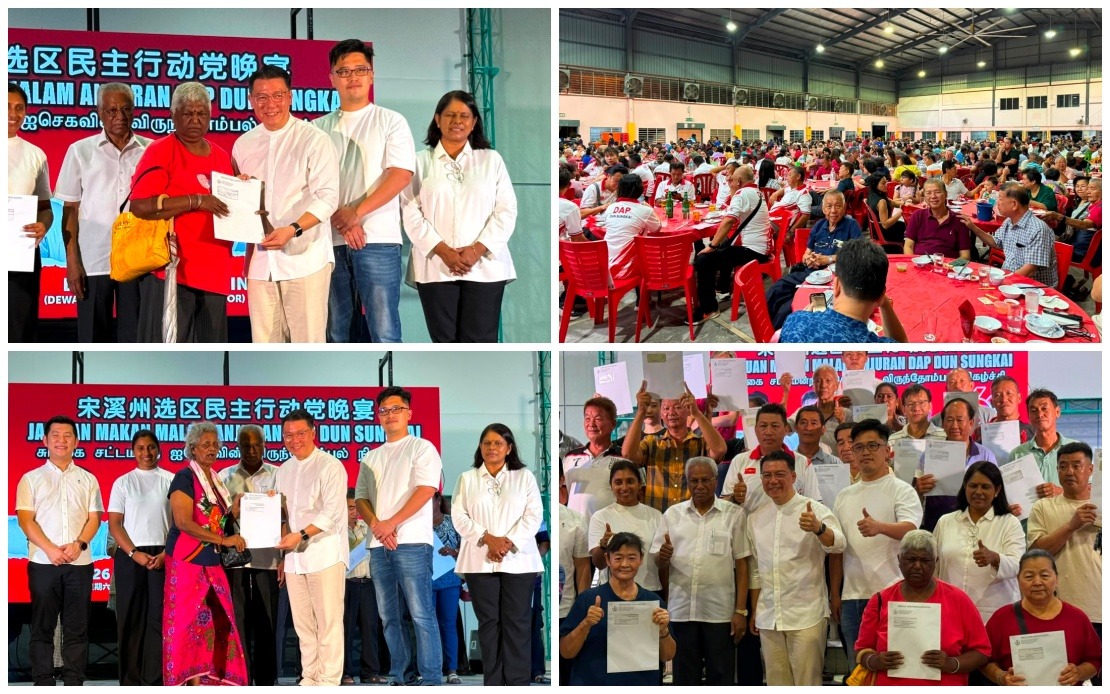
Housing and Local Government Minister Nga Kor Ming has announced the successful resolution of a land settlement crisis that has haunted 120 families in Sungkai and Kuala Bikam for over four decades. The resolution came through the distribution of land grants at a DAP Sungkai divisional dinner, marking what officials characterised as a watershed moment in the lives of vulnerable communities who had endured decades of housing insecurity across the Perak localities.
The minister framed the achievement as emblematic of the MADANI Government's broader governance philosophy, which positions inclusive development at its core. According to Nga, the administration under Prime Minister Datuk Seri Anwar Ibrahim operates from a foundational principle that no Malaysian—irrespective of ethnicity or socioeconomic standing—should be excluded from the benefits of national progress. The resolution of this specific housing dispute, he suggested, demonstrates the government's willingness to tackle longstanding grievances that prior administrations had permitted to linger unresolved.
The gathering, which drew more than 1,200 attendees representing diverse community backgrounds, served as a platform for Nga to articulate the government's commitment to minority communities, particularly the Indian population. Beyond the immediate land grants, he highlighted a constellation of targeted initiatives designed to improve conditions for Indian Malaysians. These initiatives included RM20 million dedicated to Indian settlements, RM50 million allocated to Tamil vernacular schools, and an expansion of funding for the Malaysian Indian Transformation Unit to RM150 million, collectively representing substantial financial commitments to community welfare and educational advancement.
The resolution itself depended substantially on the collaborative efforts of local representatives and civil service personnel. Nga extended formal acknowledgment to Sungkai assemblyman Datuk A. Sivanesan, whose tenure as state Human Resources, Health, Indian Community Affairs and National Integration Committee chairman positioned him to facilitate inter-agency coordination. The minister also commended unnamed civil servants whose sustained dedication across multiple government departments enabled the bureaucratic pathways necessary to translate policy intent into tangible outcomes for beneficiary families.
The forty-year duration of this settlement problem carries particular significance for understanding patterns of governance in Malaysia. Land and housing disputes affecting informal settlements often reflect deeper structural challenges in urban planning, property documentation, and coordination between federal, state, and local authorities. That such a crisis could persist across multiple electoral cycles and government transitions suggests systemic institutional barriers that required more than conventional administrative remedies to overcome. The eventual breakthrough thus represents not merely a charitable gesture but potentially a recalibration of how government agencies prioritise and resource community land disputes.
Nga's rhetoric during the event extended beyond the immediate housing resolution to encompass broader philosophical assertions about contemporary Malaysian politics. He cautioned audiences against allowing negative perceptions to overshadow actual governmental achievements, implicitly referencing the challenge of political communication in an environment saturated with competing narratives. His exhortation to evaluate government performance through objective criteria rather than affective responses reveals awareness that substantive policy outcomes may struggle for public recognition amid competing political messaging. This tension between performance and perception has become increasingly pronounced in Malaysian political discourse, particularly regarding policies targeting specific ethnic communities.
The minister's call for a political culture rooted in unity, service delivery, and developmental outcomes rather than what he characterised as outdated, divisive approaches reflects broader positioning within the current coalition government. The framing positions constructive engagement with development outcomes against destructive engagement with historical grievances or identity-based politics. For Southeast Asian observers, this rhetorical move echoes contemporary governance debates across the region regarding the appropriate balance between acknowledging historical injustices and pursuing pragmatic, forward-looking development strategies.
The event's attendee roster, which included Ipoh Timur MP Howard Lee Chuan How, Buntong assemblyman M. Thulsi, Malim Nawar assemblywoman V. Bavani, and Astaka assemblyman Jason Ng Thien Yong, demonstrates the multi-party representation characteristic of the MADANI coalition. This cross-party presence at a specifically DAP-organised occasion underscores how housing and community welfare issues function as common ground across partisan boundaries at local levels, even amid broader coalition political dynamics. The commemoration of DAP Sungkai's 60th anniversary alongside the land grant distribution further connected the immediate policy outcome to longer-standing community political mobilisation.
For Malaysian readers, particularly those in similar informal settlements across the country, the Sungkai resolution raises broader questions about timelines, mechanisms, and political will regarding remaining land disputes. Numerous squatter communities throughout Peninsular Malaysia continue to lack secure tenure despite decades of advocacy. The Perak resolution, while genuinely significant for its beneficiaries, represents one intervention within a substantially larger landscape of unresolved housing insecurity. Whether this resolution signals accelerated governmental attention to similar cases nationwide, or remains a discrete achievement within a particular political jurisdiction, remains an open question with material implications for vulnerable communities awaiting comparable interventions.
The land grants themselves, while transformative for recipients' sense of security and economic prospects, must also be understood within Malaysia's evolving land tenure and property registration frameworks. Formal land title confers not merely shelter security but also access to credit, inheritance rights, and political recognition as property-owning citizens. The transition from informal occupation to registered ownership thus carries implications extending beyond housing itself to encompass economic mobility and civic standing. For the 120 families in Sungkai and Kuala Bikam, this formal recognition represents the culmination of generational aspiration and, potentially, a foundation for sustained economic advancement across subsequent generations.

