The quarter-final clash between France and Morocco at a neutral venue in Boston this week carries significance far beyond the 90 minutes of football, rooted in the intertwined histories and contemporary relationships that bind two nations across the Mediterranean. The fixture represents more than a sporting contest between two ambitious teams; it embodies the complex legacies of colonialism, the flows of migration that have reshaped both societies, and the everyday bonds—friendships, family ties, shared language—that exist between French and Moroccan communities. In a tournament that has largely unfolded amid heightened security concerns and political tensions in European cities, Boston provides an intriguing alternative setting where supporters and observers can experience this encounter with greater ease and informality.
The historical foundation underpinning this fixture cannot be overstated. Morocco existed under French protectorate administration from 1912 until gaining independence in 1956, a relationship that left deep imprints on governance structures, educational systems, and cultural institutions. Seven decades after independence, these connections persist and have evolved, manifesting across commerce, academic exchange, and crucially, through the movement of people seeking opportunity and education. The bonds that emerged from colonial rule have transformed into something altogether different—channels through which talent flows, families maintain relationships across borders, and shared cultural references create common ground. Football has become one of the most visible and emotionally resonant expressions of these ties.
The composition of Morocco's squad vividly demonstrates how thoroughly diaspora communities have become woven into national football identity. Six members of their tournament roster were born on French soil, while numerous others developed their craft in French professional leagues or progressed through the French youth development system before electing to represent Morocco at senior level. These footballers represent a conscious strategy by the Moroccan football federation to harness talent cultivated within European structures while channeling it toward national ambition. Their presence in the squad reflects demographic realities across North Africa and Europe, where millions of people maintain dual identities and competing loyalties. This pattern extends beyond a handful of high-profile cases; it represents a systematic approach to player recruitment that has proven increasingly effective.
Perhaps no player better encapsulates these overlapping identities than teenager Ayyoub Bouaddi, whose career trajectory traces the invisible pathways connecting France and Morocco. Born in France, developed through the youth academy system at Lille, and capped at youth level by the French national program, Bouaddi eventually made the deliberate choice to commit his senior international career to Morocco. His decision reflected not rejection but rather an affirmation of heritage and heritage identity. Countless footballers face similar crossroads, where family background, birthplace, and personal aspiration intersect with national team opportunities. Some, like Bouaddi, choose to represent the country of ancestral origin; others commit to the nation where they were born. The existence of such choices enriches global football while occasionally creating complicated emotional landscapes for supporters.
The personal relationships forged between players transcend national boundaries and organisational hierarchies. The well-documented friendship between France's Kylian Mbappe and Morocco's Achraf Hakimi, developed during their time as Paris Saint-Germain teammates, exemplifies how contemporary football creates bonds that can coexist with national team competition. These relationships humanise what might otherwise appear as simple national opposition and introduce layers of genuine affection into fixtures that media narratives often frame as confrontational. Such connections pepper the player rosters of both sides, creating a texture to the fixture that distinguishes it from many other international matchups.
France arrive as world champions from 2018 and perennial contenders, possessing the tournament experience, attacking sophistication, and tournament pedigree expected of nations chasing additional World Cup glory. Their passage to the quarter-finals involved a dominant performance against Paraguay, confirming the offensive prowess that has characterised their campaign. The squad itself reflects the multicultural composition that has long defined French football, with players whose parents or grandparents migrated from Africa, the Caribbean, and elsewhere, choosing France as their footballing home. Morocco, by contrast, approaches this fixture from a position of recent institutional advancement. Four years prior, they became the first African nation to reach a World Cup semi-final, an achievement that fundamentally altered global perceptions of their capabilities and potential.
When these nations met in Qatar in 2022, France prevailed 2-0, but the encounter proved memorable for reasons extending beyond the scoreline. The match carried considerable emotional weight, yet observers noted an underlying sense of mutual respect and recognition between the two footballing communities. Morocco's remarkable tournament run captivated supporters globally, while France's multicultural squad composition illustrated broader themes about national identity and belonging. The rematch now offers an opportunity to revisit these themes with Morocco arriving from a different psychological position—no longer primarily the compelling underdogs of 2022 but rather a side demonstrating organisation, systematic player development, and genuine belief in their capacity to trouble established football powers.
Boston provides a notably different context for this encounter compared to the heightened security posture and political sensitivities that characterise similar fixtures when hosted in France or Morocco. The Moroccan community in the Boston metropolitan area, whilst smaller and less demographically visible than in Paris or Marseille, nevertheless maintains established networks of families, students, professionals, and business owners who have built lives across New England. For these residents, the quarter-final does not necessarily cleave their social world into opposing camps. Mohammed Saadi, a 57-year-old taxi driver reflecting on the fixture, noted that many French and Moroccan neighbours would watch together, shake hands afterward, and move forward—evidence that the shared circumstances of expatriate life can override national sporting allegiances.
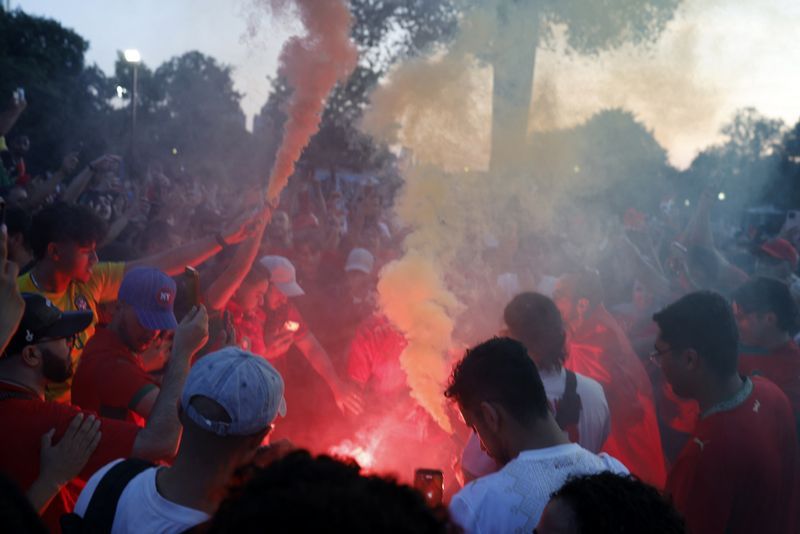
The gathering at Boston Common ahead of Thursday's match, where more than one thousand supporters congregated singing Dima l-Maghrib and waving national flags in a peaceful assembly, captured something of the celebratory rather than hostile character the occasion has assumed in this setting. Youssef Bennani, a 36-year-old software engineer who travelled from Finland specifically to attend Morocco's matches throughout the tournament, articulated the sense of occasion and community atmosphere that permeates supporter gatherings in Boston, where he encountered not only fellow Moroccan enthusiasts but also French fans, all contributing to an anticipated celebration of football rather than a contest laden with tension and menace.
Morocco's tactical and organisational evolution underscores why France cannot approach this fixture with the presumption of straightforward superiority. The 3-0 demolition of Canada demonstrated the pace, structural discipline, and calculated ambition that have propelled them back to the quarter-final stage. Their squad possesses players who have matured within European professional environments whilst retaining connection to Moroccan national identity, creating a sophisticated balance between continental football sophistication and national team cohesion. France's potent attacking capabilities, undoubtedly among the tournament's most formidable, will meet a defensive organisation and counter-attacking threat that has proven consistently difficult to penetrate throughout their campaign.
The fixture ultimately represents something beyond a conventional international sporting encounter. It reflects the reality of contemporary Europe and North Africa, where historical legacies intersect with present-day migration, where families maintain bonds across borders, and where football serves as a primary vehicle for expressing both national pride and personal identity. Boston's neutral setting allows these complexities to emerge without the amplification that European host cities bring, offering supporters and observers the opportunity to experience a quarter-final between two nations whose histories are inseparable but whose footballing communities remain connected through language, friendship, and family—as much family as rivals.

