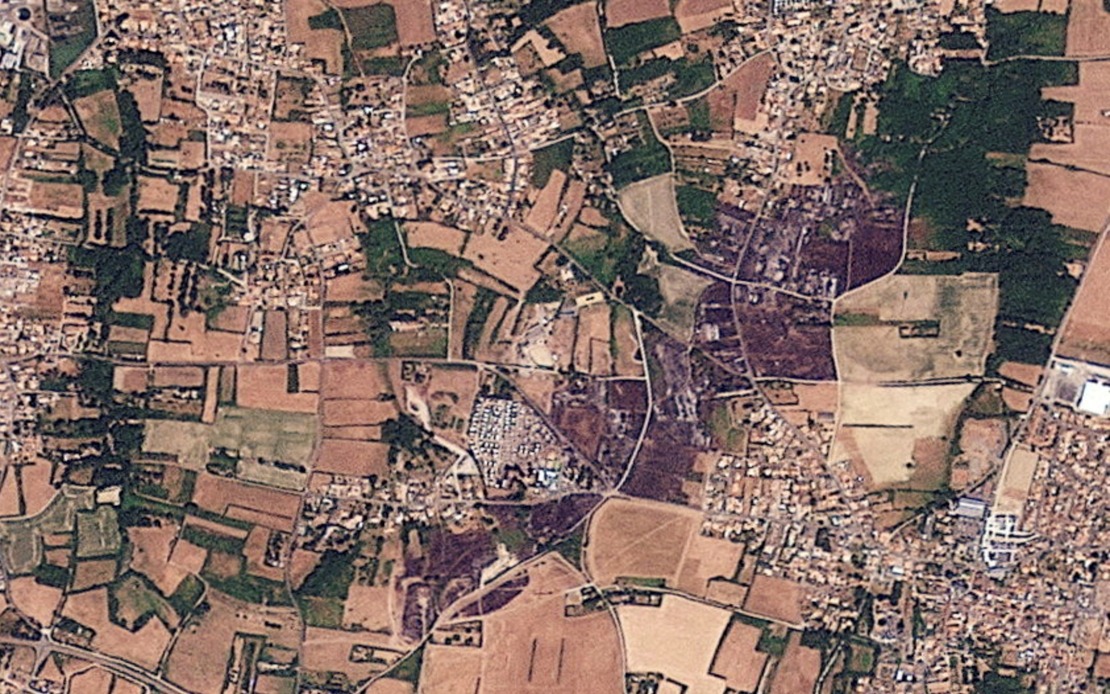
France is confronting a serious wildfire crisis as flames continue ravaging forested regions across the nation, with particular concern focused on two separate blazes tearing through the Fontainebleau forest. The combined fires have already consumed approximately 1,920 hectares of woodland, with the first outbreak emerging on Sunday and subsequently spreading overnight. Authorities have arrested two individuals suspected of deliberately igniting the initial blaze, according to BFMTV reporting, suggesting that arson rather than natural causes may be driving at least some of the destruction currently gripping the country.
The scale of the firefighting response underscores the severity of the situation. Around 600 firefighters remain actively deployed at the Fontainebleau scene, working around the clock to contain the spreading flames and prevent further territorial expansion. The first fire alone has destroyed roughly 1,500 hectares of forest, while the secondary blaze has consumed between 300 and 400 hectares additional woodland. The overnight continuation of both fires indicates that weather conditions and vegetation density are conspiring to accelerate the spread beyond what initial containment efforts could manage.
Policymakers are responding with increasingly tough rhetoric on criminal accountability. Philippe Tabarot, serving as France's Transport Minister, has demanded "very harsh sentences" for those found responsible for deliberately starting fires. His comments reveal a crucial distinction in the French approach to wildfire prosecution: while confirmed arsonists should face "very severe penalties" under the law, those suffering from pyromania—a psychological compulsion to start fires—should instead receive medical treatment rather than purely punitive measures. This nuanced stance acknowledges that not all intentional fire-starters are equally culpable from a moral or legal standpoint.
The problem extends beyond isolated incidents. French authorities have documented a troubling pattern across the nation, with 59 people arrested during the current fire season on suspicion of intentionally igniting wildfires. This statistic suggests that deliberate arson represents a significant component of France's wildfire challenge, not merely an occasional occurrence. The coordination of enforcement efforts across regional authorities indicates growing concern about organized or serial fire-starting that transcends local boundaries.
The impact reaches far beyond forest destruction. Railway infrastructure in southern France has suffered significant damage from the Trevillach wildfire, which ignited earlier this month in the Pyrenees-Orientales region. The blaze compromised rail lines along the strategic Perpignan-Villefranche-Vernet-les-Bains corridor, forcing the national railway operator SNCF to suspend all train services between Ille-sur-Tet and Villefranche-Vernet-les-Bains until at least July 20. This disruption affects commercial transport and regional connectivity, illustrating how wildfire damage cascades through economic and logistical systems.
The geographic spread of active fires demonstrates that the crisis is not confined to a single region. Wildfires are simultaneously affecting Brittany and Lozère as firefighters struggle to contain multiple simultaneous outbreaks across disparate areas. In Brittany's Côtes-d'Armor department, a heath fire erupted near Cap Fréhel on Monday, forcing the evacuation of more than 100 residents and consuming approximately 38 hectares of land. The Lozère region has separately experienced approximately 107 hectares of fire damage, compounding the national tally of destruction.
For Malaysian and Southeast Asian observers, the French wildfire situation offers important lessons about climate vulnerability and emergency preparedness in temperate regions. While Southeast Asia typically faces wildfire challenges linked to agricultural burning and climate anomalies like El Niño, European wildfires increasingly reflect shifting climate patterns and extended dry seasons. The deliberate arson component present in France's current crisis differs somewhat from Southeast Asian patterns, where most fires result from negligence or agricultural practice rather than criminal intent. However, both regions face escalating fire seasons that demand sophisticated multi-agency coordination and substantial firefighting resources.
The French response also highlights the importance of distinguishing between criminal prosecution and public health intervention when addressing fire-related incidents. Southeast Asian countries managing transboundary haze and regional wildfire coordination could benefit from similar differentiation—separating enforcement against negligent or malicious actors from rehabilitation programs addressing addiction or psychological compulsion. Such nuance in policy design often proves more effective than uniform punishment approaches.
The ongoing nature of these fires suggests that France's challenge will persist through the fire season. With hundreds of firefighters deployed, railway infrastructure damaged, and dozens of arson investigations underway, French authorities face a complex situation requiring simultaneous responses to criminal activity, emergency containment, and infrastructure restoration. The scale of deployment and the political attention generated by Transport Minister Tabarot's statements indicate that policymakers view these fires as a serious governance challenge demanding comprehensive solutions beyond simple firefighting.

