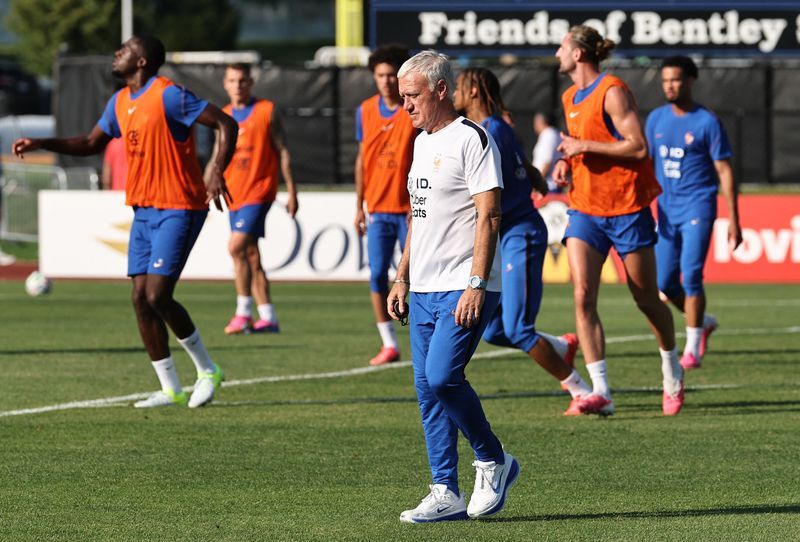
France's passage through the World Cup group stage has been defined by a dazzling attacking display that leaves most rival nations scrambling for comparison, yet coach Didier Deschamps faces a tactical recalibration before Tuesday's Round of 32 encounter with Sweden, a side that will test French organisation as much as firepower. The group stage saw Les Bleus accumulate an unblemished record in Group I, demolishing Senegal, Iraq and Norway with 10 goals across three matches, establishing themselves among the tournament's most formidable attacking outfits.
The spine of France's offensive threat rests on three individuals of genuine world-class quality: Kylian Mbappe has orchestrated the attack with his usual combination of pace and finishing, while Ousmane Dembele's hat-trick against Norway underscored his value in transition and one-on-one situations. Michael Olise, operating on the right wing, has provided the creative balance the system requires, his ability to create chances complementing Mbappe's directness. Together, they represent a constellation of talent that few international squads can replicate, giving Deschamps attacking options that extend far beyond the starting eleven.
Yet for all this offensive sophistication, the left side of France's setup has betrayed occasional structural weakness. Theo Hernandez at left back has struggled to impose himself with the consistency Deschamps demands, his defensive positioning sometimes leaving gaps that sharper opponents might exploit. The fixture against Sweden will likely see Lucas Digne introduced to bolster the defensive integrity of that flank while providing more controlled service to attacking players operating in advanced areas.
Bradley Barcola is expected to shift left-wing duties from Desire Doue, a tactical adjustment designed to inject more directness and penetrative running into an area that has occasionally appeared predictable. Where Doue offers control and intelligent movement, Barcola brings explosive acceleration and the kind of one-versus-one capability that can destabilise deep-lying defences. This reconfiguration would not fundamentally alter France's shape but rather tighten the functional coherence of their left-sided operations, particularly important against a Swedish team anticipated to sit deep defensively and look for space behind France's advancing fullbacks.
The anticipated return of William Saliba to central defence provides additional ballast. His recovery represents a significant boost for a back line that has occasionally been caught unprepared by rapid transitions, particularly during the Norway fixture when defensive lapses emerged despite the scoreline's dominance. Saliba's positioning and reading of play should provide the stability needed for a knockout match where concentration lapses become more consequential.
Sweden present themselves as competent rather than spectacular opponents, arriving in the knockout stage as Group F runners-up after claiming second place behind the Netherlands. Their opening demolition of Tunisia, delivered with a 5-1 victory, suggested attacking capability, yet the subsequent 5-1 reversal at Dutch hands and a 1-1 stalemate against Japan painted a picture of a side capable of inconsistency. What Sweden possess is physical robustness and organisational discipline, qualities that could render the evening uncomfortable should France's control falter. With Alexander Isak, Viktor Gyokeres and Anthony Elanga available, Sweden's attacking resources, whilst competent, sit considerably distant from the calibre of France's weaponry.
The transition from group stage to knockout football invariably separates the transactional from the substantive. France's ability to overwhelm opponents through sheer attacking volume masks occasional defensive carelessness that becomes more exposed when teams defend shrewdly and look to punish turnovers. France's tournament history offers comfort: excluding the 2022 final defeat against Argentina, their knockout record at World Cups stretches back to 2014 without loss, a statistic suggesting institutional capability at tournaments' crucial junctures.
Deschamps' bench represents perhaps the most significant strategic advantage in the tournament. Beyond the starting attacking triumvirate, he can introduce Barcola, Doue, Rayan Cherki, Jean-Philippe Mateta or Marcus Thuram as circumstances demand. This depth of attacking alternatives provides genuine flexibility; few squads can contemplate replacing three attacking starters of genuine quality with substitutes who themselves carry international pedigree and World Cup experience. Such resources become particularly valuable in knockout competition where fatigue and tactical adjustment become increasingly relevant across the 90 minutes.
Former England international Gary Lineker's assessment, delivered to French sports daily L'Equipe, captured the consensus view: regardless of Sweden's defensive organisation or tactical discipline, France's firepower overwhelms. He acknowledged that four elite forwards could theoretically create vulnerability on counter-attacks, a vulnerability glimpsed against Norway's second-string defensive unit, yet concluded that France's capacity to generate goal-scoring opportunities exceeds their rivals' ability to defend consistently. This represents the fundamental imbalance in the matchup.
Victory for France would advance them to the Round of 16 against the winner of the Germany-Paraguay fixture, a pairing that would pit them against either another heavyweight or a Paraguayan side seeking to prove themselves at this level. The fixture sequence suggests an increasingly demanding path through the knockout stages, one where defensive solidity becomes as valuable as attacking prowess. Sweden, despite arriving as underdogs, will provide an initial test of France's ability to execute with intelligence when knockout football's unforgiving nature eliminates room for complacency or tactical drift.
For Malaysian and Southeast Asian observers, the fixture illustrates the chasm separating elite European attacking football from regional standards. The technical execution, movement patterns and finishing standards on display represent benchmarks toward which regional clubs and national teams aspire, yet remain distant from current capability. France's anticipated progression represents a validation of their stated status as tournament favourites, though the left flank adjustment suggests even elite sides require tactical refinement when knockout competition begins.

