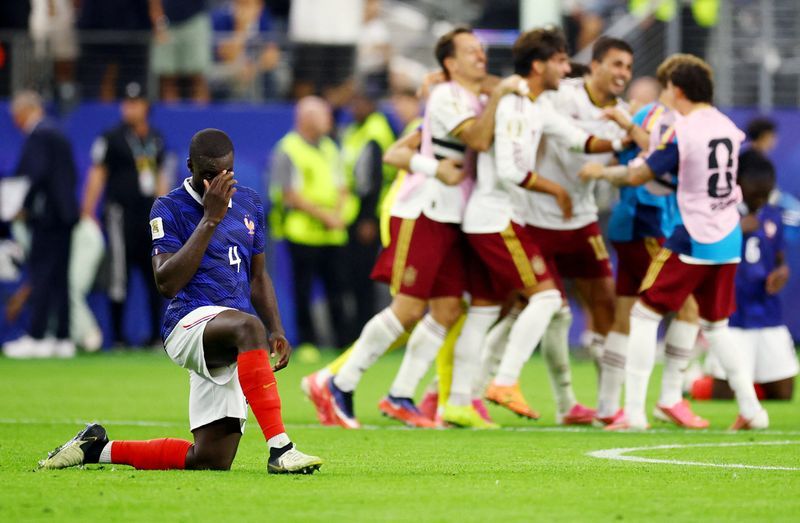
France's bid to retain their World Cup crown collapsed in dramatic fashion on Tuesday evening, succumbing to Spain 2-0 in the semi-final at Arlington, Texas. The defeat represented a stunning reversal of fortune for the tournament favourites, who entered the match as the team most expected to challenge for the trophy. What unfolded was not a closely contested encounter that could have gone either way, but a comprehensive dismantling by a Spanish side that understood the match's demands far better than their vaunted opponents. The result leaves France, who have dominated international football over the past six years, facing an early and uncomfortable exit from a competition they had seemingly positioned themselves to win.
The manner of France's collapse will haunt the squad for years to come. Unlike their 2022 World Cup final loss to Argentina, where they mounted a stirring second-half comeback and pushed the match into extra time and penalties despite falling behind, there was no equivalent resilience or recovery on display against Spain. France manager Didier Deschamps acknowledged the harsh reality in his post-match assessment, recognising that his team had been outplayed across the park. "The players are devastated, but we have to be clear-headed: technically, we were second best. That is on us," Deschamps said, a candid admission from a coach who rarely offers such unfiltered evaluations. The acknowledgement underscored just how thoroughly Spain had dominated proceedings, leaving no room for debate about which side deserved to progress.
Spain's dominance flowed from a tactical masterclass orchestrated by their creative fulcrum Rodri, who manipulated the pace and flow of the match with ruthless precision. The midfielder's control of the centre of the pitch rendered France's vaunted attacking threats ineffective, allowing Spain to dictate possession and territory throughout. France's midfield pivot, tasked with anchoring the team's defensive shape and launching attacking moves, was systematically overrun from the opening moments. Adrien Rabiot's early yellow card compromised his capacity to challenge Spain's advances, while Aurelien Tchouameni, still working his way back to match fitness following a two-game absence due to a hamstring injury, struggled to maintain the intensity required against Spain's fluid passing movements. This midfield vulnerability exposed France's backline repeatedly, forcing their defenders into reactive rather than proactive positions.
The symbolic representation of France's technical shortcomings lay in the performance of Michael Olise, the young playmaker around whom so much of pre-match discussion had revolved. Olise had been positioned as France's potential match-winner, a player with the creative vision and technical quality to unlock Spain's defence and orchestrate his team's attacking play. Instead, he cut an isolated and ineffectual figure throughout the encounter, appearing overwhelmed by the pace of the semi-final stage. The statistics told a damning story: Olise surrendered possession on twenty separate occasions, a frequency that suggested persistent difficulty in reading the match's rhythm and his opponents' pressing approach. More worryingly, he failed to complete a single dribble, a telling indicator that he was operating without the space, time, or confidence typically associated with his performances at club level. Rodri's dominance made Olise's struggles more pronounced by contrast, highlighting the gulf in midfield performance between the two teams.
France's attacking threats extended beyond Olise's limitations, with the entire forward contingent failing to establish the attacking menace expected of a team featuring some of Europe's most dangerous attackers. Ousmane Dembele, tasked with providing width and penetration on the right flank, posed virtually no threat to Spain's back line, neutralised by intelligent Spanish defending and his own apparent inability to find dangerous positions. Bradley Barcola, selected ahead of other attacking options, was equally blunt in his contributions, while his replacement Desire Doue failed to inject the required dynamism upon entering the fray. Perhaps most surprisingly, Kylian Mbappe, arguably the world's most consistently lethal finisher, never produced the moment of individual brilliance his team desperately needed. The absence of any defining contribution from a player of Mbappe's calibre suggested a collective failure in creating the conditions for him to operate effectively rather than purely an individual underperformance.
Lamine Yamal's pre-match declarations of Spanish confidence, delivered with the swagger characteristic of a teenager unencumbered by doubt, proved prophetic. Spain, far from being intimidated by France's billing as tournament favourites, appeared liberated by the opportunity to test themselves against the supposed best. The Spanish midfielder had publicly stated that France should fear his team's capabilities, a bold assertion that proved entirely justified by events on the pitch. Spain's willingness to engage France directly, rather than attempting to frustrate and absorb pressure as lesser opponents might have done, demonstrated a confidence rooted in clear tactical preparation and technical superiority. The Spanish approach of manipulating tempo—slowing play when advantageous and accelerating when opportunities emerged—proved far more effective than France's anticipated rhythm, catching Deschamps' team perpetually off-balance.
Two defensive errors proved costly, though they emerged from deeper tactical vulnerabilities rather than isolated moments of individual negligence. Mikel Oyarzabal converted a penalty awarded after just twenty-two minutes, giving Spain an early advantage that shaped the remainder of the match. Pedro Porro's goal arriving just before the hour mark effectively settled the contest, though Spain continued to play with control and purpose throughout the second period. These goals represented the consequence of France's systemic failure to establish a stable defensive foundation. The exposed midfield meant France's back four was constantly under siege, facing numerical disadvantages and lacking adequate defensive cover. Spain's repeated penetrations through the middle created the circumstances that led to both goals, each emerging from France's inability to control or contest the central areas of the pitch.
The emotional aftermath captured the depth of France's disappointment. Kylian Mbappe stood isolated on the pitch as the final whistle sounded, a solitary figure amid the Spanish celebrations. Other French players dropped to their knees or buried their faces in their hands, physical manifestations of the psychological devastation that accompanies such an unexpected and comprehensive defeat. The unified messaging of togetherness and cohesion that had dominated France's pre-match communications—repeated endlessly by players and staff in the buildup to Tuesday's match—suddenly rang hollow. That carefully constructed narrative of a squad unified in purpose and determined to reclaim World Cup glory had evaporated within ninety minutes of football, replaced by the reality of a team that had fundamentally misread both their opposition and their own readiness for the occasion.
For Malaysian and Southeast Asian observers, France's elimination carries broader implications for the tournament's competitive balance. The result demonstrates that even established football superpowers cannot guarantee success at the World Cup, where tactical acuity and collective discipline can overcome individual star power. Spain's victory also reinforces the importance of midfield control and tempo management—principles that extend far beyond this particular match. As other nations assess their own World Cup prospects, the lesson from France's collapse is unambiguous: preparation, tactical coherence, and psychological resilience matter as much as the quality of individual players available. France's exit also opens unexpected pathways for other contenders, suggesting the tournament remains genuinely competitive and that the tournament favourites' supposed dominance was perhaps more assumed than demonstrated.

