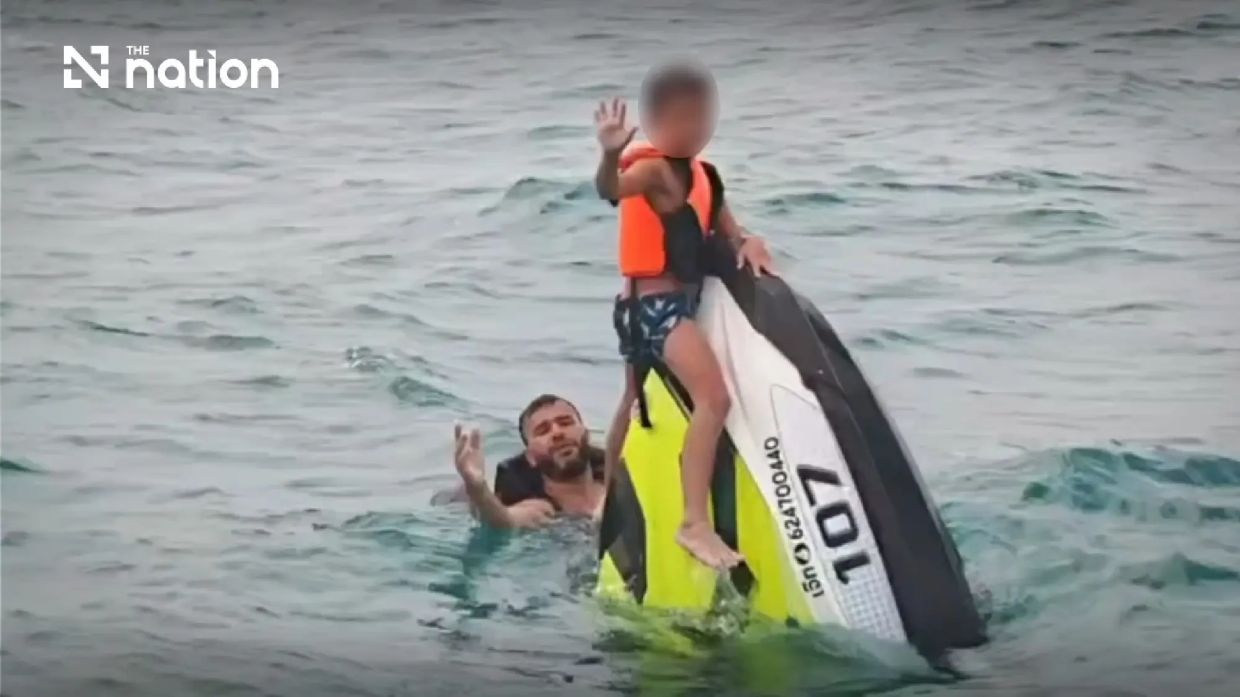
A French family's holiday took a harrowing turn when their rented jet ski capsized off the coast of Koh Samui, leaving a 50-year-old father and his sons, aged five and seven, stranded at sea for over 16 hours. The trio were eventually found and rescued on Friday morning, with local authorities confirming that despite their ordeal, all three were discharged from hospital after medical checks revealed no serious injuries.
The incident unfolded on Thursday evening when the father hired the jet ski from a local operator on Koh Samui, Thailand's celebrated resort destination in the Gulf. The rental was supposed to be a brief recreational outing, with an agreed return time set for that same evening. However, as hours passed without the family's return, concern mounted among the jet ski operator and local authorities, triggering a comprehensive search-and-rescue operation that would ultimately span the entire night.
According to Amorn Chomchoey, the local government official overseeing the response, rescuers discovered the family in a state of physical exhaustion after their extended exposure to the elements. The father and both children had ingested significant quantities of seawater during their time in the water, and the visible toll was evident when they were pulled to safety. The two boys, in particular, exhibited signs of severe distress, their complexions pale from the combined effects of dehydration, sun exposure, and hypothermia from prolonged immersion.
The rescue operation commenced when the jet ski operator became alarmed at the family's failure to return within the expected timeframe. Rather than assuming a simple delay, the operator immediately contacted local rescuers and provincial authorities, setting off a coordinated maritime search. The decision to alert officials swiftly likely proved crucial to the family's survival, as the search teams systematically scanned the waters surrounding Koh Samui throughout the night. By approximately 10 a.m. on Friday, roughly 17 hours after the family first ventured onto the sea, rescue personnel located the capsized vessel with the father and children still clinging to its overturned hull.
Video documentation of the rescue provides insight into the precarious situation that greeted the rescue team. The jet ski remained almost entirely submerged, with only its distinctive triangular front section protruding above the waterline. One of the young boys had managed to position himself atop this narrow refuge, while his father floated in the surrounding water, both thankfully wearing life jackets that undoubtedly saved their lives during the extended ordeal. Rescue personnel can be heard in the footage urgently calling out reassurances to keep the family calm while executing the delicate process of transferring them to the rescue vessel.
The cause of the capsizing has become the focus of investigators seeking to understand how the jet ski failed so dramatically after operating for just over 15 minutes. The father initially informed officials that he possessed considerable experience operating jet skis, suggesting that operator error was unlikely to be the primary factor. However, the rental company offered a competing explanation to local media, alleging that the family had ventured beyond the designated zone specified in their rental agreement. If substantiated, this account would suggest that the father may have taken the jet ski into unfamiliar waters with different conditions, or areas where the equipment was not intended to operate.
The incident raises important questions about water safety protocols and oversight at Thailand's popular beach destinations, which annually welcome millions of international holidaymakers. Koh Samui itself has cultivated a reputation as a particularly family-friendly destination, celebrated for its calm waters and extensive array of resort facilities designed to accommodate visitors with children. The prevalence of water sports rental operations on the island reflects the high demand for such activities, yet the oversight mechanisms ensuring compliance with safety zones and equipment maintenance remain areas of legitimate concern.
For this particular French family, however, the incident has not dampened their appreciation for Thailand. Local officials confirmed that after their rescue and discharge from medical observation, the family opted to remain on the island and continue with their holiday plans. This decision speaks to both their resilience and their confidence in the rescue response they received, demonstrating that even after a traumatic experience, many visitors retain positive perceptions of Thailand as a destination.
The rescue operation itself reflects the competence and readiness of Thai maritime authorities, whose quick mobilization and thorough search efforts ultimately proved successful in locating the family before their situation deteriorated further. The presence of life jackets, while not preventing the capsizing, was instrumental in enabling the family to remain buoyant throughout their ordeal. For Malaysian and regional travellers considering water sports activities at popular destinations throughout Southeast Asia, the incident serves as a reminder of the importance of adhering strictly to designated operational zones, ensuring proper safety equipment is secured, and selecting reputable rental operators with strong safety records.

