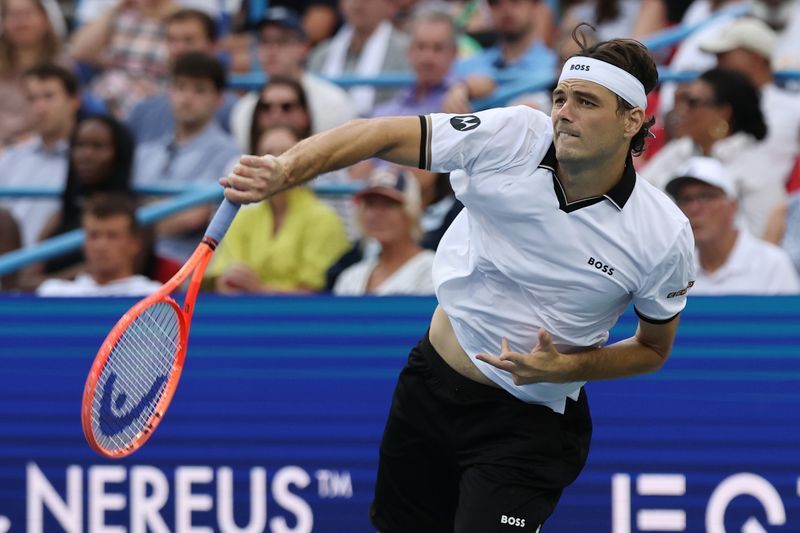
Taylor Fritz secured his place in the Washington Open final on Saturday after a composed performance against American compatriot Brandon Nakashima, winning 6-3 3-6 6-2 in the semi-final. The world number 10, seeded third in the tournament, navigated a challenging middle set to advance to the 23rd ATP final of his professional career, demonstrating the mental resilience required at the elite level of professional tennis.
The match unfolded in contrasting rhythm across its three sets, with Fritz commanding the opening exchanges before facing a brief but significant test in the second frame. Working with considerable precision off the baseline, Fritz accumulated 24 winners throughout the contest while limiting his unforced errors to just 16—a significant margin over Nakashima's 27 mistakes. The American's serving prowess proved particularly influential, as he struck 13 aces en route to victory, establishing early momentum that proved difficult for his opponent to overcome.
Fritz's breakthrough came decisively in the opening set, where competitive tennis remained tightly contested until the 28-year-old secured a critical break while holding a 4-3 advantage. Once ahead in the set, he demonstrated excellent composure in service games, closing out the opening frame in a brisk 34 minutes. This efficiency would prove characteristic of his dominant first and third-set performances, though the middle portion of the match presented unexpected complications.
Nakashima, the unseeded American whose pursuit of a maiden ATP 500 final remained his primary objective coming into Washington, responded with genuine intensity in the second set. The younger player captured an early break to establish a 3-1 lead, then consolidated with a love service game to push ahead 5-2. His aggressive positioning and willingness to dictate rallies paid dividends as he claimed the second set 6-3, forcing Fritz to reset mentally and tactically for a decisive third set.
The momentum shift proved temporary, however. Fritz reasserted control from the opening game of the third set, executing a crucial break in the second game before holding his own serve to love for a commanding 3-0 advantage. Having weathered Nakashima's resurgence, the third-seeded American maintained relentless pressure thereafter, ultimately closing out the match with growing confidence. In post-match reflections, Fritz emphasised the importance of that break in the third set, acknowledging the narrow margins that characterised an otherwise competitive encounter in which both players created limited opportunities against strong serving.
Fritz's opponent in Sunday's final will be Spain's Rafael Jodar, who engineered an impressive comeback against Chile's Alejandro Tabilo in the other semi-final. Jodar prevailed 6-7(6) 6-4 6-4, recovering from a set down to claim what represents a significant achievement during an extraordinary career trajectory for the Spanish teenager. The comeback victory showcased Jodar's mental fortitude and tactical adjustment capabilities—qualities that have defined his meteoric rise through professional tennis rankings.
Tabilo, the Chilean competitor, held the early advantage by securing the opening set in a tiebreaker, testing Jodar's composure in precisely the circumstances where consistency matters most. Rather than fracturing under pressure, Jodar demonstrated notable patience and strategic resilience. He acknowledged post-match that accepting the missed break opportunities early in both the first and second sets proved psychologically crucial, allowing him to remain focused rather than becoming frustrated by incremental setbacks. Once securing his own break in the second set, Jodar's confidence visibly expanded, with his serving velocity and accuracy increasing markedly.
The remarkable aspect of Jodar's Washington performance becomes fully apparent when contextualised against his recent history. Just five months prior to this Washington semi-final, the same Alejandro Tabilo had dismantled Jodar 6-1 6-2 at the Indian Wells Masters in March. At that juncture, Jodar remained outside the world's top 100 players, an obscure prospect among professional tennis's vast middle ranks. His subsequent trajectory defies conventional career progression patterns, with an outstanding clay-court season fundamentally transforming his competitive standing and public profile.
The catalyst for Jodar's transformation arrived at the Grand Prix Hassan II in Morocco, where the young Spanish player captured his maiden ATP title. This breakthrough victory initiated a cascading series of strong performances that have systematically elevated his ranking throughout the summer months. For Malaysian and Southeast Asian followers of professional tennis, Jodar's emergence represents the type of unexpected rise that periodically reminds observers of the sport's meritocratic nature—where sustained excellence and tactical intelligence can rapidly overcome experience deficits.
Jodar's triumph in Washington carries particular significance for his career trajectory moving forward. The 19-year-old will formally enter the top 20 of the ATP rankings when the weekly update releases on Monday, a milestone that typically unlocks enhanced opportunities through improved tournament seeding, higher-profile sponsorship possibilities, and substantive increases in career prize earnings. For context, Jodar's Washington run alone—reaching the final without losing a set before the semi-final—represents the type of high-level competition exposure that accelerates development at the professional level.
The Washington Open final thus pits seasoned professionalism against ascending youth, with Fritz seeking to add another significant title to his career while Jodar pursues what would represent a genuine breakthrough moment at the ATP 500 level. Fritz, at 28 years old and sitting comfortably within tennis's established hierarchy at world number 10, arrives as the natural favourite. However, Jodar's recent performances and demonstrated ability to elevate significantly during high-pressure moments suggest the Spaniard will present genuine competitive challenges. The encounter promises compelling tennis that illustrates contrasting career stages within elite professional competition.

