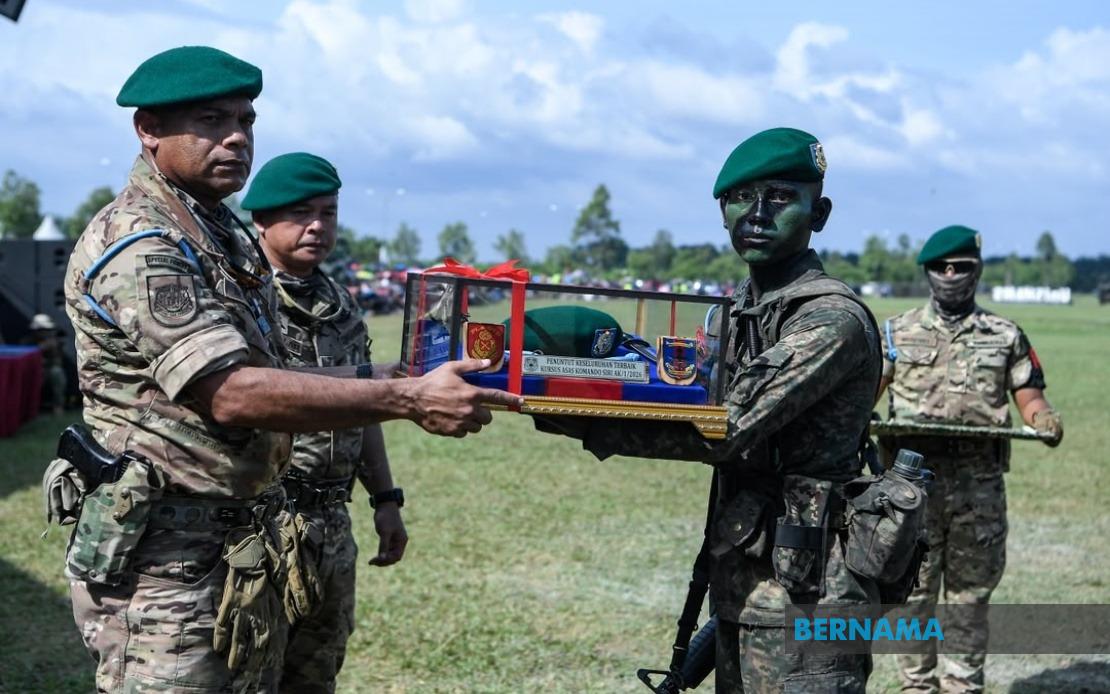
Second Lieutenant Muhammad Fadli Jamalluddin's journey to earning Malaysia's coveted green beret was anything but straightforward. The 24-year-old officer from Ampang, Kuala Lumpur, emerged as the Best Overall Trainee at the recent closing ceremony of the Basic Commando Course Series AK/1/26, held at Universiti Sultan Abdul Halim Mu'adzam Shah in Kuala Ketil. His achievement carries particular weight given that he had previously failed to complete the Basic Commando Course Series 3/2024, a setback that could have discouraged many from pursuing such an arduous military path.
Muhammad Fadli's military aspirations took root long before his formal commissioning. His interest in military service crystallised during secondary school, leading him to pursue studies at the National Defence University of Malaysia (UPNM). After graduating with a Bachelor's degree in Global Policing and Intelligence with Honours, he joined the Royal Malay Regiment in 2024, beginning what would prove to be a transformative military career. His decision to pursue the commando stream reflected a deliberate choice to tackle what he recognised as one of the most demanding specialisations within the armed forces.
The motivation driving his perseverance extended beyond personal ambition. As the third of five siblings, Muhammad Fadli sought to make his father proud whilst also challenging himself to the limits. During his final year of formal military training at UPNM, he made a conscious decision that if he had committed to an army career, he should pursue its most challenging trajectory. This philosophy proved instrumental when he encountered what could have been a career-ending obstacle midway through his commando course. The demanding nature of special operations training, he would later reflect, requires not merely physical prowess but also the intellectual capacity for complex tactical planning and sound decision-making under extreme stress.
The three-month Basic Commando Course Series AK/1/26 subjected participants to intensive land and sea-based training designed to push trainees to their physical and psychological breaking points. Muhammad Fadli came perilously close to another failure during the eighth week when he fell short in one of the training exercises. Under course regulations, this near-miss could have forced him to restart the entire gruelling programme from the beginning. The emotional toll of that moment was significant; having already completed over 100 kilometres of endurance marching and weeks of relentless physical and mental conditioning, facing potential repetition tested his resolve in ways that pure physical training could not.
When informed of his failure in that critical exercise, Muhammad Fadli wept, fully aware of how close he had come to success and how distant another complete cycle seemed. The psychological pressure was compounded by counsel from those around him, many of whom suggested he should not attempt to continue given the extreme nature of the course's demands. However, his perspective on failure had crystallised during his earlier unsuccessful attempt at the commando course. Rather than viewing the setback as an endpoint, he had reframed it as an opportunity to return with greater preparation and determination. This mindset proved crucial in the eighth week when, despite his tears, he resolved to push forward rather than accept defeat.
The course structure that Muhammad Fadli navigated reflects the comprehensive demands placed upon officers selected for commando operations. Becoming a commando officer represents a significantly higher bar than enlisted commando qualification, requiring participants to demonstrate not only superior physical conditioning but also leadership capability, rapid decision-making under duress, and the capacity to plan and execute complex special operations. The three-month timeframe compresses an enormous amount of physical hardship and tactical instruction, with participants experiencing sustained sleep deprivation, extreme environmental exposure, and psychological stress designed to simulate operational conditions.
Muhammad Fadli's achievement carried personal significance that transcended military hierarchy and recognition. His father had suffered a stroke more than a year prior to the commando course, rendering him unable to attend the closing ceremony. Nonetheless, Muhammad Fadli viewed his completion and top ranking as the most meaningful gift he could present to his parents and extended family. He expressed hope that news of his achievement would provide his father with strength during his ongoing recovery, illustrating how military accomplishment often intertwines with family motivation and filial obligation within Malaysian culture.
The Basic Commando Course Series AK/1/26 saw 38 personnel successfully complete the programme, comprising five officers and 33 other ranks. The successful completions contribute to the Malaysian military's ongoing requirement for highly trained personnel capable of executing sensitive special operations. Muhammad Fadli's distinction as Best Overall Trainee was formally recognised by Colonel Nordin Abu, Commandant of the Special Warfare Training Centre (PULPAK), during the official closing ceremony. This recognition underscores the institutional commitment to acknowledging excellence within the commando training pipeline.
Muhammad Fadli's trajectory offers broader lessons relevant to military recruitment and training philosophy in Southeast Asia. His experience demonstrates that initial failure need not preclude ultimate success, particularly when institutional structures permit second attempts and when individual motivation remains sufficiently robust. The Malaysian military's willingness to allow recertification attempts reflects confidence in identifying genuine commando material despite initial underperformance. Furthermore, his achievement illustrates the capacity of younger military officers to absorb feedback, restructure their approach, and return with enhanced capability and determination.
The commando course's intensive three-month duration and its emphasis on both physical conditioning and mental resilience align with international best practices in special operations training. Unlike some longer commando courses that extend over six months or more, the compressed timeframe demands that participants arrive adequately prepared through earlier phases of military training. Muhammad Fadli's UPNM background and Royal Malay Regiment service presumably provided foundational conditioning and discipline that enabled him to execute the commando course with sufficient preparation to ultimately excel.
Looking forward, Muhammad Fadli's elevation within the special operations community opens career pathways toward more advanced training and potentially posting to the 21st Special Service Group (21 GGK), Malaysia's premier special operations unit. His demonstrated resilience, tactical intelligence background, and capacity to learn from failure position him well for assignments requiring sophisticated planning and precise execution. For Malaysian military observers and those monitoring regional defence capabilities, the emergence of highly trained young officers through the commando pipeline represents institutional strength and forward-thinking personnel development.

