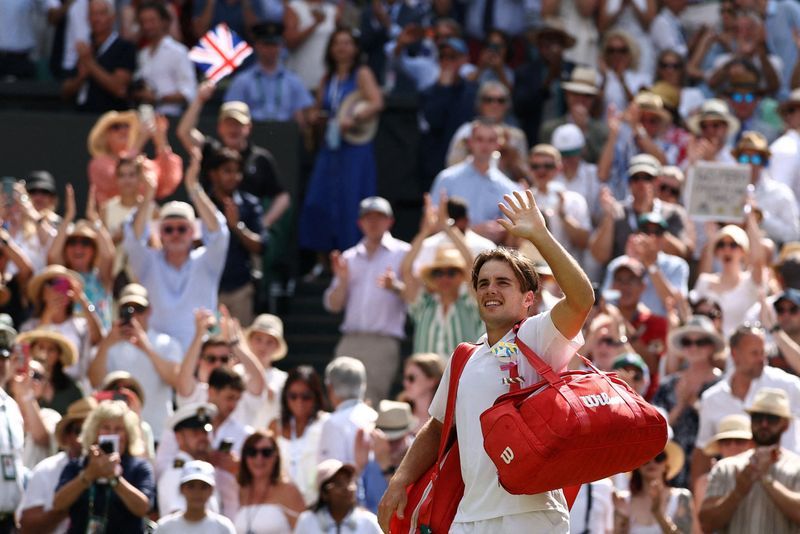
Arthur Fery's Wimbledon adventure defied even his own expectations. The British tennis player had resigned himself to a relaxing week in Greece, accepting that his participation in the grasscourt championship would be minimal. Instead, the 23-year-old found himself embedded in a remarkable run that has captivated the British public and rewritten the narrative of what a wildcard entry can achieve at one of sport's most prestigious tournaments. After beating five consecutive opponents to reach the semi-finals on Friday, Fery's journey finally ended when Germany's Alexander Zverev proved too formidable in straight sets, but not before the young player had etched his name into Wimbledon folklore.
Fery's emergence as a genuine contender represents the kind of underdog story that resonates far beyond the tennis court. Ranked 114th globally at the tournament's outset, he possessed minimal expectations and even less preparation for a deep run. His prior record at the four Grand Slam events had been decidedly modest, with just two main draw victories under his belt before this month. The decision to accept a wildcard invitation appeared routine, a chance to gain experience at the highest level whilst his friends headed south for Mediterranean sun. Yet as each round unfolded, the calculations changed, and what should have been a brief London interlude transformed into an 11-day odyssey that proved transformative for his professional ambitions.
The contrast between his anticipated and actual week underscores the unpredictability that makes tennis captivating. Fery had genuinely expected to lose early, freeing himself for leisure travel. One of his friends possessed such confidence in this outcome that he departed for Greece ahead of schedule, assuming his friend would join him within days. The friend's return just two days later, sheepishly reversing his travel plans to support Fery's improbable ascent, captures the surreal nature of the wildcard's success. Fery's recounting of this anecdote reveals both humour and the genuine shock that surrounded his progression, even among those closest to him who should have backed his abilities.
The scale of public backing Fery received transcended normal sporting enthusiasm. England's football team, fresh from their own international competitions, sent a video message of encouragement. More significantly, senior members of the British royal family made appearances at his matches, with Queen Camilla and Princess Kate both attending Centre Court to witness his performances. This level of establishment recognition typically requires sustained success or celebrity status; for a 23-year-old wildcard to command such attention speaks to the hunger for British sporting triumph and the emotional investment in homegrown talent achieving at the sport's pinnacle. The encouragement created momentum and visibility that further propelled Fery's journey, transforming him from an obscure provisional entry into a national sporting narrative.
Fery's experience navigating the heightened expectations and attention represents a significant psychological challenge that extends beyond his immediate circumstances. The player demonstrated considerable maturity in acknowledging that his ranking trajectory—expected to catapult into the mid-30s following this run—will fundamentally reshape his professional environment. Securing sufficient ranking points to guarantee entry into most tour events for at least the next year removes a perpetual source of anxiety that has constrained his ability to develop a consistent schedule. Yet this liberation carries its own burden. Higher-ranked opponents will no longer underestimate him, tournament organisers will expect greater consistency, and the public will anticipate continued excellence from the player they have embraced.
The financial dimension of Fery's run provides immediate practical benefits that merit attention from a Malaysian sporting perspective. His semi-final appearance generated £900,000 in prize money—approximately £1.21 million in combined earnings. For context, this sum represents more compensation than many professional tennis players accumulate across entire seasons. The financial security enables Fery to invest properly in training infrastructure, coaching expertise, and lifestyle optimisation that previously may have been constrained by budget considerations. Regional tennis players and administrators monitoring global developments should recognise how tournament structure and prize distribution at major events can fundamentally alter career trajectories for emerging talent.
Fery's reflection on the broader transformation ahead demonstrates consciousness of the psychological dimensions that often determine whether breakout performances catalyse sustained achievement or remain isolated peaks. He explicitly acknowledged needing time to process the intensity and scale of recent experiences before resuming competitive play. This restraint and self-awareness contrasts with the temptation to immediately capitalise on momentum through over-commitment. The player correctly identified that his next major test will arrive during the North American hardcourt swing, culminating in his debut appearance at the US Open at Flushing Meadows. These tournaments represent a different challenge entirely, with higher-ranked competitors and alternative court conditions that may not suit his developing game.
For Southeast Asian tennis observers and administrators, Fery's trajectory offers instructive lessons regarding talent identification and development pathways. The British system's capacity to identify promising players through wildcard mechanisms, combined with access to world-class training facilities and grand slam venues, creates conditions for rapid advancement. The contrast with regional frameworks—where player development often depends on scarce public funding and limited tournament opportunities—remains stark. Fery's success should prompt reflection on how regional tennis associations can construct domestic systems that similarly identify and nurture emerging talent through strategic competition scheduling and resource allocation.
Looking forward, Fery enters uncharted territory with both enthusiasm and realistic perspective. His career progression will depend substantially on whether he can consolidate gains through consistent performance across multiple tournament environments rather than regressing to previous patterns. The upgraded Greek holiday he can now afford represents pleasant compensation, yet the greater reward lies in professional doors opening across the global tennis circuit. Success at Wimbledon as a wildcard has proven exceptionally rare—his achievement as the first in 25 years to reach the semi-finals underscores the rarity of such outcomes. Whether Fery joins the small cohort of players who transform single breakthrough performances into sustained tour excellence remains an open question, but his foundation has been firmly established.

