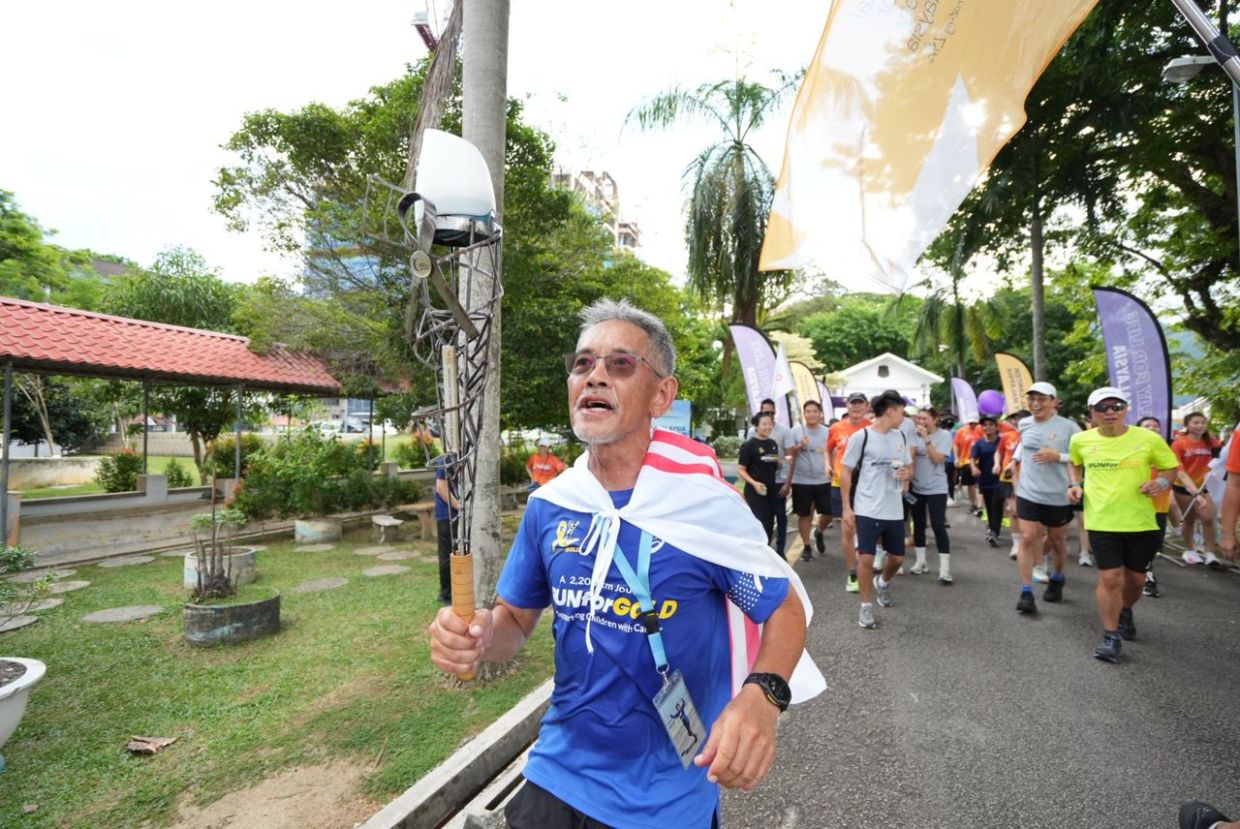
At 66 years old, SG Lim—a retired civil engineer and dedicated runner from Penang—might have expected to ease into the quieter rhythms of retirement. Instead, the death of his wife, Goh Joo Lee, from cancer in 2024 propelled him into an unexpected chapter of physical endurance and renewed purpose. Rather than retreating from grief, Lim chose to transform it, embarking on one of the most ambitious personal challenges of his life that would ultimately reshape how he processes loss and honour his late spouse's memory.
The months following Goh Joo Lee's passing at age 63 saw Lim navigating the disorientation that accompanies profound loss. He spent time moving between continents and countries, splitting his days between Australia with his two children, Malaysia with his mother and siblings, and periods of solitude in Hong Kong. Yet these travels, though geographically varied, left an emotional void that motion alone could not fill. When reflecting on his late wife, Lim's description is spare and poignant: she was "loving" and "caring" in ways that extended far beyond her immediate circle. Even whilst battling cancer in hospital, she remained preoccupied with the wellbeing of those around her, including strangers in adjacent wards. He recalls her purchasing flowers for a fellow cancer patient she had never met, a gesture that illuminated her character even in her darkest moments. Her artistic talents—drawing, painting, and creating—left traces across her social media that continue to serve as windows into her creative spirit.
The turning point in Lim's grieving process arrived through reading, specifically a book by Laurence Carter that inspired him to consider a monumental physical undertaking. He reached out to Carter for guidance and began conceptualizing an ambitious plan: to run across the length of Peninsular Malaysia. This was no casual notion born of a solitary afternoon; it represented a deliberate channelling of grief into action. With backing from the National Cancer Society Malaysia (NCSM), his vision crystallized into "Run For Gold"—a marathon designed to raise awareness and financial support for children currently battling cancer. By tethering his personal sorrow to a cause that honoured Goh Joo Lee's compassionate nature, Lim discovered a framework through which loss could generate meaning.
Preparing for such an endeavour demanded meticulous conditioning. Following his completion of the Sydney Marathon in August, Lim intensified his training regimen with calculated precision. He committed to pre-dawn departures starting at 5am, deliberately ran during midday heat to acclimate his body, engaged in regular strength training, and even acquired new technical skills by teaching himself video editing to chronicle his journey on social media. These preparations extended beyond the merely physical—they represented an emotional commitment to honouring both his wife's memory and the mission he had undertaken. Every morning run became a meditation on loss; every marathon training session, an act of devotion.
When Lim finally commenced his journey across 11 states and federal territories, he carried with him not only his grief but also a deepening awareness of the cause he championed. His inaugural visit to a children's oncology ward operated by NCSM struck him with visceral force. Observing frail children and the helpless expressions of their parents crystallized his sense of righteous purpose. Here were young lives interrupted by illness; here were families bearing burdens no parent should carry. Lim's running legs became instruments of advocacy, and each kilometre completed a small act of solidarity with children enduring far greater struggles.
The human connections forged along the route proved as significant as the physical distance traversed. In Pekan, Pahang, Lim encountered a retired teacher and his wife whose commitment to the cause transcended passive support. Unable to contribute financially, the couple offered their legs, their lungs, and their voices. The wife ran alongside Lim through multiple states—Johor, Melaka, and Penang—while her husband became an itinerant ambassador, visiting eateries and community spaces to articulate the cause to strangers. What struck Lim most profoundly was their devotion to each other, the tender dynamic of a couple operating as a unified force. Watching them move through the journey as a partnership triggered acute pangs of loss; they embodied the collaborative love he and Goh Joo Lee had shared.
After nearly three months and 2,200 kilometres of running—covering terrain both familiar and foreign, traversing monsoon conditions, fatigue, and the psychological weight of sustained exertion—Lim crossed the finish line in George Town, Penang. The moment bore the imprint of everything he had been processing. His first utterance, spoken aloud and barely containing emotion, was directed at his absent wife: "Darling, we made it!" In those few words lay the entire arc of his journey—the grief transformed into action, the solitary runner who carried his beloved's spirit across an entire nation, the man who had converted personal devastation into collective benefit.
Yet the completion brought unexpected revelation. Beyond the physical relief of finishing, Lim found himself overwhelmed by the human geography of his journey. Family members, childhood friends, former classmates, and countless strangers who had heard his story lined the finish line to celebrate his arrival. What had originated as a deeply personal pilgrimage—a private conversation between a grieving widower and the memory of his wife—had metastasized into a communal event. The route he had run had become a thread connecting disparate individuals united by compassion for children with cancer and admiration for one man's determination to convert despair into hope. For Lim, this public validation confirmed that his wife's most defining qualities—her loving nature, her caring instincts, her capacity to uplift those around her—had transcended her death and now animated the work he had undertaken in her name.

