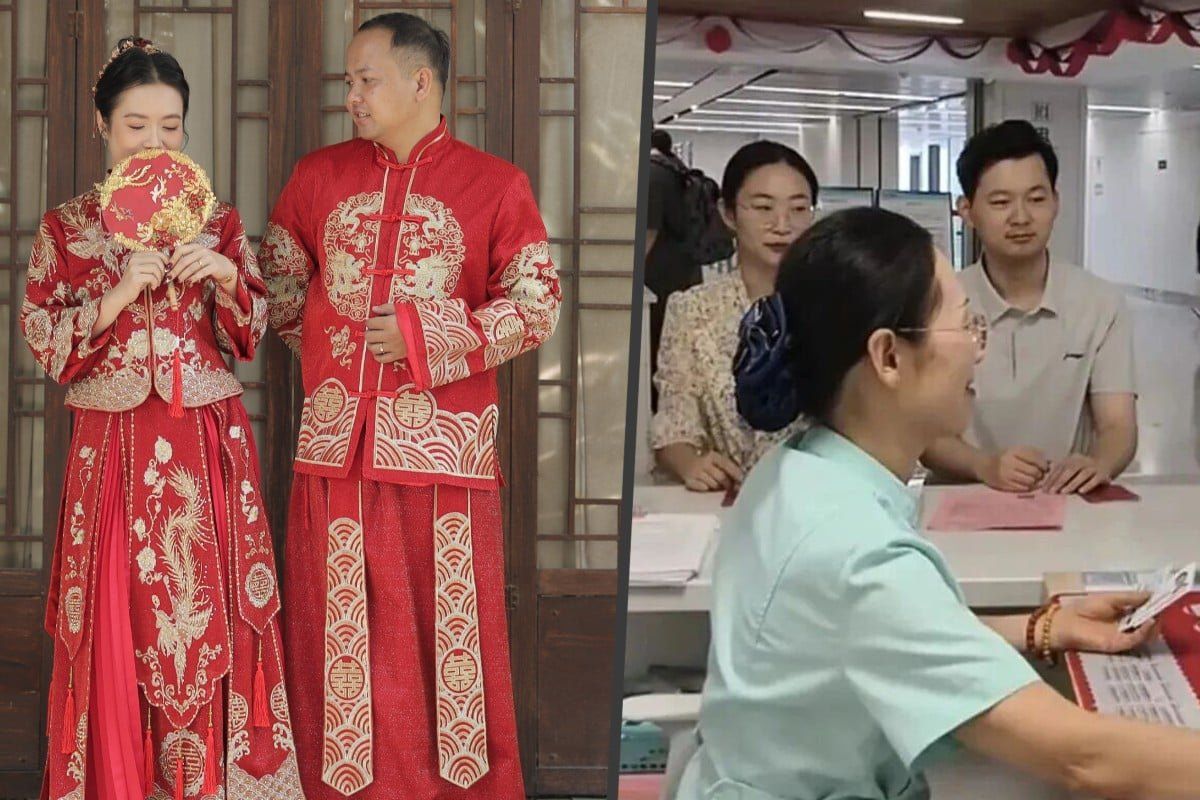
China's battle against plummeting marriage rates has taken an unexpectedly creative turn, with authorities now allowing couples to register their unions in decidedly romantic settings—or at least unexpected ones. A hospital in Zibo City, Shandong province, joined a growing roster of unusual venues in August by opening its Maternal and Child Health Hospital facility for marriage registration services, capitalising on what officials framed as convenient one-stop administrative efficiency. The development came just weeks after the Postal Savings Bank of China made headlines by becoming the nation's first financial institution to offer the same service at its Tianjin branch, sparking widespread online ridicule about the incongruous pairing of banking and matrimony.
The proliferation of offbeat marriage registration locations reflects a significant policy shift implemented in May last year, when China fundamentally reformed its approach to marriage administration. Under the updated regulations, couples no longer require their hukou, or household registration documents, to formalise their unions and possess far greater flexibility in choosing where they marry. These streamlined procedures were specifically designed to remove bureaucratic obstacles that previously forced couples to navigate complex procedures at designated civil affairs offices, often requiring them to travel to their registered household locations regardless of where they actually resided.
The regulatory overhaul opened floodgates for entrepreneurial thinking about where marriage could be formalised. By May this year, just twelve months after the regulations took effect, China had established more than 500 dedicated marriage registration sites outside traditional civil affairs bureaus, with an additional 1,300 outdoor locations partnering with authorities to issue certificates. The venues span the full spectrum of imaginative locations: centuries-old temples in Beijing and Nanjing where couples don traditional attire, scenic public parks, railway stations, and even the observation deck of Guangzhou Baiyun International Airport in southern China's Guangdong province, which sweetened the offer by providing complimentary access to watch planes departing and landing. Shanghai took the concept further by partnering a nightclub with local civil affairs authorities to conduct certification ceremonies within the club's premises.
Whatever the strategic brilliance of bringing marriage administration to the people, the government clearly hopes the initiative will reverse an alarming demographic crisis. Marriage registrations in China reached 6.76 million in the previous year, an improvement of 657,000 couples compared to the year before. More impressively, the third quarter recorded 1.61 million marriages, representing a robust 22.5 percent increase year-on-year. These figures initially suggested that removing procedural friction might indeed encourage more couples to formalise their relationships and contributed to optimism within policymaking circles about whether administrative convenience could address deeper social anxieties surrounding marriage.
Yet the momentum appears to have stalled dramatically. During the first half of this year, marriage registrations experienced a sharp reversal, declining by 7.5 percent year-on-year with 3.28 million couples marrying. This reversal indicates that convenience, however thoughtfully implemented, addresses only surface-level impediments to matrimony rather than the structural anxieties preventing young Chinese from committing. The disconnect between policy ambition and lived reality has not escaped social media commentators, who have articulated skepticism about whether improved access to marriage registration venues actually addresses the genuine barriers keeping people unmarried.
The scepticism reflects deeper cultural and economic anxieties that convenience initiatives cannot resolve. Online commentators have highlighted that the fundamental obstacles preventing marriage lie beyond administrative mechanics—they encompass financial insecurity, fears of family conflict, anxiety about sacrificing personal autonomy, and a generational shift away from viewing marriage as an obligatory life milestone. One particularly pointed observation noted that young people simultaneously fear the material and emotional burdens marriage entails while simultaneously rejecting the cultural expectation that matrimony represents a necessary transition to adulthood. Young Chinese increasingly question whether marriage genuinely enhances their wellbeing or primarily constrains their freedoms and consumes financial resources that might otherwise support personal development or security.
For Malaysian and Southeast Asian readers, China's demographic struggles and policy responses carry sobering implications. The region's own marriage rates have declined significantly across countries including Singapore, South Korea, and Japan, suggesting that East Asian societies broadly face common pressures rather than culturally specific phenomena. Younger generations across the region express similar reservations about marriage, citing financial constraints, housing costs, career ambitions, and concerns about work-life balance. China's experience demonstrates that policymakers cannot engineer demographic reversal through administrative redesign alone; they must address the economic anxieties and social pressures that make young people view marriage as increasingly incompatible with their wellbeing.
China's approach also reveals an implicit government anxiety that marriage rates function as a proxy for national strength and demographic stability, driving authorities to implement increasingly creative interventions. The expansion beyond hospitals and banks to metro stations, airports, and temples reflects escalating desperation to normalise marriage through environmental and cultural association. By situating marriage registration within entertainment venues and health facilities, officials attempt to reframe matrimony from bureaucratic necessity to integrated life experience. However, this marketing logic encounters resistance from young people who recognise that marrying in a nightclub or hospital corridor does not resolve the deeper financial and existential questions that cause them to delay or forgo marriage altogether.
The divergence between China's marriage registration initiatives and actual marriage behaviour suggests that demographic challenges require multifaceted policy responses extending far beyond administrative convenience. Addressing housing affordability, workplace flexibility, childcare accessibility, and cultural expectations around gender roles within marriage would more directly target the obstacles preventing young people from committing. Until policymakers acknowledge that young people's marriage hesitation reflects rational assessments of economic burden and social constraint rather than mere procedural inconvenience, initiatives like hospital registration services and airport marriage certificates will likely continue disappointing officials hoping for demographic turnarounds. China's experience offers a cautionary lesson for other East and Southeast Asian governments contemplating their own demographic crises: administrative creativity cannot substitute for fundamental economic and social reform.

