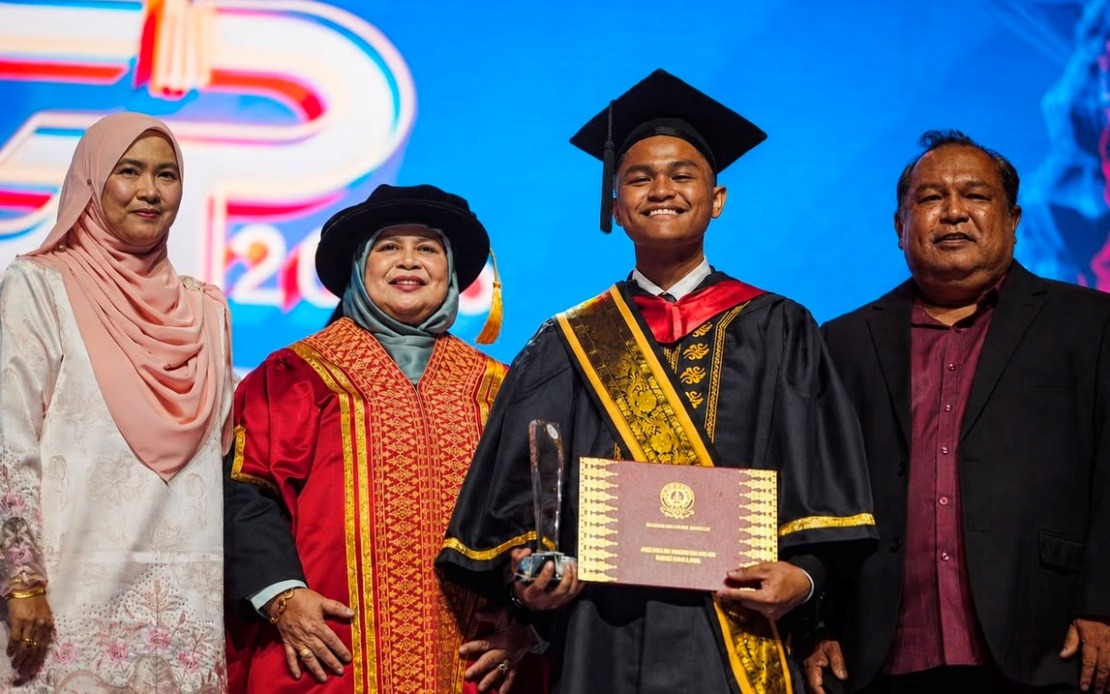
Muhammad Aaqif Dino Faezal represents a growing cohort of Malaysian students whose academic trajectories have been fundamentally shaped by institutional support from Majlis Amanah Rakyat (MARA). Having progressed from MRSM Tun Ghafar Baba in Melaka through Kolej MARA Banting (KMB), the 19-year-old is now preparing to commence studies in geology at Imperial College London this September, an achievement underscored by his recent selection as the 2026 MARA College Graduate Icon.
The pathway that opened for Aaqif hinged on access to MARA's Young Talent Development Programme (YTP), which funded his pursuit of the International Baccalaureate Diploma Programme (IBDP) at KMB from 2024 through May 2026. His narrative illuminates a persistent challenge within Malaysia's higher education ecosystem: the prohibitive cost of world-class education abroad, which remains inaccessible to talented students from middle and lower-income backgrounds. Without such sponsorship mechanisms, Aaqif acknowledges that undertaking tertiary studies and maintaining residence in the United Kingdom would have remained financially unfeasible, effectively closing a door that raw ability alone might have opened elsewhere.
The significance of Aaqif's appointment carries implications beyond individual achievement. His selection criteria—academic excellence, demonstrated leadership, civic contribution, and potential for future influence—reflect MARA's deliberate calibration toward developing not merely scholars but future leaders capable of steering Malaysia's strategic sectors. His stated ambition to channel his geological expertise toward Malaysia's oil, gas, and energy industries underscores an intentional domestic return expectation embedded within such sponsorship frameworks.
During his tenure at KMB, Aaqif's engagement extended markedly beyond classroom performance. Serving as president of the Students' Representative Council (MPP), he navigated the organisational dynamics of student governance while simultaneously excelling in co-curricular pursuits, garnering both the KMB Best Graduate Award and the Co-curricular Icon Award. These accolades suggest a student who successfully balanced the competing demands of rigorous international curriculum with institutional leadership responsibilities, a competency increasingly valued in globalised professional environments.
The numerical calibre of his IBDP results—44 out of 45 points—positions him within Malaysia's highest academic echelon for secondary-level achievement. This score trajectory established the academic foundation upon which his Imperial College application would have been evaluated, as UK universities remain highly selective regarding IBDP performance metrics. The consistency between his examination performance and his broader institutional contributions suggests an integrated approach to personal development rather than narrow academic optimisation.
Aaqif's institutional journey also reflects KMB's evolving role within Malaysia's secondary education landscape. The college has progressively positioned itself as a pipeline for students seeking entry into prestigious global universities, combining International Baccalaureate curricula with structured leadership development. KMB director Arfaseela Amir's observations regarding the integration of intellectual capability with character development signal an institutional philosophy that rejects the false dichotomy between academic excellence and personal integrity, instead treating both as foundational to competitive advantage in international contexts.
The Young Talent Development Programme itself warrants examination as a policy instrument. By directly funding promising students through both secondary and tertiary phases, MARA effectively de-risks educational progression for high-achieving individuals whose family circumstances might otherwise truncate their trajectories midway. This longitudinal support model differs from one-off scholarship awards and enables consistent mentorship, institutional familiarity, and academic scaffolding across the crucial secondary-to-tertiary transition.
For Malaysian readers navigating education sector developments, Aaqif's trajectory carries several implications. First, it demonstrates that competitive admission to genuinely elite global institutions remains accessible to Malaysian students, provided they secure both requisite academic credentials and financial support. Second, it illustrates how domestic institutions like KMB and MRSM have cultivated curricula and teaching methodologies sufficiently robust to prepare students for international undergraduate study at the highest level. Third, it highlights the continued strategic importance of government-backed talent development programmes in a landscape where private alternatives remain concentrated among affluent families.
The programme's emphasis on domestic return, reflected in Aaqif's own stated intentions, also addresses a perennial concern within Malaysian policy circles regarding brain drain. By explicitly cultivating expectations that scholars will leverage international education for domestic contribution—particularly within strategic sectors like energy—MARA structures its interventions around a compact of mutual obligation. This approach differs from unconditional investment and reflects a pragmatic understanding that talented individuals trained abroad must be persuaded to repatriate their capabilities.
Aaqif's recognition as Graduate Icon furthermore signals MARA's commitment to publicising success narratives from its programmes, a function that extends beyond individual celebration to serve broader recruitment and legitimisation purposes. Each such award generates media visibility that reinforces the credibility of MARA's selection processes and outcomes, simultaneously encouraging new applicants to pursue sponsorship pathways and justifying continued institutional funding to government stakeholders.
Looking forward, the critical metric for such programmes will be measuring not merely entry into prestigious institutions but the extent to which scholars like Aaqif actually fulfil their domestic repatriation commitments post-graduation. Geology expertise directed toward Malaysia's energy security presents tangible strategic value, particularly as the nation navigates energy transition challenges and pursues deepwater petroleum and renewable resource development. Whether Aaqif and similarly-positioned graduates translate their Imperial training into sustained contributions to Malaysian industry will ultimately determine the return on MARA's investment.
The broader ecosystem enabling Aaqif's success—encompassing MRSM's secondary provision, KMB's international curriculum, MARA's financing, and Imperial's receptiveness to Malaysian applicants—represents a multilayered pipeline that has demonstrably functioned at least once. Replicating and scaling such pathways for additional high-potential students remains among Malaysia's most pressing educational priorities, particularly given intensifying regional competition for global university placements and the stakes attached to national talent development.

