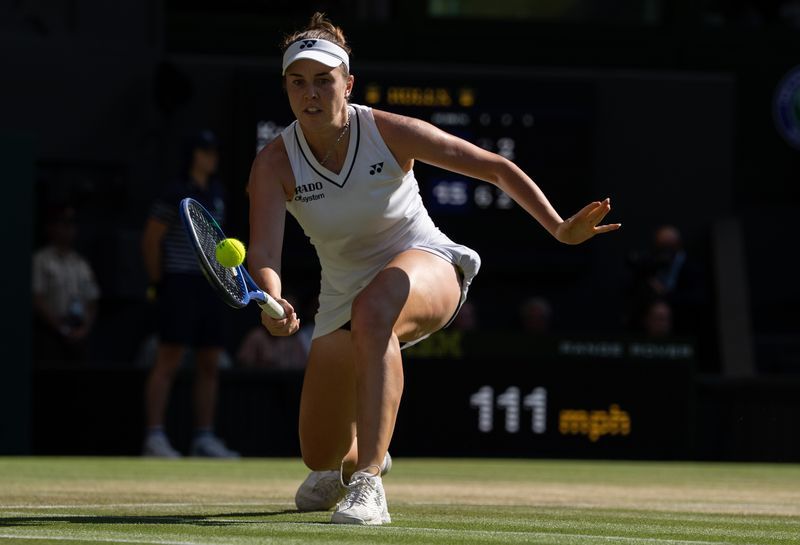
Linda Noskova's Wimbledon triumph represents far more than a tennis victory—it illustrates a profound lesson about resilience that extends beyond the confines of Centre Court. The 21-year-old Czech player defeated her compatriot and friend Karolina Muchova 6-2 5-7 6-3 in Saturday's final, claiming the Venus Rosewater Dish despite appearing to have surrendered her destiny in the second set when she relinquished five consecutive match points from a commanding position.
For most competitors at such an early stage of their career, squandering such a significant advantage in tennis's biggest moment would represent a psychological rupture. Leading 5-2 in the second set with the championship within touching distance, Noskova appeared destined to join an esteemed pantheon of Czech women to have won at the All England Club. The trajectory seemed inevitable; the narrative already written. Yet what unfolded instead became a masterclass in mental fortitude, offering Southeast Asian audiences—increasingly engaged with tennis through emerging regional players—an examination of how elite athletes recover from devastating setbacks in real time.
Muchova's resurgence was stunning in its swiftness. She reeled off five consecutive games, transforming a seemingly hopeless situation into momentum that carried the match to a deciding set. Noskova visibly retreated into herself, walking toward her chair with her hands covering her ears, attempting to block out the crowd's roar. The psychological landscape had shifted dramatically. What had appeared to be an inevitable coronation now felt like an imminent collapse, with the match slipping through her fingers like sand.
The turning point, remarkably, proved to be a moment of visual contemplation rather than tactical adjustment. As Noskova departed for a comfort break before the third set, her eyes caught sight of the championship trophies positioned along her route. In that instant, she made a conscious mental choice. Rather than fixating on the smaller replica trophy, she focused on the main Venus Rosewater Dish, using it as a psychological anchor. The gesture, though simple, reflected a deliberate reframing of her mindset—from accepting defeat to demanding victory.
During that bathroom break, Noskova employed practical techniques that sports psychologists would recognize as essential for performance recovery. She splashed cold water on her face, a physical reset that complemented her mental repositioning. Most significantly, she articulated to herself that the match was effectively restarting. The previous five games had happened; they could not be changed. What remained was the third set, an entirely new contest where she could reassert control. This compartmentalization of pressure—isolating the immediate challenge from the accumulated weight of what had preceded it—proved crucial.
When she returned to the court, the first game of the third set became her redemptive moment. Holding serve against the momentum that Muchova possessed represented a psychological victory that exceeded its tactical importance. Noskova later reflected that the outcome would have been dramatically different had she lost that opening game, acknowledging how easily momentum and confidence can cascade through a match. With that hold secured, something shifted internally. Her timing on groundstrokes improved, her footwork accelerated, and the intensity that had characterized her first set resurged.
By the time Noskova reached match points again at 5-3—more than an hour after her first one evaporated—she seized the opportunity without hesitation. The delay between her first and final match points became a narrative arc unto itself, demonstrating that recovery from adversity sometimes requires cycling through doubt before emerging renewed. At 21, she became the third Czech woman to win the Wimbledon singles title in four years and the youngest women's champion since her countrywoman Petra Kvitova claimed her first title in 2011, underscoring the strength of Czech tennis on the world stage.
Noskova's psychological resilience cannot be divorced from her life philosophy and experiences beyond tennis. She carries a personal gravity that rarely accompanies players of her age. Two years prior to her Wimbledon triumph, her mother Ivana died from cancer—a loss that fundamentally reshaped her perspective on competition and achievement. She has deliberately structured her life around values that extend far beyond tournament rankings. During her off-season, she volunteered in Zanzibar, working at a school through a charitable organization, an experience she described as renewing her appreciation for life's foundational blessings.
Growing up in a village within a Czech forest landscape has cultivated in Noskova a deep connection to environmental stewardship. She has articulated plans to pursue volunteer work focused on conservation issues once her professional tennis career concludes. The nose ring she wears serves as a quiet expression of individuality that reflects someone uninterested in conforming to conventional expectations. These biographical details matter because they reveal a person whose sense of self-worth transcends competitive outcomes, providing emotional ballast during moments of crisis.
This broader perspective likely enabled Noskova to recover her equilibrium more quickly than many competitors could. When your identity encompasses environmental advocacy, charitable work, and personal loss navigated with grace, a lost match—even a Grand Slam final—retains its significance without becoming existential. Her age (21) paired with this maturity creates an unusual combination that suggests she will process future defeats and triumphs with wisdom beyond her years. The trophies she glimpsed en route to that bathroom break represented not validation of her worth but rather recognition for sustained effort.
For Malaysian and Southeast Asian observers following global tennis, Noskova's victory carries instructive value. The region's emerging players can observe how winning major titles often hinges not on perfection but on the ability to navigate imperfection. The Czech player did not become technically superior in the third set; she became mentally more resilient. Her technical repertoire remained consistent, but her psychological framework shifted from defensive to assertive, from doubting to demanding. That transformation occurred through deliberate mental techniques and a life philosophy that extended beyond tennis, providing her with resources that transcended the sport.
As Noskova processes her achievement, she recognizes that the entire tournament—two full weeks of competition—warranted the emotional and physical investment. She has indicated she will never forget this period, understanding instinctively that such moments of adversity overcome and ultimate triumph shape athletes in ways that victories achieved without resistance cannot. The Venus Rosewater Dish she will lift aloft becomes not merely a trophy but a symbol of the psychological journey undertaken to claim it, a journey that required her to look directly at heartbreak and choose to overcome it anyway.

