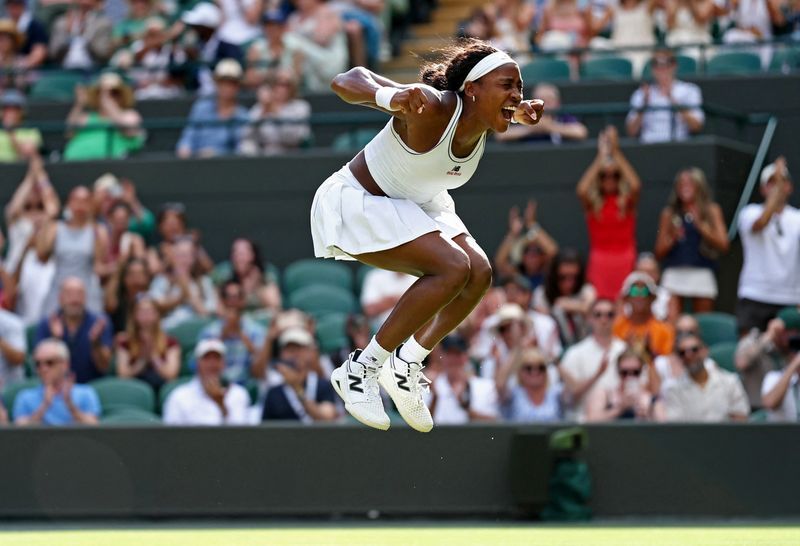
Coco Gauff delivered under pressure at Wimbledon on Wednesday, recovering from a set down to edge past Argentina's Solana Sierra 6-3 3-6 7-6(10-7) and secure her passage to the third round. The encounter on Court One proved an intense affair for the two-time Grand Slam champion, who seized the critical tiebreak opportunity to keep her campaign alive at the one major tournament that has persistently eluded her grasp throughout her career.
For the seventh-seeded American, this victory carries particular significance given her disappointing record at the grass-court venue. Wimbledon stands apart among the four major championships as the only Grand Slam where Gauff has struggled to penetrate beyond the fourth round, a gap in her otherwise impressive resume that has increasingly drawn attention from observers. Sierra, meanwhile, represented a formidable challenge: the Argentine, ranked 56 globally, had earned direct entry to the tournament and carried the distinction of being the first lucky loser to reach the women's final 16 during the Open era, a remarkable achievement that underscored her capacity to perform against elite opposition.
Gauff's opening gambit proved commanding as she dominated the first set, storming through without significant resistance on a surface that demands precision and timing. However, momentum shifted dramatically thereafter. An unusual service mishap—a serve that veered sideways into the umpire's chair—appeared to unsettle the American, and Sierra seized the opportunity to exert sustained pressure. The Argentine broke Gauff early to establish a 2-0 advantage and methodically built her lead to 4-1, forcing the match into a deciding third set after claiming the second stanza.
The third set unfolded as a tense, fluctuating battle where neither player could establish decisive supremacy. When Sierra earned a break point at 1-1, Gauff demonstrated her mental fortitude by saving it before unleashing a thunderous 124 mph serve to regain control and move to 2-1. The Argentine responded with equal resilience, defending three consecutive break points to secure the 3-3 mark before breaking Gauff once more to surge ahead 4-3. This represented a critical juncture where Sierra appeared positioned to take control of the contest entirely.
Gauff's response exemplified the championship mentality that has defined her career trajectory. Serving at 5-3 to remain in the match, she held firm before breaking Sierra immediately afterward to level the set and shift the psychological advantage. This sequence proved crucial, leaving Sierra fighting for survival as the tension mounted with every point. The momentum continued swinging in Gauff's direction as the match approached its climax, though neither player could definitively close out proceedings in regulation play.
The tiebreak itself became the ultimate proving ground, with Sierra threatening to seize victory when she accumulated a 7-4 advantage. Yet Gauff demonstrated the competitive instinct that characterizes her play under pressure, reeling off six consecutive points in a devastating run that seized the initiative entirely. She clinched the match with a 117 mph ace on the first of two match points, completing a comeback that will likely prove significant for her Wimbledon ambitions.
Following her victory, Gauff reflected on the match's dynamics with measured perspective. She acknowledged that Sierra had elevated her game substantially, describing the encounter as a back-and-forth struggle where neither player dominated from baseline. She noted that Sierra's aggressive shot-making frequently forced her into defensive positions, requiring her to capitalize on opportunities to apply aggression when openings presented themselves. Despite these challenges, Gauff credited her serving performance as the decisive factor throughout the three sets, and particularly the tiebreak resolution that proved the difference between advancement and disappointment.
The significance of this victory extends beyond the immediate third-round matchup. Gauff's struggle at Wimbledon has become a talking point in tennis discourse, with many analysts suggesting that the grass surface plays to different strengths than the hard courts where she typically thrives. Sierra's impressive recent trajectory, culminating in her unlikely deep run from lucky loser status last year, meant that this represented precisely the type of challenging early-round opponent capable of creating upset potential. That Gauff navigated this hurdle despite being unsettled at points during the contest suggests growing comfort and adaptation to the demands of grass-court tennis.
For Southeast Asian tennis followers observing from afar, Gauff's performance demonstrates the resilience required to sustain careers at tennis's highest level. Her willingness to weather adverse moments and execute when stakes are highest—as exemplified by the decisive tiebreak sequence—offers lessons applicable to athletes across the region developing their competitive foundations. The match also illuminated Sierra's capacity as an emerging force who had earned her place at Wimbledon through sheer determination, providing inspiration for players from less traditional tennis nations who aspire to compete at Grand Slam level.

