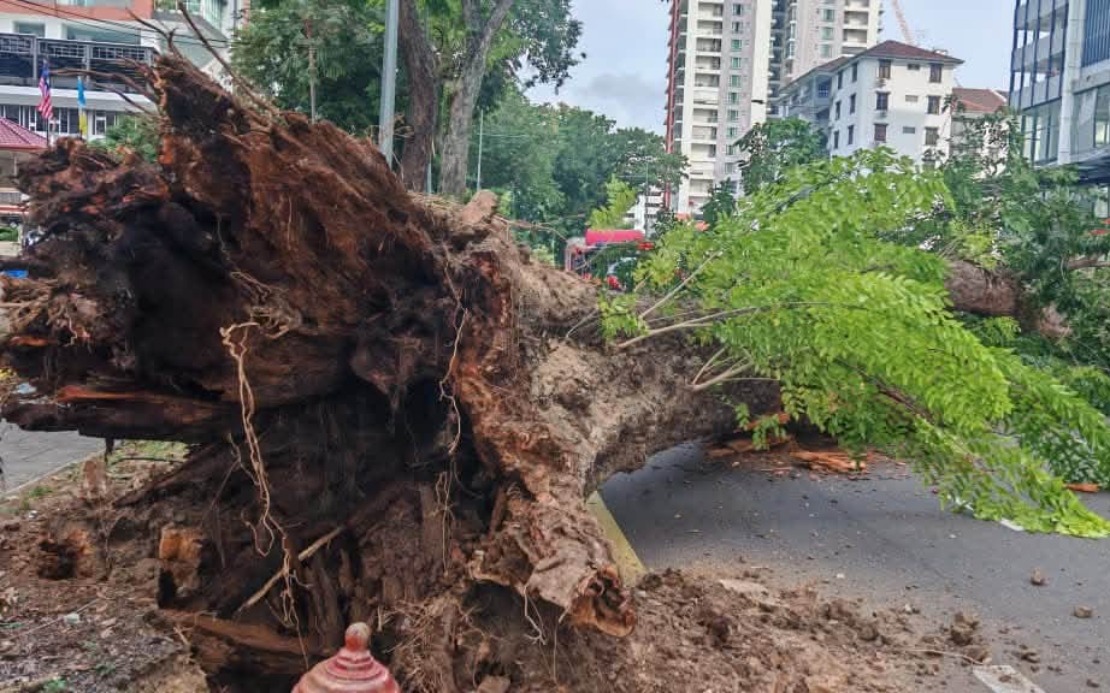
A large Angsana tree spanning nearly three decades in growth has collapsed along Jalan Macalister in George Town, crushing a vehicle and hospitalising its three occupants. The 28-metre-tall Pterocarpus indicus, commonly known as the Angsana, fell without warning at approximately 9 am, striking a Perodua Ativa sports utility vehicle carrying an elderly couple and their grandchild. Though no severe weather conditions preceded the incident, the structural failure has raised questions about urban tree management practices in Penang's capital.
Major Rajendran, the mayor of Majlis Bandaraya Pulau Pinang (MBPP), attributed the collapse to a combination of interconnected factors that had weakened the tree over time. The municipal authority's investigation revealed that approximately 30 per cent of the tree's root system had succumbed to rot, while cavity decay affected about 40 per cent of its base trunk. These internal structural deficiencies alone might not have been catastrophic, but when compounded by environmental and infrastructural pressures, they created an unstable foundation incapable of supporting the tree's considerable weight and height.
Beyond the biological degradation, chronic soil compaction surrounding the tree had significantly constrained its ability to develop a robust root network. Urban environments typically present challenges for mature vegetation, and Jalan Macalister appears to have been no exception. The restricted rooting space available to the tree prevented it from establishing the deep, stabilising root system necessary for a specimen of its age and stature. When combined with recent infrastructure upgrading works in the vicinity, these cumulative pressures transformed a once-healthy urban fixture into a potential hazard. The MBPP mayor noted that despite the absence of heavy rain or strong winds at the time of collapse, these conditions had created sufficient structural vulnerability for the tree to fail under its own weight.
The municipal response was relatively swift, with removal operations commencing at 9.41 am and road clearance completed by 2.20 pm. However, the incident has prompted scrutiny of the council's tree management protocols. The MBPP had conducted an assessment of mature and aged trees along Jalan Macalister during 2024, identifying 13 specimens for removal, all of which have since been felled. Most notably, the most recent maintenance work on these trees occurred on January 29, 2024, relatively recently before the collapse. A remote sensing study conducted the previous year had indicated that trees along the corridor were in satisfactory condition with no warning signs of impending failure.
This apparent contradiction between the remote sensing assessment and the actual structural condition of the fallen tree raises concerns about the accuracy and reliability of such monitoring methodologies. Remote sensing technologies, while useful for broad-scale surveys, may not detect internal decay processes such as root rot and cavity formation until they have reached critical stages. A tree might appear healthy from external observation while simultaneously deteriorating internally, leaving a compressed window for intervention before catastrophic failure occurs. The gap between the last remote sensing study and the actual collapse suggests that more frequent, ground-based arboricultural inspections may be necessary for elderly trees in urban settings.
On a broader scale, the MBPP's tree management programme encompasses considerable numbers of specimens across the municipality. During 2024, a total of 2,535 trees were identified for various interventions, including 45 cases involving drainage obstruction, 138 confirmed dead trees, and 2,242 others assessed as falling into risk or miscellaneous categories. An additional 110 trees were targeted for removal due to development or infrastructure projects. This year alone, 179 high-risk trees have been approved for felling, with 148 already removed by mid-year, and a further 247 trees eliminated in the first three quarters. The scale of these removal operations underscores the challenges facing urban forestry management in densely built environments.
The variety of reasons driving tree removal reveals the complexity of maintaining vegetation in an urban municipality. Trees are felled for obstructing drainage systems, being dead or dangerously leaning, posing collapse risks, accommodating development projects, enabling road and river widening initiatives, and encroaching upon utility infrastructure such as Penang Water Supply Corporation pipelines. Each justification represents a tension between preserving green space and accommodating urban development, infrastructure maintenance, and public safety. The MBPP's prioritisation of trees posing immediate safety risks, particularly those affected by infrastructure works and operating within restricted rooting zones, reflects the difficult balancing act municipal authorities must perform.
In response to this specific incident, the MBPP has instructed its appointed contractor to accelerate tree management efforts along Jalan Macalister. The accelerated programme includes reducing the heights of trees identified as potentially unstable and removing specimens that certified arborists have flagged as carrying significant collapse risk. This proactive approach demonstrates recognition that the George Town incident was not an isolated anomaly but rather a manifestation of vulnerabilities that may exist elsewhere within the municipality's urban forest. For Malaysian cities managing ageing tree populations in constrained urban environments, the collapse serves as a cautionary reminder of the consequences of allowing structural decay to progress unchecked.
The incident also highlights broader implications for Southeast Asian cities grappling with rapid urbanisation and aging infrastructure. As cities densify and infrastructure upgrades proliferate, the rooting space available to mature trees continues to diminish. Compaction from construction activities, installation of underground utilities, and surface-level hardscaping all contribute to conditions that gradually weaken even formerly robust specimens. In climates prone to heavy seasonal rainfall, such environmental stresses can accelerate root diseases and fungal colonisation. Urban planners and municipal authorities across the region must weigh the costs of maintaining aging trees against safety imperatives, while simultaneously recognising the irreplaceable ecosystem and aesthetic value that mature specimens provide to city environments.

