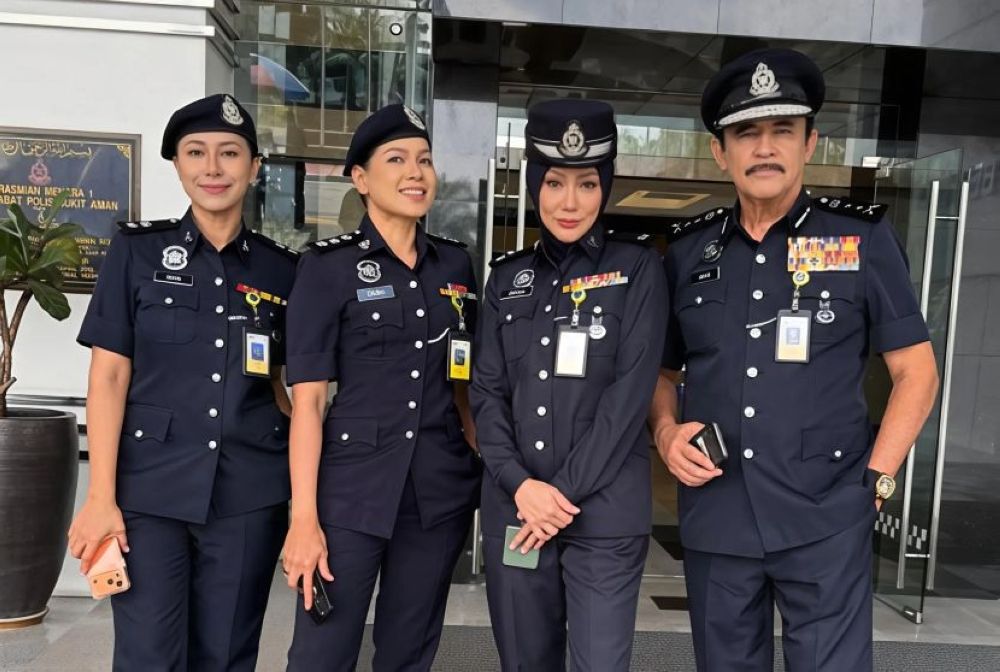
The production of Gerak Khas 2.0 has taken a decisive turn after an actress involved in the 26-episode drama series was arrested on drug charges, prompting producer Datuk Yusof Haslam to remove her from the project entirely. The actress tested positive for three types of drugs during a police raid conducted by officers from Dang Wangi district police headquarters on July 7, triggering swift action from the production team to safeguard what Haslam described as the integrity of the undertaking.
Haslam disclosed that the production was already in its final stages when the incident occurred, with approximately 90 percent of filming completed and only roughly two weeks of work remaining. Despite the advanced state of production, he made the uncompromising decision to eliminate all remaining scenes featuring the actress, who was slated to appear in Episodes 23 and 24 of the series. The producer stressed that the timing of the discovery—early in the drama's broadcast run—left the team with limited options to address the situation without compromising their vision.
The actress portrays a police inspector character in the series, making her removal particularly significant given the production's relationship with the Royal Malaysia Police (PDRM). Haslam explained that he had explicitly cautioned all cast and crew members about maintaining exemplary conduct and avoiding activities that could damage the reputation of both the drama and the police force it depicts. His warnings, delivered at the outset of production, underscored the responsibility placed on those involved to uphold standards befitting a series centred on law enforcement.
Haslam's response to the situation reflected an unforgiving stance on personal accountability. When questioned about whether he had entertained appeals or alternative explanations from the actress, he stated categorically that he had refused to engage with such requests. His statement—"it's too late"—conveyed both a practical assessment of the production timeline and a philosophical position on the consequences of individual choices. He presented the decision as a teaching moment, suggesting that once serious breaches of conduct occur, prior accomplishments and standing within the industry become secondary considerations.
The producer framed his actions as setting a precedent for the entire entertainment community, not merely addressing one individual's transgression. He articulated a broader message to other performers and production staff that involvement in activities associated with negative behaviour—whether drug-related or patronising establishments like nightclubs—carries reputational risks that extend beyond personal consequences. His comments about societal judgment, particularly toward women in public view, acknowledged the asymmetrical scrutiny faced by female entertainers whilst maintaining that this reality makes maintaining a clean profile even more imperative.
This situation underscores the tension between practical production considerations and ethical standards in the Malaysian entertainment industry. While Haslam could have attempted to minimise disruption by keeping the actress in the project or negotiating alternative arrangements, he instead chose to absorb the additional costs and logistical challenges of reshooting or excising scenes. This decision signals to the industry and the public that his production company prioritises institutional reputation over convenience, a stance that carries both business implications and cultural messaging.
The cast of Gerak Khas 2.0, which includes established figures such as Hans Isaac, Erra Fazira, C. Kumaresan, and Salina Saibi, now exists without one of its police inspector characters. The other actresses portraying officers in the series are Tisha Shamsir, Nabiha Aimi, and Emily Elizabeth, whose continued presence emphasises that the removal targeted one individual rather than reflecting systemic issues within the production. This selective approach helped Haslam maintain the credibility of the broader ensemble while demonstrating that transgressions would not be overlooked.
The incident raises questions about due diligence in casting and the expectations placed on actors during long-term productions. Haslam noted that the actress had previously worked on Skop Production projects without incident, suggesting that background issues may not always surface during the casting process. Yet his willingness to sever the professional relationship completely, despite her prior satisfactory work history, indicates that such previous performance counts for little when confronted with serious legal and moral lapses.
From a regional perspective, Malaysia's entertainment industry remains relatively conservative in its handling of drug-related controversies involving public figures. The swift and severe response by Haslam aligns with broader social attitudes in the country, where substance abuse is viewed with considerable gravity. For a production involving the police force as its central focus, the appearance of propriety becomes non-negotiable, as any suggestion of compromise with cast members facing drug charges could undermine the narrative authority of the series itself.
The timing of the discovery—just a week after the drama's premiere—meant that audiences had already formed initial impressions of the actress's performance in the role. As the series continues to air, viewers will notice the absence of her character in later episodes, potentially creating discontinuity that production teams would normally seek to avoid. This visible gap in the final episodes serves as a permanent record of the incident, something Haslam appears willing to accept as the cost of maintaining standards.
Haslam's comments about parental responsibility and the limits of external control, expressed through his analogy about children, reflect the complexity of managing large creative teams. Even with clear directives and expectations, individuals ultimately make their own choices, sometimes with devastating consequences for group projects. His willingness to publicly address this reality, rather than simply burying the matter, suggests a belief that transparency about such incidents serves a broader cautionary function within the industry.
As Gerak Khas 2.0 continues its broadcast run, the removal of this actress from the remaining episodes will likely be noted by attentive viewers and industry observers. The incident demonstrates that in Malaysia's entertainment sector, legal troubles and drug-related arrests can trigger immediate professional consequences, regardless of production schedules or sunk costs. For other actors and crew members, Haslam's firm stance serves as a concrete reminder that the entertainment industry, while creative and collaborative, ultimately maintains its own code of conduct with real penalties for violations.

