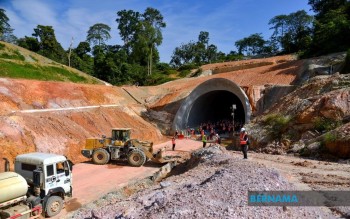
The federal government has greenlit a substantial RM207.2 million investment portfolio spanning 46 separate development initiatives across the Pasir Puteh parliamentary constituency in Kelantan, signalling a strategic commitment to harness the transformative potential of the East Coast Rail Link. The approval, announced by Deputy Economy Minister Datuk Mohd Shahar Abdullah during parliamentary proceedings, represents a concentrated effort to position this historically under-resourced region as an emerging logistics and industrial powerhouse along Malaysia's eastern corridor.
The project slate encompasses comprehensive land preparation and infrastructure enhancement work designed to establish the Pasir Puteh downstream industrial zone, deliberately situated to capitalise on proximity to the ECRL's dedicated cargo handling facilities. This layered approach reflects a deliberate pivot away from treating major infrastructure investments as standalone developments, instead embedding them within broader regional economic ecosystems. Deputy Minister Mohd Shahar emphasised that site development is proceeding under the ECRL Integrated Land Use Master Plan, a coordinated framework intended to optimise the station's dual functionality as both passenger transport hub and freight logistics centre.
Geographic positioning has emerged as a decisive advantage in this developmental calculus. The Pasir Puteh ECRL station's strategic location relative to the Tok Bali Supply Base creates what planners describe as a natural logistics convergence point. This spatial proximity reduces transportation friction costs and positions the area to attract capital investment that might otherwise gravitate toward established industrial clusters in Selangor or Penang. For a constituency historically dependent on agriculture and small-scale commerce, the potential emergence of a modern logistics corridor represents a genuine structural shift in local economic capacity.
The broader policy framework positioning these projects reflects Malaysia's 13th Malaysia Plan approach to regional development disparity. Rather than deploying generic infrastructure upgrades across constituencies regardless of comparative advantage, the government is deliberately identifying each location's inherent economic strengths and amplifying investment toward sectors where regional assets already exist. Mohd Shahar articulated this principle directly: localities strong in logistics receive concentrated port and transport infrastructure development, while tourism-dependent areas receive hospitality and cultural facility investment. This targeted specialisation theory argues that concentrated advantage compounds faster than diffused generalist approaches.
Implementation timelines remain deliberately extended, with project commencement scheduled for 2026 and activities continuing through 2030. This five-year runway allows for design refinement, land acquisition, and preliminary enabling works before major construction commences, though it also means local communities will face a extended waiting period before tangible economic benefits materialise. The duration reflects the scale and complexity of establishing industrial zones from foundational stages rather than retrofitting existing facilities.
Monitoring and accountability mechanisms have been built into the project architecture through the MyRMK system, a centralized tracking platform intended to maintain parliamentary and public visibility over implementation progress. Periodic reporting to the Dewan Rakyat commits the government to systematic disclosure of project advancement, cost variations, and scheduled milestones. This transparency infrastructure reduces opacity that historically plagued regional development initiatives where projects would receive initial approval before disappearing into bureaucratic execution shadows.
For Malaysian policymakers and regional analysts, the Pasir Puteh initiative exemplifies a maturing approach to utilising mega-infrastructure as catalytic development tools. The ECRL, initially debated primarily as a transportation asset connecting Klang Valley to Kota Bharu, increasingly functions as an anchor point for deliberately planned industrial clusters intended to redistribute economic activity away from hyper-concentrated Klang Valley regions. This second-order infrastructure thinking—recognizing that transportation networks generate value only when surrounded by complementary economic activity—represents advancement from earlier infrastructure models.
For Kelantan specifically, the investment concentration in Pasir Puteh's logistics corridor addresses longstanding regional inequality patterns. The state has historically ranked among Malaysia's lowest-income constituencies with persistent outmigration of working-age populations toward Kuala Lumpur and Selangor. A functioning logistics hub with stable employment prospects could interrupt this demographic drainage by providing competitive local economic opportunities. Industrial zone employment typically offers wage premiums relative to agricultural livelihoods and creates downstream service sector opportunities in accommodation, retail, and transportation that benefit broader community segments beyond direct facility workers.
The downstream industrial focus—emphasising value-added processing and light manufacturing rather than raw material extraction—reflects policy sophistication about sustainable regional development. Rather than pursuing extractive or primary production industries that typically offer modest wage premiums and limited skill development, downstream industrial activities generate higher-value employment requiring workforce training and technical capability building. Successful logistics hubs historically catalyse ecosystem effects where ancillary businesses cluster around core operations, multiplying employment creation beyond initial project footprints.
State-federal coordination remains critical for execution success. Kelantan's state government must align land policy, business licensing, and utility provision frameworks with federal development objectives. The Pasir Puteh initiative's scale presumes substantial state-level cooperation in land transfer, environmental clearance, and workforce readiness programming. Without synchronised state action, even generously funded federal projects can encounter implementation friction that delays activity commencement and dampens private sector confidence in facility viability.
Private sector participation ultimately determines whether government infrastructure investment catalyses genuine economic dynamism. The government provides essential foundation infrastructure—roads, rail connections, utilities, zoning frameworks—but logistics hub functionality depends on attracting operators capable of establishing cargo handling operations, warehousing facilities, and distribution services. Investment promotion efforts will require targeted engagement with regional and international logistics operators, demonstrating site competitive advantages relative to alternative Malaysian locations and neighbouring countries' emerging industrial zones.
The Pasir Puteh project approval arrives amid broader Southeast Asian competition for logistics hub supremacy. Vietnam, Indonesia, and Thailand are simultaneously developing rail-connected industrial corridors competing for multinational investment and regional trade routing decisions. Malaysia's ECRL advantage—technical sophistication, stable governance, established supply chain connections—requires complementary local development to realise full competitive benefit. Districts failing to develop productive hinterland around rail facilities risk infrastructure investment delivering minimal economic multiplier effects while remaining primarily passenger transport arteries.
Beyond immediate Pasir Puteh implications, this initiative signals government readiness to sustain multi-year development commitments through political cycles and budget competitions. Five-year implementation horizons require maintaining resource commitments even as new political pressures emerge. MyRMK system reporting establishes mechanisms intended to create parliamentary continuity pressures that extend beyond individual ministry administrations, though such systems' actual effectiveness depends on parliamentary seriousness about monitoring implementation quality beyond symbolic approval processes.

