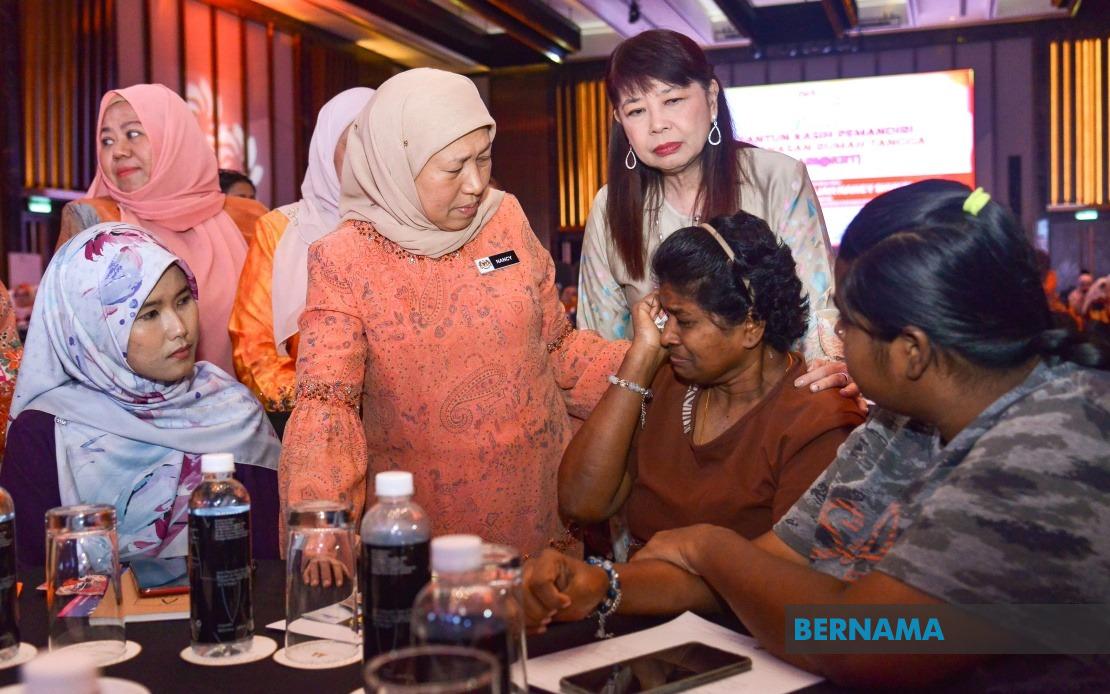
The Ministry of Women, Family and Community Development unveiled the SARI@KRT: Road to Eliminate Violence Against Women (EVAW) 2026 programme on Tuesday, pledging comprehensive support for approximately 1,400 survivors of domestic violence across the country. Minister Datuk Seri Nancy Shukri announced the initiative in Kuala Lumpur, emphasising that the government's approach extends far beyond awareness campaigns to actively rebuilding the lives of affected individuals through targeted intervention and sustained assistance.
The programme represents an escalation in the government's response to rising domestic violence figures, with each Malaysian state expected to accommodate a minimum of 100 participants. The initiative concentrates on three critical pillars: strengthening psychosocial support services to address trauma and mental health concerns, providing comprehensive legal assistance to navigate court processes and protection orders, and creating pathways for economic empowerment that enable survivors to achieve financial independence and self-reliance.
Recent crime statistics paint a concerning picture of domestic violence prevalence across Malaysia. Between January and June 2024, police recorded 4,014 cases of domestic violence, marking a significant increase from 3,678 cases during the corresponding period in 2023. This upward trajectory reflects a year-on-year growth rate that demands urgent intervention. Johor emerged as the state with the highest incidence, documenting 721 cases in the first half of the year, followed by Selangor with 614 cases and Perak with 405 cases, indicating that domestic violence remains a widespread issue rather than isolated incidents.
While these figures appear alarming, the Ministry's position suggests a nuanced interpretation. Rather than viewing the increase solely as evidence of deteriorating social conditions, Nancy attributed the rise partly to heightened public awareness and growing willingness among victims to report incidents to authorities. This perspective acknowledges that improved reporting mechanisms and reduced stigma may account for some portion of the recorded increase, though it does not diminish the underlying severity of the problem affecting Malaysian households.
Analysis of domestic violence triggers reveals that relationship dysfunction forms the primary catalyst for violent incidents. Misunderstandings and communication breakdowns account for 1,967 cases, representing nearly half of all recorded incidents. This finding underscores the reality that many violent situations emerge from preventable interpersonal conflicts rather than insurmountable incompatibility. Following communication failures, substance abuse emerges as the second major risk factor, with 444 cases linked to drug abuse, while financial stress contributes to 378 reported cases. These causal patterns suggest that targeted interventions addressing conflict resolution, addiction treatment, and financial counselling could prove instrumental in violence prevention.
A particularly significant dimension of the SARI@KRT programme involves addressing financial abuse, an often-overlooked form of domestic violence that causes profound harm despite leaving no visible marks. Nancy highlighted situations where spouses possess adequate financial means yet deliberately withhold support from their families, compelling partners to independently cover household expenses and children's needs. She characterised such behaviour as constituting abuse, framing financial support as a joint responsibility that both marriage partners must shoulder equitably. This expanded understanding of domestic violence encompasses economic control mechanisms that restrict victims' autonomy and independence, often trapping them in abusive relationships through financial dependency.
The KPWKM has introduced practical mechanisms to remove barriers preventing survivors from accessing justice. A dedicated special allowance programme enables survivors to afford attendance at court proceedings involving child maintenance claims, addressing the reality that transportation and time costs often prevent vulnerable individuals from pursuing legal remedies. This measure recognises that economic hardship frequently compounds victimisation, creating cascading disadvantages that impede escape from abusive situations.
For Malaysian readers, the programme's emphasis on economic empowerment carries particular significance. By equipping survivors with vocational training, employment support, and financial literacy resources, the initiative addresses the structural vulnerability that perpetuates cycles of abuse. Many survivors remain trapped in violent relationships partly because they lack independent income and fear destitution following separation. By systematically removing these economic obstacles, the SARI@KRT programme targets root causes of victim entrapment rather than merely treating symptoms.
The regional context further underscores the importance of such initiatives. Domestic violence remains endemic across Southeast Asia, with Malaysia's experience mirroring broader regional patterns. Programmes like SARI@KRT position Malaysia as a regional leader in systematically addressing violence against women through integrated approaches combining psychosocial, legal, and economic support. The initiative signals governmental commitment to treating domestic violence as a public health and social justice priority rather than a private family matter.
Ministry officials urged the public to actively participate in identifying individuals requiring assistance and to facilitate early intervention by ensuring potential victims know how to access available support services. This emphasis on community involvement recognises that professional resources alone cannot reach all vulnerable individuals, particularly those isolated in remote areas or deterred by cultural stigma from seeking official help. Building community awareness of support mechanisms becomes essential to the programme's success in reaching the targeted 1,400 survivors across Malaysia's diverse demographics and geographic regions.

