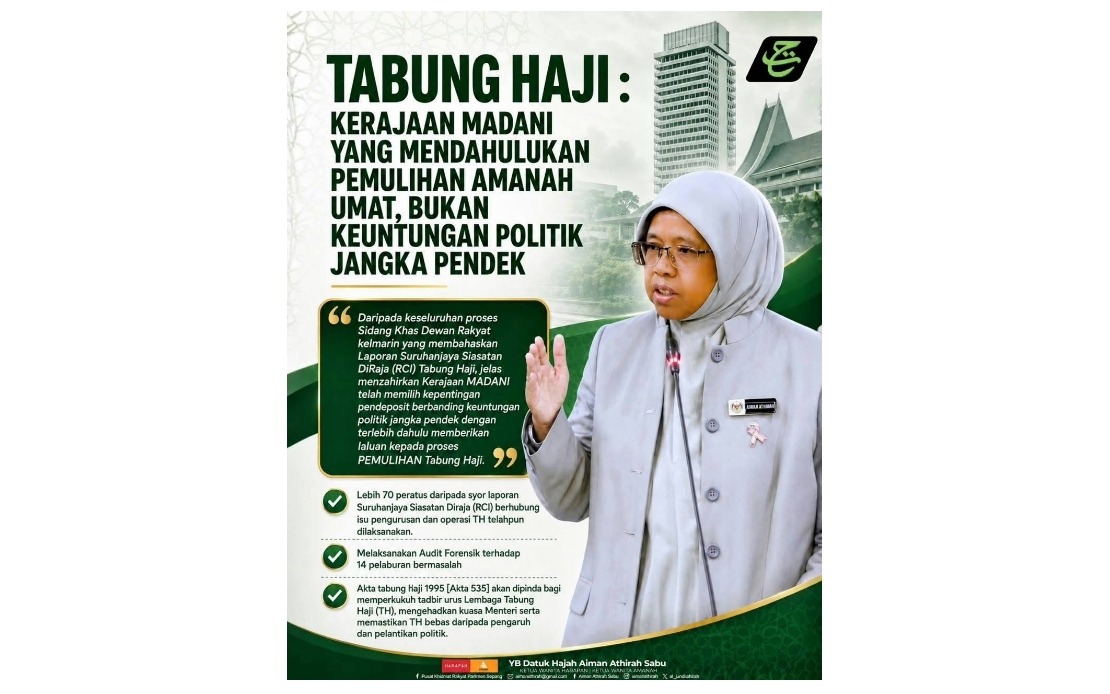
The Malaysian government's decision to exercise restraint in releasing the Tabung Haji Royal Commission of Inquiry report reflects a deliberate choice to protect depositors rather than seek immediate political advantage, Deputy Minister of Housing and Local Government Datuk Aiman Athirah Sabu has argued. Her statement comes amid mounting pressure from certain political quarters, including PAS and Parti Wawasan Negara, who have publicly questioned the timing and rationale behind the administration's cautious disclosure strategy.
Aiman Athirah's position underscores a fundamental tension in governance: the need to balance transparency with institutional stability. Tabung Haji operates as more than a conventional savings institution—it serves as the custodian of Islamic aspirations for millions of Muslims seeking to fulfil the fifth pillar of Islam through the pilgrimage to Mecca. With over 10 million depositors entrusting their haj savings to the organisation, any abrupt or poorly managed disclosure of governance failures risks triggering the kind of destabilising panic withdrawals that ravaged the institution in 2018, when depositors withdrew over RM6 billion following revelations of internal mismanagement.
The historical context of TH's 2018 crisis provides a sobering backdrop to current deliberations. That episode demonstrated how quickly public confidence can evaporate when financial institutions are perceived as mismanaged, leading to cascading withdrawals that can imperil even fundamentally sound operations. The government's argument for measured disclosure therefore rests on a legitimate institutional concern: rushing to publicise the RCI findings without first implementing corrective measures and rebuilding depositor confidence could recreate conditions for a run on the institution that would harm the very people the government claims to serve.
Yet the government's recovery efforts over the past several years suggest tangible progress. Investment income reached a record RM4.64 billion in 2025, while profit distribution to depositors increased substantially from 1.25 per cent in 2018 to 3.5 per cent in 2025. Perhaps more significantly, TH has managed to maintain the cost of performing haj at RM33,000 for three consecutive seasons despite inflationary pressures on management expenses. These metrics indicate that institutional restoration has moved beyond rhetorical promises into demonstrable performance improvements.
The scale of historical losses revealed during recent parliamentary proceedings adds weight to the government's caution. Second Finance Minister Datuk Seri Amir Hamzah Azizan disclosed that TH had suffered nearly RM13 billion in losses from 14 troubled investments, with seven experiencing total loss. Of this sum, RM10.2 billion was absorbed through a government rescue package involving Urusharta Jamaah Sdn Bhd in 2018, while RM2.6 billion in impairment losses were borne by TH itself between 2018 and 2025 on investments remaining under active management. Disclosing such figures without simultaneously demonstrating that governance reforms have genuinely addressed underlying weaknesses could trigger renewed public anxiety.
Minister in the Prime Minister's Department (Religious Affairs) Dr Zulkifli Hasan revealed during a special Dewan Rakyat sitting that over 70 per cent of RCI recommendations concerning TH's management and operations had already been implemented. This partial implementation—now coupled with forensic audits of the 14 troubled investments—represents a middle path between complete secrecy and immediate full disclosure. The forensic audit process itself serves a dual purpose: it ensures comprehensive investigation of past failures while generating the detailed findings necessary to reassure depositors that problems have been properly identified and addressed.
The government's commitment to amend the Tabung Haji Act 1995 to strengthen governance, curtail ministerial discretion, and insulate the institution from political pressure signals recognition that structural reforms must accompany administrative cleanup. Political appointments and ministerial interference have historically plagued Malaysian statutory bodies, and a genuine reform agenda would necessarily constrain these power dynamics. Such legislative amendments, however, take time to navigate through Parliament and require public consultation—a process incompatible with precipitous disclosure of the RCI report before reforms are embedded in law.
Aiman Athirah's criticism of opposition lawmakers who walked out during the special Dewan Rakyat sitting reflects broader frustration with what the government views as performative politics masquerading as principle. The walkout can be interpreted as a refusal to engage with the government's substantive arguments about institutional stability, choosing instead to signal disapproval through absence. From the government's perspective, such behaviour exemplifies the very politicisation of the TH issue that deposits confidence-building measures at risk. Whether such criticism carries weight depends partly on whether observers believe the government's measured approach genuinely prioritises depositor protection or merely provides convenient political cover.
For Malaysian readers and regional observers, the TH situation encapsulates broader questions about institutional reform in Southeast Asia. How should governments balance the competing demands of transparency, public accountability, and financial stability? Does delaying disclosure of institutional failures, even with stated intentions to protect depositors, ultimately undermine trust in governance? The answers matter not merely for TH but for how Malaysia's financial regulatory ecosystem functions more broadly.
The government's position also reflects a particular vulnerability inherent in Islamic financial institutions. Unlike secular savings vehicles, TH carries profound religious and cultural significance that transcends ordinary financial considerations. Depositors view TH funds as sacred trusts earmarked for a religious obligation, lending emotional weight to any institutional failure that ordinary investment vehicles might not encounter. This dimension potentially justifies more deliberate communication strategies than conventional finance might demand.
Moving forward, the critical test will be whether implementation of RCI recommendations and legislative reforms genuinely address governance weaknesses or represent tokenistic gestures designed primarily to manage political optics. The government's recovered financial metrics suggest substance, yet sustained scrutiny remains warranted. Depositors deserve both transparent information and institutional stability—ideally reinforced by clear evidence that political influence has genuinely diminished and professional management has strengthened. The government's gamble is that measured disclosure accompanied by demonstrable reform will prove more confidence-sustaining than rushed transparency that might trigger fresh alarm among the nation's 10 million haj savers.

