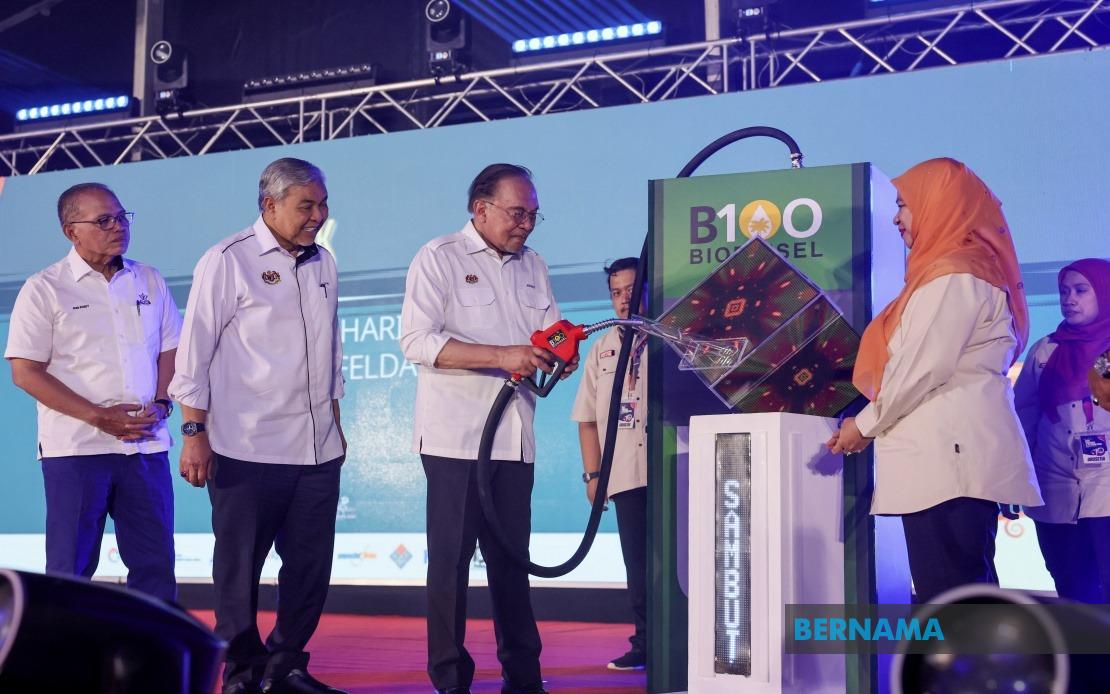
Prime Minister Datuk Seri Anwar Ibrahim has signalled a significant policy shift in how residential development is permitted on Federal Land Development Authority (FELDA) properties, announcing plans to amend the Land (Group Settlement Areas) Act 1960 to enable settlers to construct more than one dwelling on a single residential lot. The move represents a pragmatic response to evolving housing needs within FELDA settlements, particularly among younger generations seeking to develop their inherited land holdings for multiple family units or rental income.
Addressing attendees at the FELDA Settlers' Day and the organisation's 70th Anniversary celebrations held at Tun Abdul Razak Stadium in Bandar Pusat Jengka, Anwar indicated that FELDA has been tasked with preparing detailed draft amendments to the legislation within a two-month timeframe. These amendments will subsequently be forwarded to the Cabinet for approval before being introduced for parliamentary debate and passage later in the year. The condensed timeline reflects the government's determination to resolve what has become a pressing issue for many settlers who face constraints when attempting to maximise the economic potential of their landholdings under current regulatory frameworks.
The immediate catalyst for this legislative initiative stems from a housing development reality already unfolding on the ground. Approximately 8,000 residential units have been constructed and occupied on individual FELDA lots since December 31, 2025, representing a de facto situation that has outpaced the statutory framework. Rather than pursuing enforcement action against these developments, the government has elected to legitimise them through formal legal amendment, a pragmatic acknowledgment that the original Act 530 provisions no longer adequately reflect contemporary settlement patterns and economic realities.
Pending finalisation of the legal amendments, Anwar announced that the government would immediately grant approvals for water and electricity connections to all 8,000 existing homes currently lacking these essential services. This interim measure addresses urgent infrastructure gaps while legislative processes proceed. Water supply responsibilities will be transferred to respective state governments, placing the burden of capital investment and service delivery squarely on state authorities. Concurrently, Tenaga Nasional Berhad (TNB), Malaysia's primary electricity distribution company, has been directed to accelerate connection processes across all 8,000 properties, ensuring that housing developments do not languish in a state of incomplete infrastructure provision.
The broader context for this initiative involves the FELDA New Generation Housing Project, commonly referred to as PGBF, which was launched in 2013 to modernise FELDA settlements and provide contemporary housing solutions. This programme encompasses 43 distinct development sites distributed across seven Malaysian states: Pahang, Johor, Negeri Sembilan, Kedah, Terengganu, Kelantan and Perak. The total scope involves 8,224 housing units, representing a substantial investment in renewing FELDA communities and improving living standards beyond the original land settlement model that characterised FELDA's operations since its establishment.
For Malaysian readers, this policy shift carries significant implications for regional property development and settlement patterns. FELDA represents one of Malaysia's most extensive rural development schemes, with a substantial population base concentrated in key agricultural regions. Permitting multiple dwelling units on individual lots could catalyse densification of existing settlements, potentially transforming them into more economically vibrant communities with increased commercial activity and diversified livelihood opportunities beyond traditional agriculture.
The amendment also addresses generational concerns within FELDA communities. Younger FELDA members have increasingly sought to develop their inherited plots rather than maintain them solely as individual family residences. Current restrictions have forced creative—and often irregular—workarounds, including subdivision arrangements that lacked formal legal standing. Legalising multiple dwellings provides a transparent framework that can be properly taxed, regulated and planned at both state and local authority levels, improving administrative clarity and revenue collection.
From an infrastructure perspective, the immediate decision to facilitate water and electricity connections demonstrates recognition that services should not be withheld pending legislative resolution. State governments will face substantial financial commitments in extending water supply networks, particularly in more remote FELDA settlements. The timeline for these utility extensions will likely become a key performance indicator for state administrations, particularly in states like Pahang, Johor and Kelantan where multiple PGBF sites are concentrated.
The amendment process itself merits observation given Malaysian legislative precedent. Act 530 has remained largely static since 1960, reflecting the original conceptualisation of FELDA settlements as homogeneous agricultural communities with standardised individual lot ownership. Updating this framework requires careful drafting to address zoning implications, density limits, parking requirements and other planning considerations that contemporary development norms demand. The Cabinet's review period will be critical in determining whether the amendments impose meaningful development standards or simply remove the outright prohibition on multiple dwellings.
Regionally, this development reflects broader trends in Southeast Asian land reform and settlement modernisation. Several countries have grappled with updating land legislation that predates contemporary urbanisation pressures. Malaysia's approach—permitting amendment through parliamentary process rather than pursuing wholesale legal overhaul—offers a methodical pathway that other nations managing similar land settlement schemes might observe.
Economically, permitting multiple dwellings on FELDA lots could unlock considerable latent value in these properties. Settlers with developable land can now contemplate income-generating opportunities through rental housing or sale of additional units, potentially diversifying livelihoods beyond agricultural production. This may prove particularly valuable for aging settler populations seeking to monetise their assets for retirement security. However, implementation will require careful attention to prevent speculative buy-up of FELDA lands by external investors seeking to circumvent restrictions on non-settler ownership.

