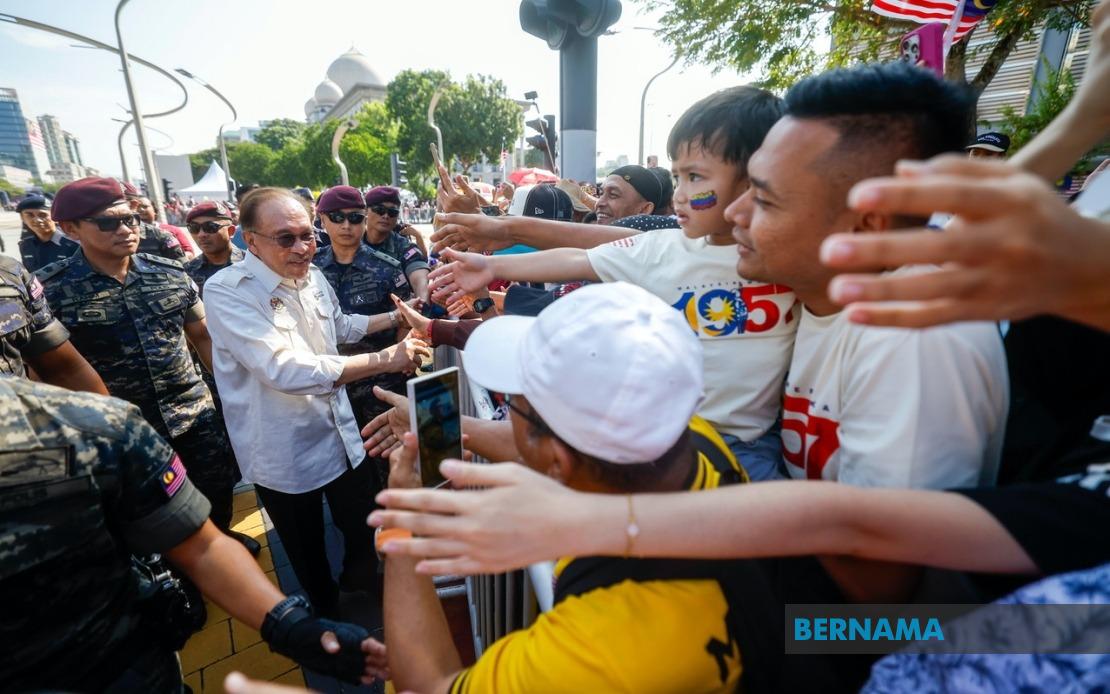
Prime Minister Datuk Seri Anwar Ibrahim's announcement of six targeted policy initiatives during his 2026 National Day Address reflects genuine engagement with public feedback and the immediate concerns affecting ordinary Malaysians, according to Housing and Local Government Minister Nga Kor Ming. Speaking in Putrajaya, Nga emphasised that each measure directly addresses areas where citizens experience tangible hardship, ranging from household fuel costs to healthcare infrastructure and livelihood support for business owners.
The six pillars of the initiative encompass a broad spectrum of everyday concerns that resonate across Malaysia's diverse communities. The fuel subsidy component restores BUDI MADANI eligibility to 300 litres for BUDI95 and 400 litres for BUDI Diesel, directly easing transportation and household energy expenses. Simultaneously, a RM500 million injection into school maintenance brings the 2027 allocation to RM1.5 billion, addressing deteriorating educational infrastructure that parents and teachers have repeatedly flagged. These dual investments signal recognition that household budgets remain strained and that foundational services require urgent renewal.
Healthcare digitalisation receives substantial backing through a RM1 billion commitment to modernise information systems across 150 hospitals and 2,000 health clinics. This infrastructure overhaul targets systemic inefficiencies that have frustrated patients seeking prompt medical attention and doctors managing administrative burdens. The investment acknowledges that contemporary healthcare delivery demands technological sophistication comparable to standards in advanced economies, positioning Malaysia to compete internationally for medical tourism and talent retention.
Youth employment and digital competitiveness feature prominently through a free three-month artificial intelligence subscription programme targeting 100,000 young Malaysians aged 18 to 30. This initiative addresses anxieties about generational relevance in an AI-driven economy, providing practical skills acquisition without cost barriers that might exclude lower-income participants. As regional economies race to harness artificial intelligence capabilities, Malaysia's deliberate human capital investment signals strategic ambition beyond reactive adaptation.
Small business support encompasses two complementary mechanisms designed to ease the precarious financial position of traders and small-to-medium enterprises navigating volatile economic conditions. The e-Invoicing exemption threshold rises from RM1 million to RM3 million, reducing compliance burden for businesses still establishing operational scale. Concurrently, RM200 million allocated for Geran Sejahtera MADANI alongside an additional RM1 billion micro-business financing in 2026—bringing total financing to RM6 billion—acknowledges that enterprise formation and survival depend partly on accessible credit.
Nga contextualised these measures within a broader narrative of national unity and shared prosperity. He articulated that Malaysia's 69-year development trajectory reflects collaborative effort transcending ethnic and religious divisions, with Malays, Chinese, Indians, Dayaks, Kadazans and other communities contributing labour and ingenuity toward common advancement. This framing matters significantly in a multicultural democracy where policy legitimacy hinges partly on perceived equitable distribution of government resources and recognition of diverse stakeholder contributions.
The minister's emphasis on inclusivity carries particular resonance amid persistent concerns about welfare distribution in Malaysian politics. By anchoring the six initiatives within a broader philosophy of cross-community cooperation and mutual benefit, Nga attempts to preempt criticism that any single group receives disproportionate advantage. Fuel subsidies benefit all motorists regardless of background; school maintenance improves educational access nationwide; healthcare modernisation serves patients across demographic categories; AI training opens opportunity doors for capable young people of all communities; and SME support extends to traders operating in both urban and rural contexts.
Yet deeper analysis reveals implementation challenges that transcend rhetorical commitment to inclusion. Distributing RM1 billion effectively across 150 hospitals and 2,000 clinics requires coordinated execution capacity that remains uneven across Malaysia's federal and state structures. Similarly, reaching 100,000 youths with quality AI training demands educational infrastructure and mentorship ecosystems that currently concentrate in developed urban areas, potentially reinforcing existing regional disparities unless design explicitly counters such tendencies.
The SME support package, while substantial in numerical terms, confronts a structural reality: access to RM6 billion in micro-business financing depends on formal credit eligibility criteria that informal sector operators often cannot satisfy. Many traditional traders lack documented assets, credit histories, or business registrations required by conventional lending institutions. Genuine inclusive growth necessitates credit mechanisms explicitly designed for informal sector participants, not merely increased funding channelled through existing bank-based architecture.
Fuel subsidy restoration represents perhaps the most politically salient component, directly affecting household consumption budgets across income categories. However, fuel subsidies carry known distortions and fiscal costs that constrain resources available for longer-term productivity investments. The government faces recurring tension between immediate relief for household budgets and structural economic transformation through education, health, and infrastructure quality that generates durable competitiveness.
Malaysian political economy requires that government spending decisions simultaneously satisfy immediate welfare expectations and long-term development imperatives. The MADANI administration's six initiatives attempt this balancing act by combining direct relief with strategic investments in human capital and digital infrastructure. Success ultimately depends less on rhetorical framing than on rigorous implementation, equitable benefit distribution across regions and demographic categories, and transparent accountability for results.
As Southeast Asia confronts intensifying regional competition and technological disruption, Malaysia's policy orientation toward youth skills, healthcare modernisation and SME viability reflects justified strategic priorities. Whether announced initiatives translate into meaningful improvement in living standards and economic opportunity for ordinary Malaysians remains the consequential question that will define MADANI government performance beyond the National Day address.

