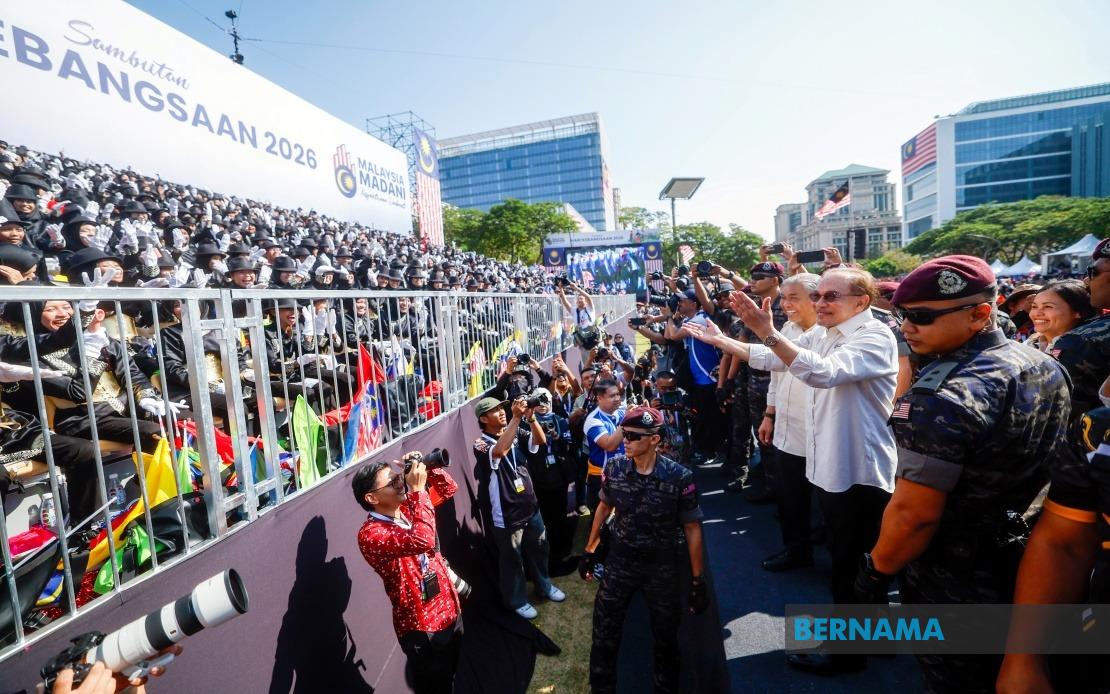
Prime Minister Datuk Seri Anwar Ibrahim commended the energy and commitment displayed by Malaysians during the 69th National Day parade and festivities held at Dataran Putrajaya on August 31, expressing heartfelt appreciation to organisers and attendees alike. His spontaneous declaration of "Great, great show!" to assembled journalists captured the evident satisfaction with the event's execution, reflecting a visible alignment between the government's celebration goals and public reception.
The grand gathering drew more than 100,000 participants to the nation's administrative heart, with many Malaysians camping overnight and arriving in waves from the early morning hours. This substantial turnout underscored the enduring public appetite for national commemorations, despite the mid-week timing of the festivities. The scale of attendance provided a tangible measure of civic engagement, demonstrating that Malaysia's diverse population continues to find common ground in celebrating shared nationhood and identity.
Under the Malaysia MADANI thematic banner, organisers crafted a celebration centred on "Kesejahteraan Dinikmati"—the enjoyment of well-being—positioning the commemoration as a reflection of government priorities rather than merely ceremonial spectacle. This philosophical framing seeks to connect abstract policy commitments with lived experience, a distinction particularly resonant for voters assessing governmental performance beyond rhetoric. The choice of theme suggests deliberate positioning toward economic welfare and inclusive prosperity narratives.
The ceremonial structure itself represented substantial logistical coordination. The parade incorporated 10,819 participants distributed across 76 contingents supplemented by 22 marching bands, while 328 military and civilian assets ranging from land to sea and air platforms provided visual grandeur. Additionally, 112 service animals participated alongside 22 electric vehicles, the latter representing implicit messaging around environmental consciousness and technological modernity. A human graphics performance on the terraces added contemporary creative elements to traditional parade formats.
His Majesty Sultan Ibrahim and Her Majesty Raja Zarith Sofiah graced the occasion, conferring constitutional significance upon the proceedings. The formal reception by Anwar and his wife, Datuk Seri Dr Wan Azizah Wan Ismail, alongside Communications Minister and Main Committee chairman Datuk Seri Fahmi Fadzil, illustrated the high-level governmental investment in the event's ceremonial dimensions. The presence of the Yang di-Pertuan Agong legitimises national celebrations while reinforcing the symbiotic relationship between constitutional monarchy and democratic governance in Malaysia's political framework.
Particularly noteworthy was Anwar's direct engagement with ordinary citizens following the formal proceedings. His decision to walk more than 500 metres through Dataran Putrajaya, accommodating photograph requests and receiving direct feedback from citizens, represented a calculated approach to political accessibility. One attendee specifically thanked him for the BUDI95 petrol subsidy restoration from 200 to 300 litres monthly—a benefit announced during his National Day Address the previous day. This unsolicited public appreciation suggested that economic relief measures resonate meaningfully with voters and that direct citizen-leader interaction amplifies their perceived impact.
The fuel subsidy announcements accompanying the celebration carry substantial implications for Malaysia's economic management. The restoration of BUDI95's monthly quota to 300 litres benefits over 16 million users of subsidised RON95 petrol, representing a significant governmental commitment affecting household transportation budgets across income strata. This decision reflects ongoing tension between fiscal prudence and electoral considerations, particularly given the subsidy system's considerable burden on government finances. The expansion signals willingness to prioritise immediate cost-of-living relief over longer-term budgetary consolidation.
Additionally, Anwar announced that more than half a million eligible owners of diesel-powered pickup trucks and jeeps would receive up to 400 litres of monthly BUDI Diesel subsidy commencing September 1. This targeted expansion addresses a distinct economic constituency—small-business operators and agricultural workers heavily dependent on commercial vehicle fuel costs. The initiative demonstrates granular policy differentiation between vehicle categories and usage patterns, suggesting recognition of diverse livelihood dependencies across Malaysia's economic landscape.
The comprehensive nature of announced initiatives—encompassing both petrol and diesel subsidies—indicates coordinated governmental messaging rather than isolated announcements. By bundling multiple benefit expansions within the National Day address, the administration creates a narrative of broad-based welfare expansion, theoretically distributing political credit across diverse constituencies. For economists and fiscal analysts, such measures require scrutiny regarding long-term sustainability, subsidy leakage, and opportunity costs relative to alternative social investments.
From a regional perspective, Malaysia's National Day celebration patterns reflect broader Southeast Asian approaches to national commemoration. While Vietnam and Thailand employ large-scale military parades emphasising state power, Malaysia's celebration balances patriotic symbolism with inclusive public participation and recent governance branding around "MADANI" concepts. This softer approach to nationalism aligns with Malaysia's multicultural framework, where celebrations must accommodate diverse religious and cultural sensitivities while maintaining cohesive national identity narratives.
Anwar's visible enjoyment and direct citizen engagement at the celebration contrast with prior political dynamics where National Day events occasionally sparked controversial discussions. His accessible posture and willingness to receive citizen feedback in public settings signal an attempt at recalibrating executive-public relations toward greater perceived openness. Whether such gestures translate into sustained political capital remains a question for coming months, particularly as fuel subsidy extensions intersect with broader fiscal management and inflation concerns.
Looking forward, the celebration establishes benchmarks for public expectations regarding Malaysia MADANI implementation beyond symbolic affirmations. Citizens who responded to fuel subsidy announcements with gratitude will inevitably scrutinise whether promised benefits materialise consistently and equitably. The government's ability to sustain announced welfare measures whilst managing fiscal constraints will fundamentally shape perceptions of policy credibility and executive competence in addressing economic pressures affecting ordinary Malaysian households.

